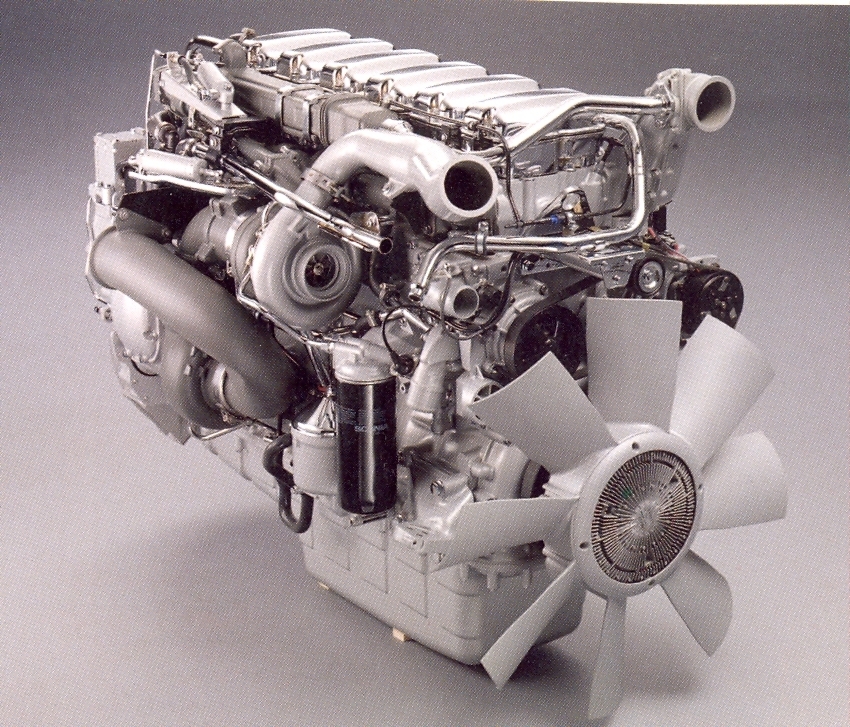
Was Detroit Diesel listening to Paul when they created their next
generation engine to replace the Series 60?
Well, the DD15 has a non-waste gated turbo connected through a gear box
that drives the crank shaft, very similar to what Paul has been
describing for years....
They are getting back 10% hp increase AND 5% fuel burn reduction from
this. I read about it in this month's
http://www.dieselpowermag.com
<http://www.dieselpowermag.com/>
<
http://www.dieselpowermag.com <http://www.dieselpowermag.com/>> when
it came in the mail yesterday. It is a bit too centered on large trucks
running diesels these days. Maybe they will wake up and realize
Americans will buy diesel cars and small trucks in droves if the EPA
will leave their emissions requirements in one place for the makers to
meet. (DCX got requests for 50K Liberty diesels when they only tooled
for 5K per year. Similar demand for the E320 CDI M-B)
-dave
Is there anything on that web site about the turbo compound Dave?
If not can you scan that article for me? 300 dots per inch is about
right.
This seems to be a better site.
http://www.detroitdiesel.com/engines/dd15/economy.aspx
That is good for a diesel as there is not a lot of waste energy in
the exhaust. Turbo compound will come. It is just a question of when.
--------------------------------------------------------------
Configuration Inline 6 cylinder
Displacement 14.8L
Compression Ratio 18:4:1
Bore 5.47 in (139 mm)
Stroke 6.42 in (163 mm)
Weight (Dry)2970 lbs
455-560 Horsepower
1550-1850 Lb-Ft Torque
---------------------------------
Dave, if you don't mind please take some detailed pictures
of the turbine parts of the DD15 at the Detroit auto show.
--
Paul Lamar ...No rotor no motor.
Pretty interesting. I think it's funny the graphic says "RPM's".. Is
that trucker? :)
I'd like to see more pictures too. How long 'till it's ready for
production?
Matt-
It was introduced in Oct 2007 and several truck drivers have written
glowing
testimonials.
What I can't figure out is how the blow down turbine works.
It looks backwards to your average turbocharger turbine. The hot gases
appear to enter the center of the turbine and exit at the periphery.
Very interesting.
It also appears they are feeding the power directly into the starter ring
gear on the flywheel. This results in a high built in gear reduction.
Very elegant, simple and compact way of doing it indeed. Entirely
different than
Scania and Caterpillar.
----------------------------------------------------------
I searched the web for radial outflow turbines and this is the only
thing I came up with. I can't say for sure this is what Detroit Diesel
is using but
it will work. Apparently it has advantages as it may generate a lot of
torque
at lower RPM's so the gear reduction box problem may not be as severe.
Pretty cheap to manufacture too as it can be investment cast.
It may also have some blade cooling advantages as the heat flow path
is very short. Efficiency is in the 90% range which is needed in a turbo
compound.
ntrs.nasa.gov/archive/nasa/casi.ntrs.nasa.gov/19800008223_1980008223.pdf
I can't say for sure this is what they are using. I could be totally out
in left field.
The wonderful thing about this engine is every other truck engine
manufacturer in the world is now forced to go turbo compound.
A 5% reduction in fuel burn and a 10% improvement in power is huge.
I don't think Caterpillar or Scania came close to these numbers.
Billions will now be spent on turbo compound R&D. I'll also
bet there will be some patent battles.
--
Paul Lamar ...No rotor no motor.
Hallo Paul,
a Truck magazin here says that this Detroit Diesel will be the new
?world engine? also for Mercedes Benz in Europe and Mitsubishi/Fuso in
Japan. Because Mercedes Trucks have a share of 40% in the europaen
market may be this will be the breakthrough of the Turbocompound.
According to that report the maximum torque of the DD15 is 2500 Nm. 260
Nm of that comes from the Turbocompound. Sorry, no further technical
details.
I know that every truck company in europe has a Turbocompound in their
R&D department, but hesitate to put it on the market. May be because of
the experience of Scania. The normal power range of trucks here is about
420 HP. Scania pushed up their 420HP engine to 470 HP by Turbocompound
with the same fuel consumption (but then of course lower BSFC). A 40 ton
truck&trailer cruising with 85..90 kph [53 to 56 MPH] (electronically limited) needs
only about 180 HP. It seems that this is too much part load for an
advantage of the extra turbine. Because Highway cruising is absolutely
most of the working time the owner cannot really see a lower fuel
consumption. A truck test from 2005 shows this very clear (enclosed).
Compared with the MAN competitor it has much lower FC at high loads
(hilly road ?Etappe 4? or WOT at a 3.5% ramp ?Vollastverbrauch
Steigung 3.5%?), but more FC at Highway cruising (?Etappe 1? - caused by
different ratios of both trucks).
Scania has a new strategy now. To meet the emissions they have a high
rate of exhaust gas return (drop down NOX). The loss of power is then
compensated by the Turbocompound. So the new Scania Turbocompound has
only 420 HP, but with the same fuel consumption and much better
emissions.
Reiner
Interesting at 50% power diesel BSFC is very good indeed.
We have some high mountains in the west to climb and loads are 80,000 pounds
or more. Trucks creep up those inclines as low as 10 MPH. Top speed on the
flat is more like 80 MPH. That takes HP!
Thanks for the nice picture and test data Reiner.
Paul Lamar
The Rotary Engine NewsLetter. Powered by Linux.
ACRE NL web site.
http://www.rotaryeng.net
Copyright 1998-2007 All world wide rights reserved.