Today I had the pleasure to visit the Rotamax plant where I was toured
around by the RotaMax president Eric Barger. For a number of hours I
looked at every part they make (which just happens to be every part of
their rotary engine) and to ask questions. Frankly, I was way more
impressed than I thought I would be. So in a series of e-mail, this
being the first, I will try to describe the Rotamax engine and the
company too. But for this first e-mail, here are some teasers. No
order, just as I think of them.
The Rotamax engine is charge cooled and has needle roller bearings
that are pressure fed oil.
The Rotamax engine is both side port and p port. The p port is
operated by manual butterfly valve. The engine I was told idles very
smoothly at low RPM just using the side port. I did not see it
myself but I have no doubt it is true.
The Rotamax engine has cool side intake.
The Rotamax engine has no oil sump. Among other things, this is a
perfect set up for aerobatics. It has a total loss oil system. In a
nut shell, oil is pulled from a small tank on the firewall. It is
pumped to the needle bearings which are fully lubricated. Some of he
oil travels through the eccentric and flows out of ports to add more
lube to the inside to the bearings. From this point the oil is flung
onto the tip seals where it is eventually burned. It does not use
much oil, and it is totally clean. There is no dirty oil ever in this
engine.
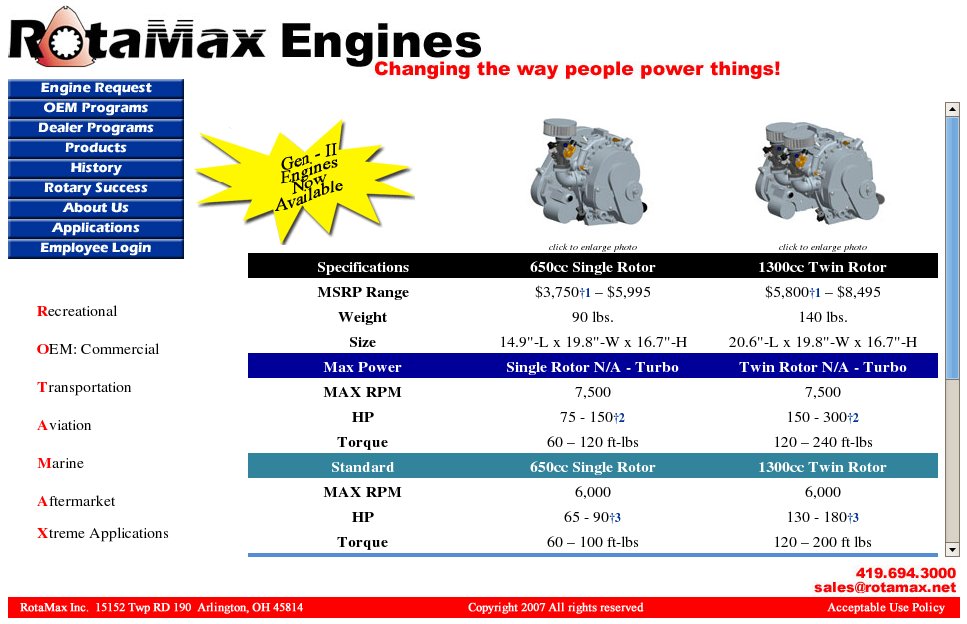
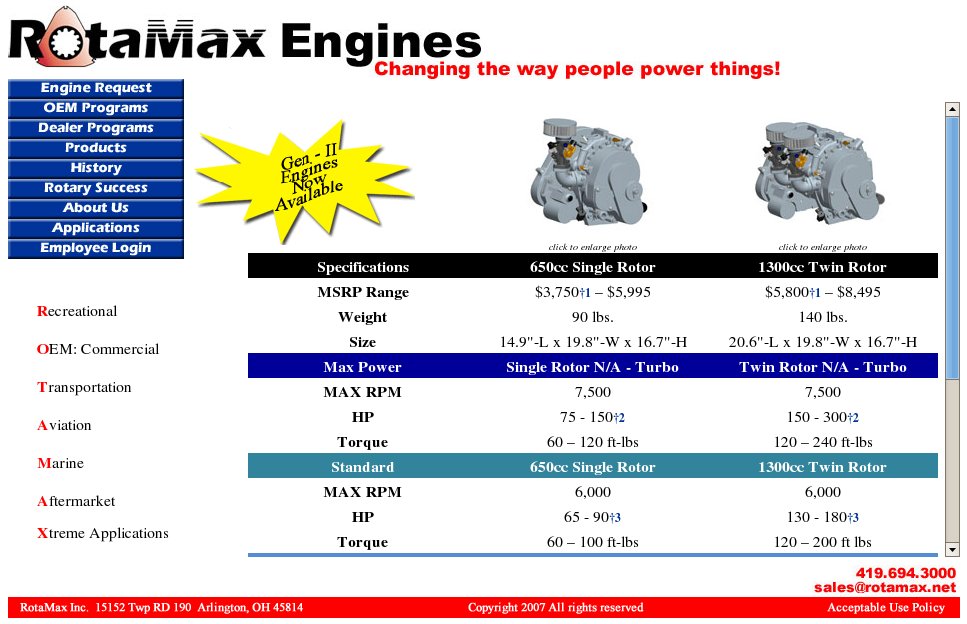
The Rotamax is very light weight. The two rotor weighs 130 lbs No
[PSRU] drive, "yet".
The Rotamax is produced by a small, talented crew, that includes a CAD
driver (Pro E) a couple of machinists, an engine guy who knows his
stuff. They have a room full of cnc lathes, mills, grinders that are
obviously being used a lot.
The Rotamax rotor housing is aluminum without a steel liner. Instead
it is coated You can forget trying to find out about the details of
this operation--It is something they are not going to share. Same for
side housings. A pair of side housings were pulled after 40hours and
had absolutely no wear. No step at all. Housings and ends are ground
in house. NICE... NICE... NICE!
First photo: Paul do you know this guy ?
Second photo: The eccentric before and after machining.
Third photo: Beautiful workmanship on the rotor. Note the seal
groves. The three holes are for charge cooling.
That is it for tonight. Jerry
Could someone please confirm the weight of the engine?
Photo *P1010022.jpg shows it being held in both arms against your chest.
Is this the **130 lb** engine?
Thanks,
John
http://www.rotamax.net/
According to the web site it is 140 pounds for the two rotor.
Of course that is less PSRU.
Paul Lamar ...No rotor no motor.
The Rotary Engine NewsLetter. Powered by Linux.
ACRE NL web site.
http://www.rotaryeng.net
Copyright 1998-2007 All world wide rights reserved.