> The heat flow path from combustion chamber to the rotor
> bearing and then on to the e-shaft is very short in Wankel
> engines. See the attached jpg.s. The rotor combustion
> chamber surface runs up to 500 F. This heat transfer
> path must be blocked or the rotor cooled to prevent
> the rotor bearing and e-shaft from over heating.
>
> The rotor bearing integrity is key to the maximum RPM
> of any Wankel engine. Since HP is a direct function of RPM
> the power to weight ratio of a rotary is also a function
> of the maximum RPM the engine can achieve.
> The current oil cooled rotor Mazda engine is limited to about
> 11,000 RPM in racing and about 9,000 RPM street.
>
> It seems to me this problem or feature needs to be addressed
> in future rotary engine designs. SAE paper 900035 addresses this issue
> for charged cooled (CCR) rotaries but it may be applicably to
> oil cooled (OCR) rotor Wankel engines such as the Mazda as well.
>
>
http://www.rotaryeng.net/
> "Down load tech paper on charged cooled Rotamax type rotary engines."
>
> What this SAE paper suggest is making the e-shaft hollow and cooling
> the rotor bearing area from within the e-shaft by oil or glycol/water
> coolant. How this is achieved is through relatively new technology
> called hydro-forming. The frame rails on a Corvette are hydro-formed.
> It has the potential for cutting the cost of the e-shaft as well.
>
> A length of 4340 steel tube is placed in a very strong female mold
> and super high pressure is applied. A hardenable steel alloy is chosen
> as the hardness of the rotor bearing e-shaft surface is critical.
>
> The wall thickness of the tube could be pre-machined to better control
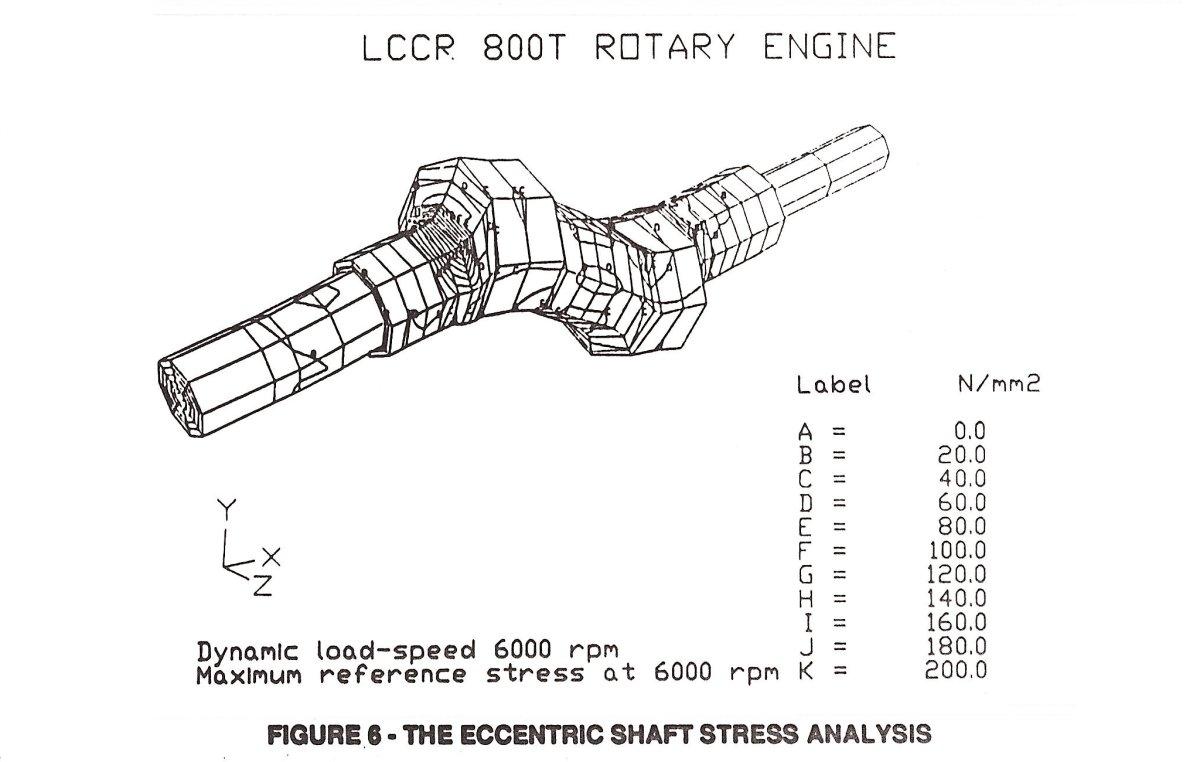
> the wall thickness of the final product. FEA or Finite Element Analysis
> would be used to determine the wall stresses so local wall thickness can
> be tailored to equalize the stress and minimize the weight
> and maximize the heat transfer to the coolant.
>
>
http://en.wikipedia.org/wiki/Hydroforming-
>
> Something as simple as a glorified fire cracker placed in the tube
> could also do the job. US coins are made by explosively bonding
> dissimilar metals.
>
>
> Paul Lamar ...No rotor no motor.
Here is your glorified fire cracker, Paul. I got about a half-dozen
lying around in the back yard somewheres . . .
http://www.hill.af.mil/shared/media/photodb/photos/601010-F-0000H-002.jpg
Loads of fun with the kids, or Fourth of July. Can't find 'em now,
grass has grown up . . .
Do you think you could use 'em? I can't make 'em work anymore since I
lost my Captain Midnight decoder ring . . . :-)
SERIOUSLY, I have questions. If we hollow out the e-shaft to run oil
through it, wouldn't we be making the e-shaft intrinsically
_weaker_ as
well?
How much
_can_ we hollow out a stock Renesis e-shaft (just for example)
without weakening it? (Yes, I know, the article is talking about a
_new_ e-shaft, hydroformed to spec.
_But_ if we want to apply to
concept to existing oil-cooled rotaries as Paul suggests, I ask so that
we would not be required to make expensive, brand new e-shafts for
perfectly good existing engines.)
If we hollow out the e-shaft, would we not be also required to make the
diameter of the e-shaft bigger? If so, how much bigger?
How would making the overall diameter of the e-shaft bigger affect the
engine's eccentricity ("stroke")? How much bigger can an e-shaft be
made until it negatively affects the engine's functioning?
What other questions should I be asking, and have not?
And of course, how do we know, and how do we know we know?
Thanks,
Les Nordman :-)
Most of the stress is near the surface of any shaft. Most of the
stress in the e-shaft is in the fillet area between the main bearing and the eccentric
lobe. It does not need to be any bigger. Nobody has every broken a properly
balanced Mazda rotary engine E-shaft despite generating up to 800 HP so obviously
it is over designed and can be hollowed out without problems. The same thing
cannot be said about piston engine crankshafts that all crack sooner or later.
Paul Lamar ...No rotor no motor.
The Rotary Engine NewsLetter. Powered by Linux.
ACRE NL web site.
http://www.rotaryeng.net
Copyright 1998-2007 All world wide rights reserved.