> Paul
>
> Have you seen this?
>
> http://www.wipo.int/pctdb/en/wo.jsp?wo=2004074655
>
> Erik Wahlstrom
>
> Very interesting but so far I don't understand exactly what it is
they > are trying to do and I am not a lawyer let alone a patent
lawyer :) Combining a > Wankel rotary with a turbine is a good idea
no matter how they go about it.
>
> However there must be something beyond that I don't understand or
they
> would never get a patent.
>
> The dwg's are not too clear. Too bad they don't allow 3D's in
patents.
>
> Paul Lamar
This is astonishing! It is obviously an attempt to patent the
conceptual framework of a turbo-compound engine. Their "gas
turbine" is
a turbocharger and the wording about the "fixed pressure ratio" element
is so cleverly ambiguous that it could be any Otto cycle engine. This
reminds me of the "Look and Feel" patents that Apple once heaped
claims
upon.
I could go on forever about this topic. But, I'll just comment that it
is sad, for me, to see American giants of engineering innovation like
Pratt & Whitney resorting to this sort of activity to generate revenue.
Aubrey Thompson
It looks like the patent office will give a patent to anybody
for anything and let it be fought out in the courts making the
lawyers rich. This one should be pretty easy to shoot down.
Paul Lamar
Well, this is just a patent application. I haven't read it in
detail, but if you look at the preliminary report on patentability, it
doesn't look very positive.
Bob W.
Paul,
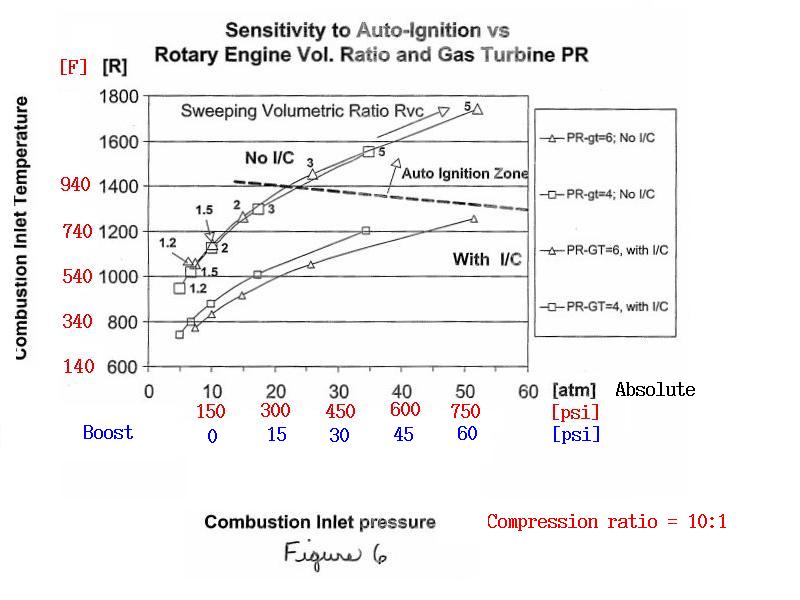
I think this work is a theoretical study similar to the NASA studies we
have discussed before. They are "sweeping" the rotary engine
compression ratio through a range from 1.2 to 5 in the calculations to
get an overall compression ratio of about 7 to 50. So, from the graph
you can see that to stay below the auto-ignition zone without an
inter-cooler, the overall pressure ratio must be less than about
(2.6)(6) = 15.6 or about (3.8)(4) = 15.2. Hasn't this been known by
hot rodders for at least 50 years? The "new art" that the patent
application claims seems to be the discovery of this Auto Ignition
Zone. I find it curious that, as in the NASA studies, single stage
turbochargers operating at pressure ratios of 6 are assumed to be
readily available.
Aubrey Thompson
What do you mean by a pressure ratio. Lets say it is 6. Does that mean
the pressure in the combustion chamber prior to ignition is 6 X Atmos.?
Are my red and blue chart modifications correct?
Paul Lamar ...No rotor no motor.
Paul,
I think the horizontal axis depicts the combustion chamber pressure
prior to ignition. According to the text, it is the product of the
turbine pressure ratio and the volumetric compression ratio of the
rotary engine raised to the 1.3 power. The origin of this equation is
not explained. Presumably the exponent of 1.3 is a result of
temperature rise during the compression motion. So, your red additions
seem about right. By the normal definition of "boost", it would be the
manifold gauge pressure produced by the turbine. In this case that
would be fixed at either a pressure ratio of 4 (boost of 45 psi) or a
pressure ratio of 6 (boost of 75 psi).
Aubrey Thompson
That is what I was guessing. Notice the little numbers on the
graph such as 1.2, 1.5, 2, 3, 4 and 5 those look like turbo charger compressor
pressure ratios. They need to state the compression ratio of the Wankel
as well. Nothing other than 9.5:1 to 10:1 are practical anyway.
--
Paul Lamar ...No rotor no motor.
The Rotary Engine NewsLetter. Powered by Linux.
ACRE NL web site.
http://www.rotaryeng.net
Copyright 1998-2007 All world wide rights reserved.