Truck engine manufacturers are jumping on the TC band wagon.
Pratt & Whitney Canada are trying to patent the turbo compound
rotary so I would not be a bit surprised if they were not building
some hardware to try it. At least I hope so.
I find it interesting that Pratt & Whitney US and Pratt & Whitney Canada
is allied with Rocketdyne.
http://utc.com/
Rocketdyne was rumored to be working on the TC rotary here in SoCal.
Paul Lamar ...No rotor no motor.
Paul,
Was messing around with e-shaft direct-drive turbocompound concepts..
Roughly what's the diameter of the flywheel on a 13b? At 6000rpm an 18
inch wheel has a tip speed around 325mph and a 24 inch wheel has a tip
speed around 450mph.
Also, does anyone have some calcs for determining average flow velocity
based on volume and pipe diameter? Need to figure out what diameter
direct drive wheel would be required to interface well with the exhaust
flow.
Maybe a 2:1 planetary reduction - the tc turbine 2x the e-shaft speed
would make the interface between the exhaust and the turbine more efficient.
I wonder if a turbo compound could drive through a small automotive
torque converter - ideally with an electric lockup. They seem pretty
robust and there are lots of different versions out there.
http://en.wikipedia.org/wiki/Torque_converter
It occurs to me that the rotary engine might have a big advantage when
considering a direct drive (or close ratio) turbo compound - high
continuous RPM. This can make the size of the wheel smaller and yet
still have the tip speed close to the flow speed of the exhaust.
There's no way a direct drive would work on a big diesel.. Aircraft
operations have it easier too - essentially one continuous RPM whereas
road going applications require quite a bit of dynamic range. Even for
a tractor-trailer engine which is mostly continuous operation.
Matt-
The ring gear is about 12 inches in diameter.
Well you can start with the volume and speed of air going in as a start
and knowing air temp of the exhaust you can figure the volume
and speed of the air coming out. Assume the pipes are the same size. Then
you add heat which increases the volume and speed coming out.
V1 x T1 = V2 x T2 Temperature must be in Rankin. V is volume.
Pressure is constant.
T1 is 100 F or 560 Rankin
(V1 x T1)/T2 = V2
T2 is 1700 F or 2160 Rankin
Speed of the air going in is V1/Area = Speed in.
Speed coming out is V2/Area = Speed out.
I suspect the mass flow is the same as matter can nether
be created nor destroyed except by fission.
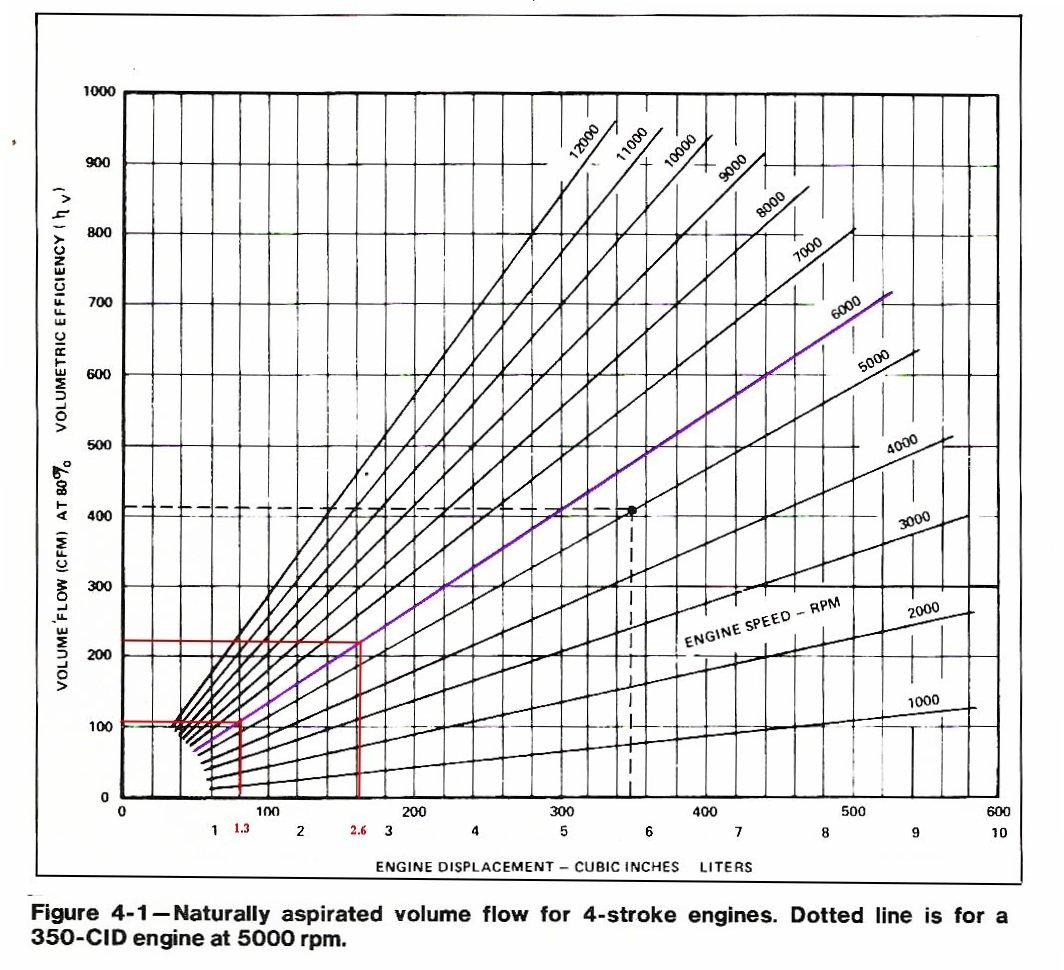
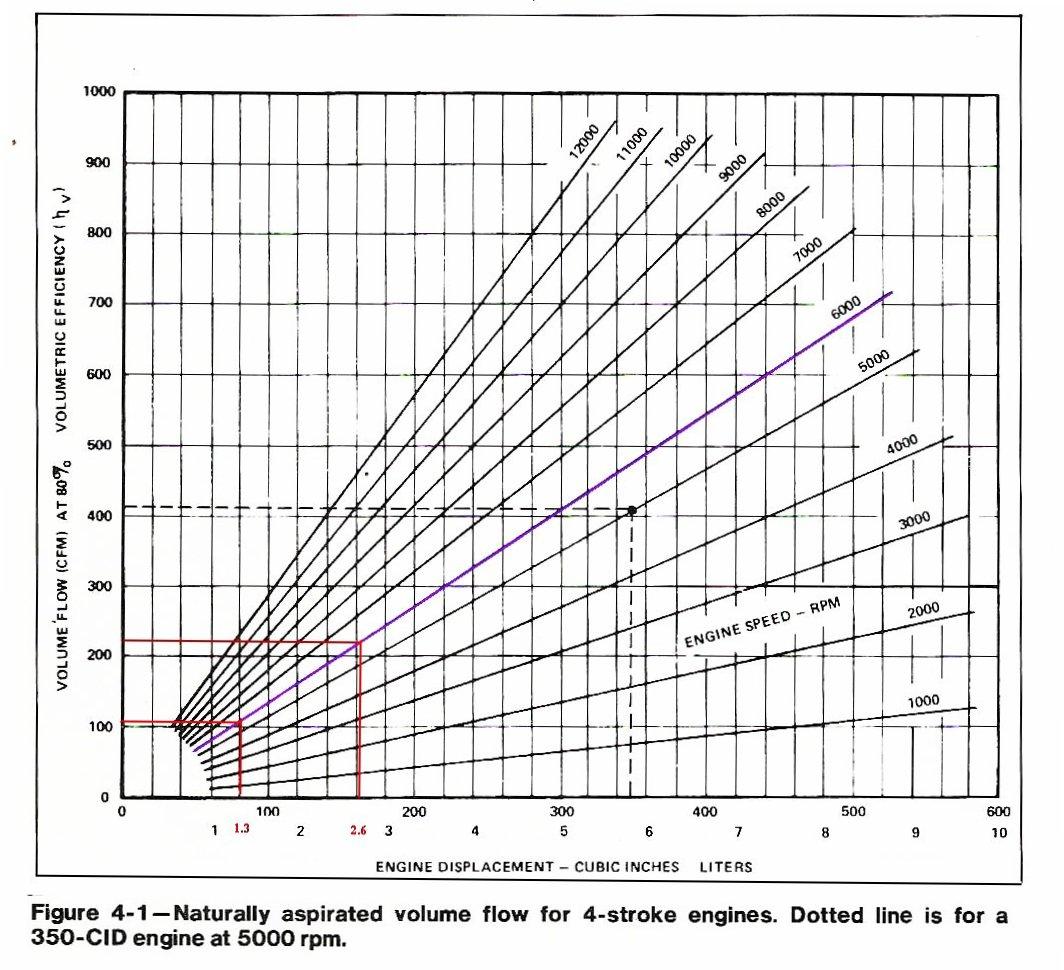
A 13B pumps as much air as a 2.6 liter piston engine which is about
230 CFM at 6000 RPM and a VE of 80%
At a VE of 100% it would be about 275 CFM.
With a p-port the VE is 120% so it would pump about 330 CFM.
See the attached chart.
Assume it is two 2 inch intake pipes so area would be 6.28 square inches
or .0436 square feet. Speed going in would then be 7,568 feet per minute
or 126 feet per second or 185 MPH going in.
Coming out it would be 2160/560 x 126 FPS or 486 FPS.
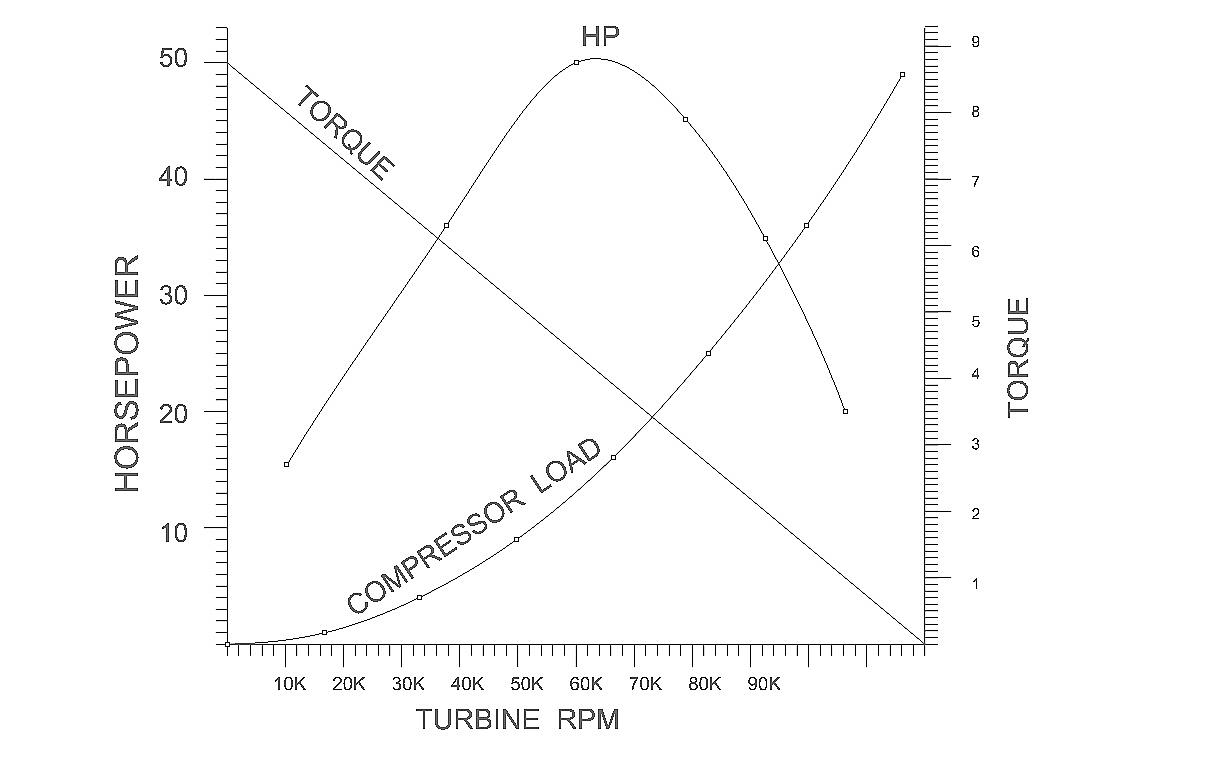
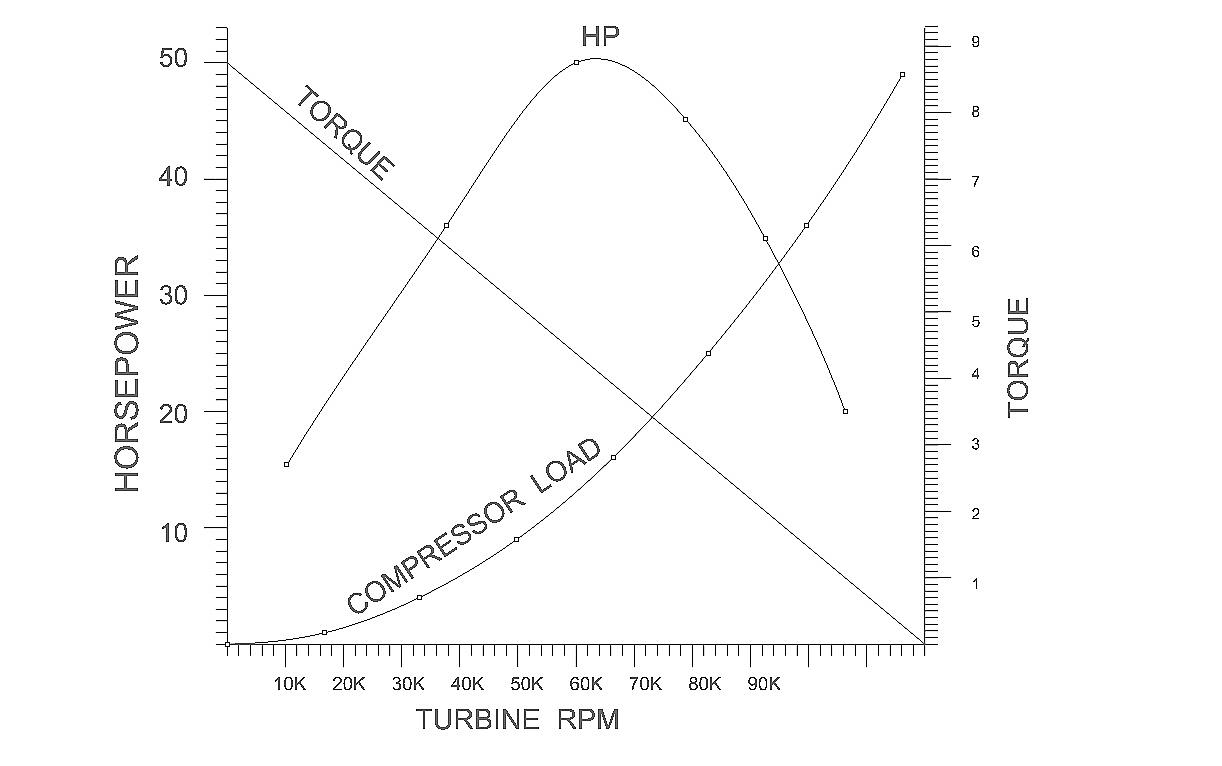
A turbine generates max HP when the blade velocity is half the
flow velocity. That is because the turbine torque is max at zero RPM and
zero at max flow velocity when the flow and the blade are both going
the same speed. HP is the product of torque times RPM. See the attached
chart.
So size the turbine so the blades are going 243 FPS or 165 MPH.
I'll leave the turbine diameter as an exercise for the student :)
You can speed up the air coming out by necking the output pipe area down
(at the expense of slight back pressure) and slow the air down by diverging
the pipe area. Also you can use a variable nozzle like modern turbo chargers
to tailor the best turbine HP to the e-shaft RPM and the turbine diameter.
Check my arithmetic and physics. I could be wrong.
Paul Lamar ...No rotor no motor.
The Rotary Engine NewsLetter. Powered by Linux.
ACRE NL web site.
http://www.rotaryeng.net
Copyright 1998-2007 All world wide rights reserved.