Also, Hydrogen could be usable to suppress the knock onset somewhat.
H/Air mixture burns 5 times as fast as fuel/air mixture, thus speeding
up the whole combustion event - so there's less time for yet-burned
mixture ahead the flame front to "think about behaving badly". This is a
"might", since free hydrogen is a known factor on knock onset. If H can
be combined to mostly H2 before injection, it might help.
If H2-assist could be tested together with 16X -type direct chamber
injection, we might be able to reach low .40's SFC on rotaries. Might,
could, perhaps :)
More notes regarding combustion event and knock:
Some sources state that Formula 1 engines don't knock above 12 000 rpm.
Things are happening so fast above that point that there's simply no
time left for knock. That also explains those 5 bar boost levels on past
1.5 liter F1 turbo engines with 1200 hp peak powers.
12000 rpm is 200 Hz crank frequency, or 5 us per revolution. If we say
that combustion event is 40 deg or 1/9 of revolution ( -20 - +20 TDC )
then the whole event lasts 0.55 us on 12000 rpm.
6000 rpm is double that, or 1.1 us. So, if this event can be made 2x
faster by eg. H2 injection (1.5x on 7500 rpm, and 1.35x on 9000 rpm),
we're on realm of 12000 rpm combustion - and hopefully killed the knock
altogether.
H2 injection could be done by simply installing a bottle on airplane,
and putting injector on manifold. just like on N20 injection system.
Practical, non-racing or long cruise applications might need a water
electrolysis unit instead. Gas bottles are not necessarily light.
Then, how much water is 5% H2 of gasoline flow on 1h of flight? Let's
take mistral G-360. cruise sfc abt. 0.44 on 65%, so fuel flow is 103
lb/hr. 5% of this is ~5 lb. And 2x600 hp, 8 hours is 480 lbs.
How much H2 is on one unit of water?
O atomic mass: 16, H atomic mass: 1 =2/18=11%.
Then, for G-360 we would need 45.5 lbs of water per hour, and 12% less
intake air for combustion, if O2 is injected to manifold.
40 lbs water for every 100 lbs of avgas? to get 10% benefit on sfc?
Of course not.
H2 is not cheap, neither are light composite tanks to keep extra weight
down, so tank H2 injection seems to be limited to racing - provided it
works at first place.
And electrolysis H2 seems to be limited to marine and stationary
applications.
But then,
all the time when flying, we are leaving behind a trail of H2O, CO2 and
NOx. How about a partially closed loop to extract the water on exhaust
gas, ie. condensing heat exchanger on exhaust combined with 6-stroke cycle?
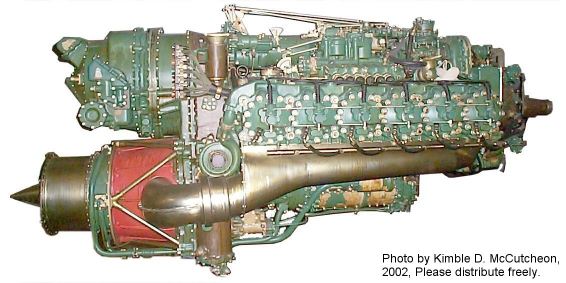
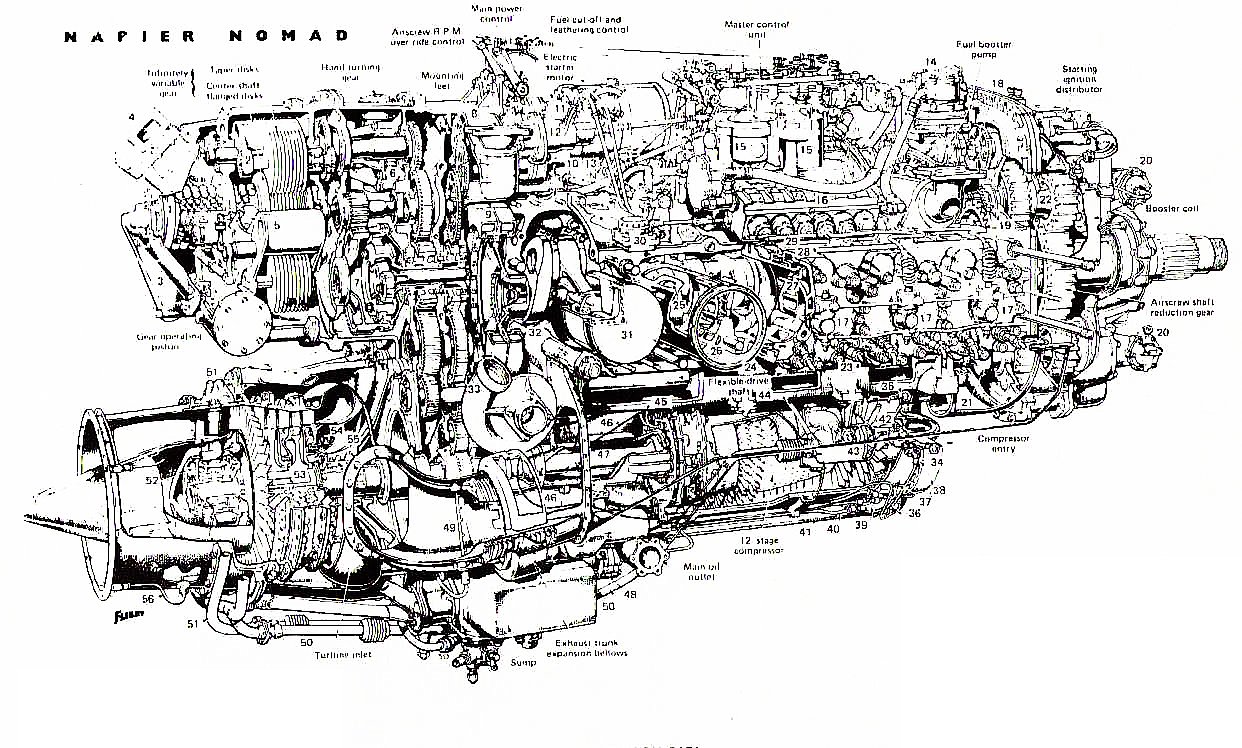
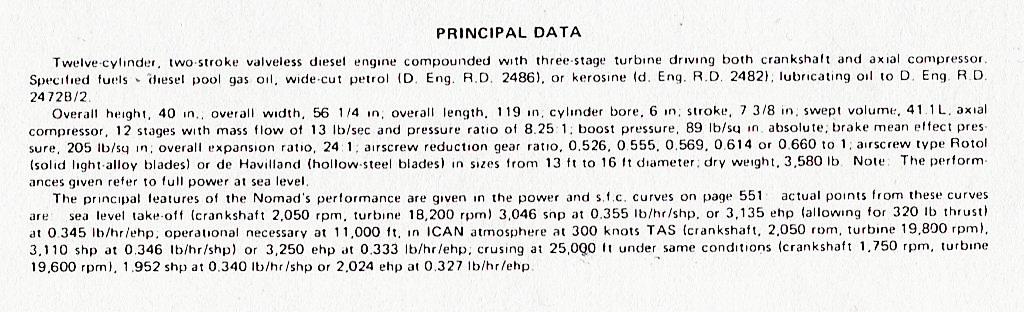
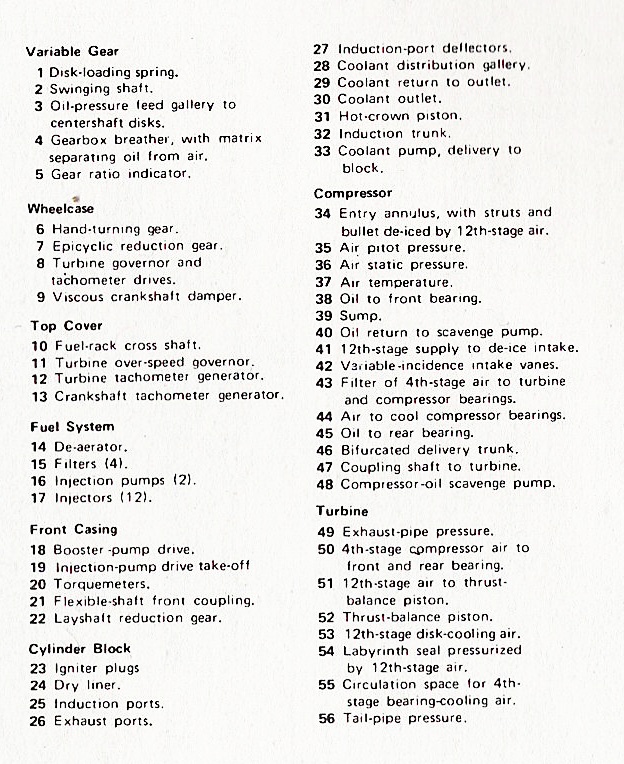
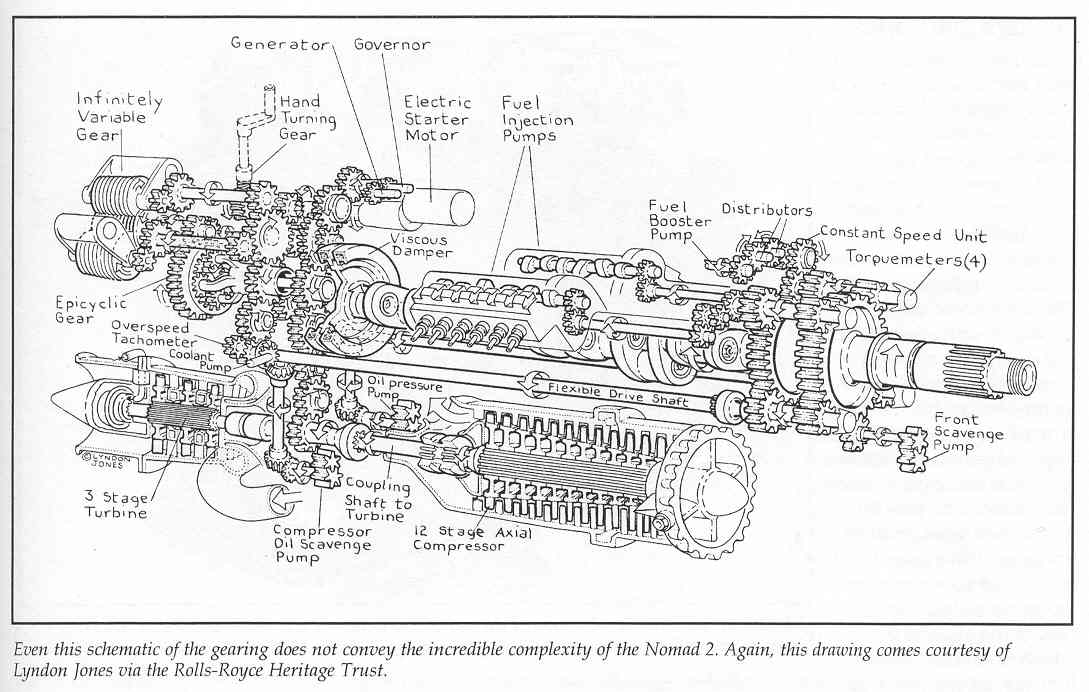
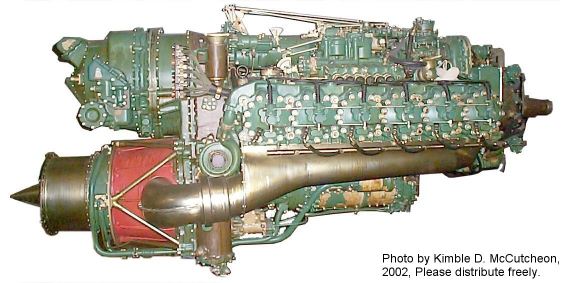
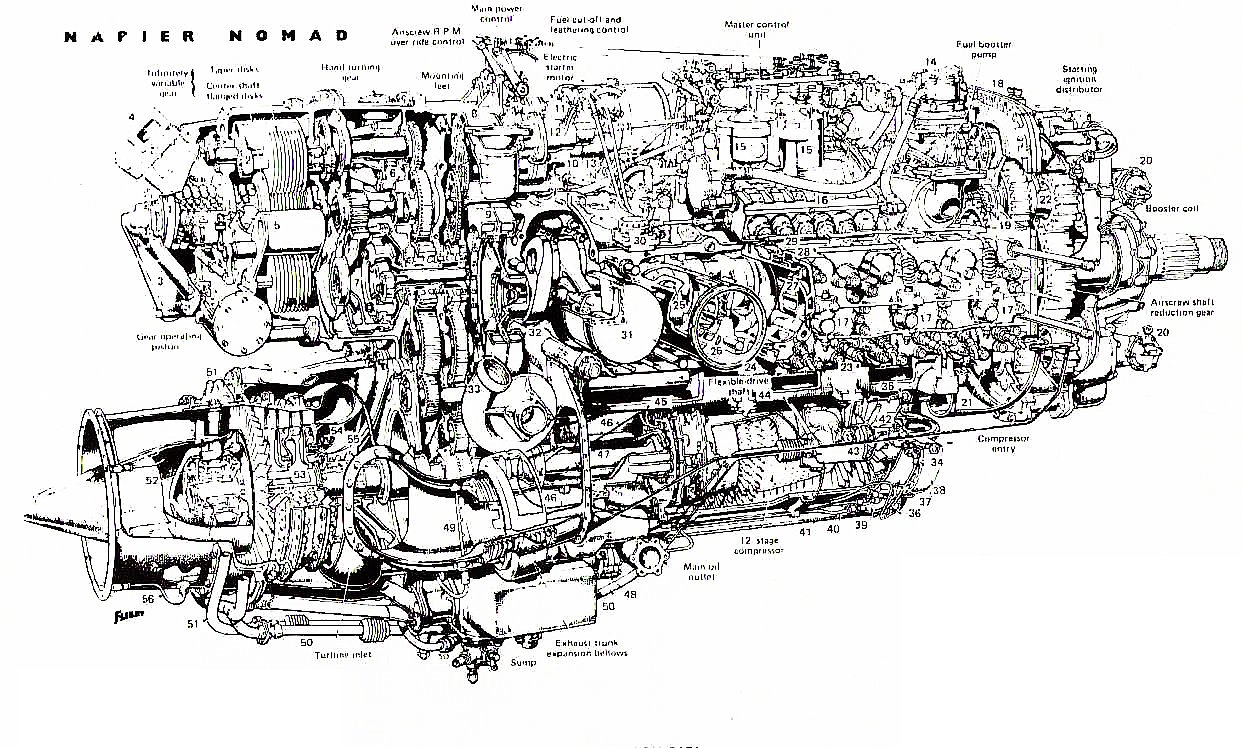
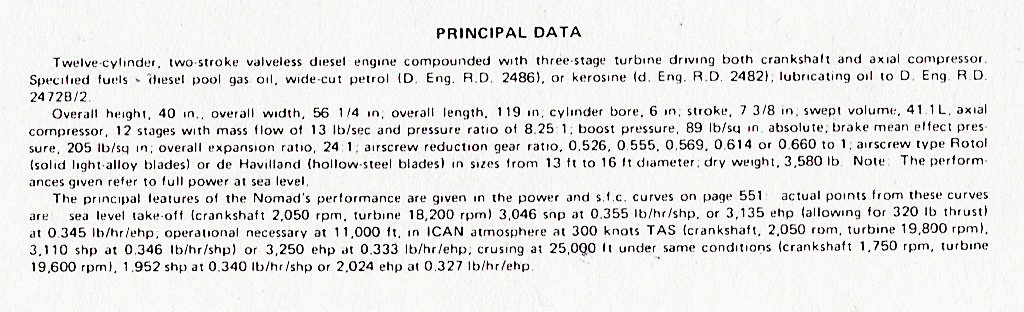
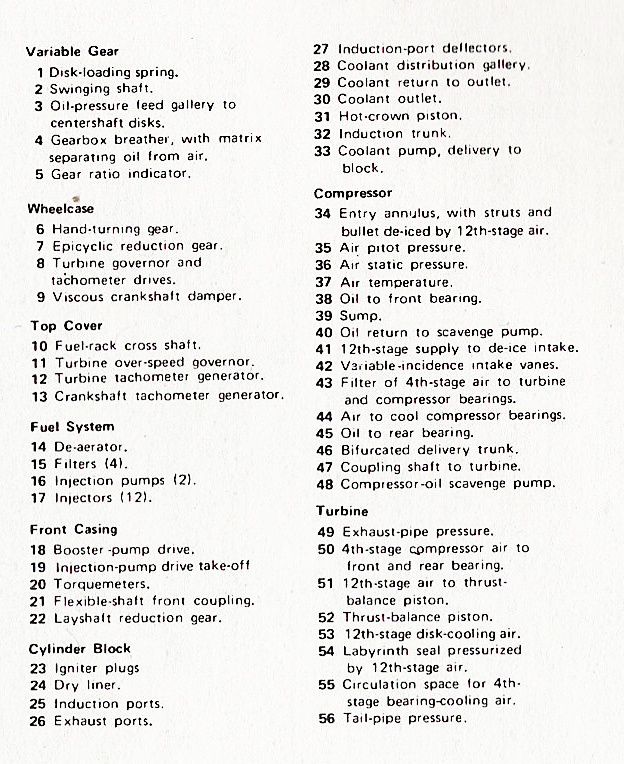
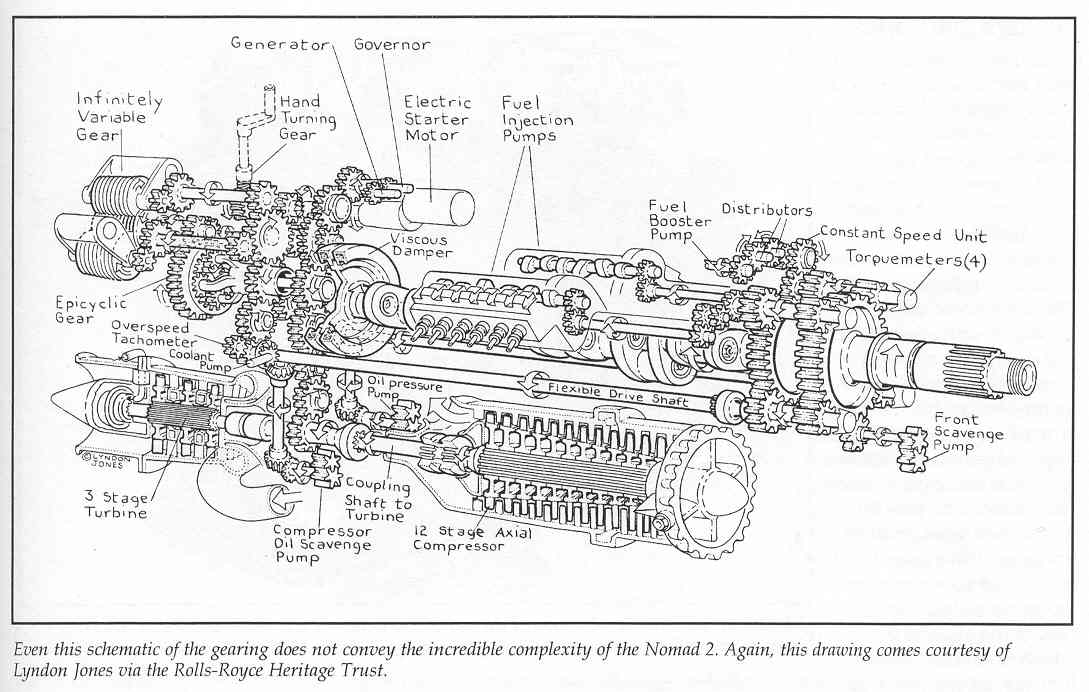
Now, Napier Nomad starts to look like a garden-variety appliance...
Then one semi-unrelated tidbit:
Maximum motor octane number (MON) possible is 124. This is achieved with
pure toluene with atrocious amounts of TEL - almost twice what 115/145
AVGAS had. Research octane number for that is about 134, so US pump gas
AKI (R+M/2) for that lead soup would be 129 :)
Aviation PN (performance number) could be something like 125/170.
So, VP fuels 120 MON air racing brand seems to be as good as gasoline
ever gets.
Cheers,
Petri
Excellent work Petri. Thanks. You are a very clear thinker and writer.
You do your homework. You see the big picture.
BTW I added some pictures of the Napier Nomad for the new people.
--
Paul Lamar ...No rotor no motor.
The Rotary Engine NewsLetter. Powered by Linux.
ACRE NL web site.
http://www.rotaryeng.net
Copyright 1998-2007 All world wide rights reserved.