>> Now this sounds interesting, like the propane used on diesels. What
>> about the storage of the 2H2O2 gas ? Is it in a high pressure tank ?
>> Sounds a bit like a bomb without the detonator. What does it take to
>> detonate such a device ? If the gas flow is on (thinking like a
scuba
>> diver here - never holding your breath your lung pressure is always
>> equal to that before your face) wouldn't an ignition of this gas
line no
>> matter how far from the pressure tank be the same as lighting a
fuse on
>> an old iron civil war bomb ?
>>
>> -dave
> The way these things are used in auto engines, is that the water is
> hydrolyzed, and fed into the intake. There is very little
hydrogen gas
> at any one time. It's used as it's converted. There is enough to
> possibly blow up the container, and you could put your eye out with
> flying shrapnel.
> Bob W.
So, you carry water, electrolyze it with current from the engine's
alternator and burn it as you go ? Seems like you'd need a larger
alternator just for this process.
-dave
And more HP is consumed by the larger alternator. One HP for each
600 watts assuming the alt. eff. is 80%. At 12 volts 600 watts is 50 amps.
So how many volts and how many amps are required to make x amount of
hydrogen?
Paul Lamar
No turbo-compound. Just an exhaust turbine driven alternator for making
H2/Brown's gas..
Barring some newly repeatably-demonstrated/proven physical/electrical
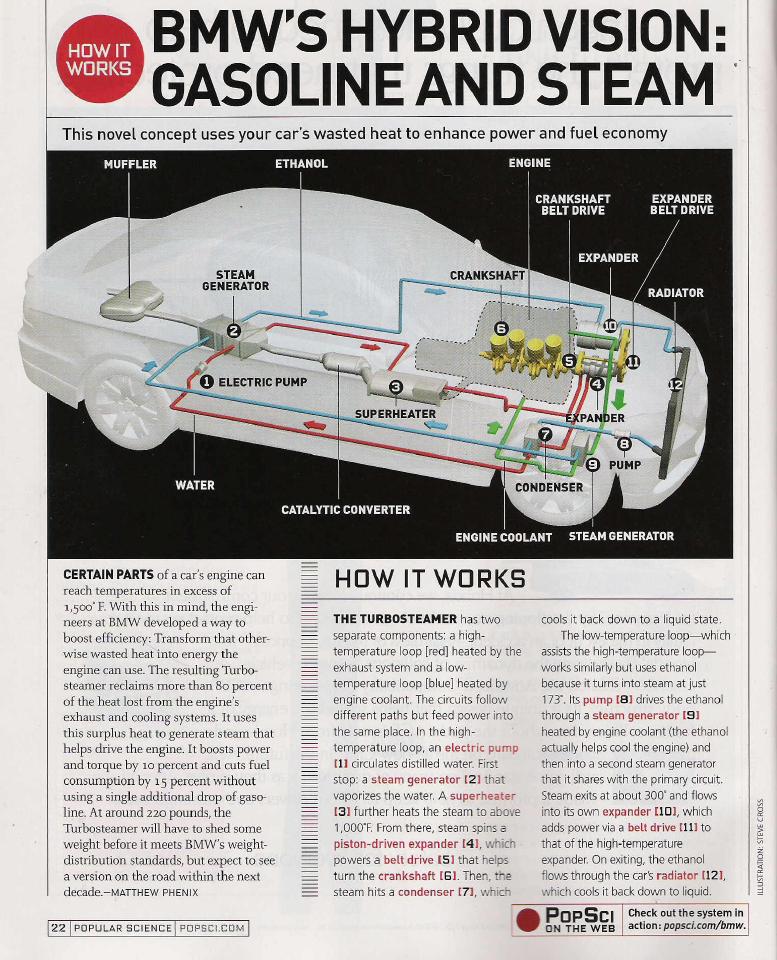
properties of H2O/H2, I suspect a turbo compound is going to actually
deliver higher overall efficiency improvements compared to any kind of
hydrogen plant. Adding bottoming cycle recovery is probably yet even
more efficient than trying to make hydrogen on board.
Matt-
I am working on a new HTML version of the turbo compound section of the
web site. When I get that done I will make a pdf.
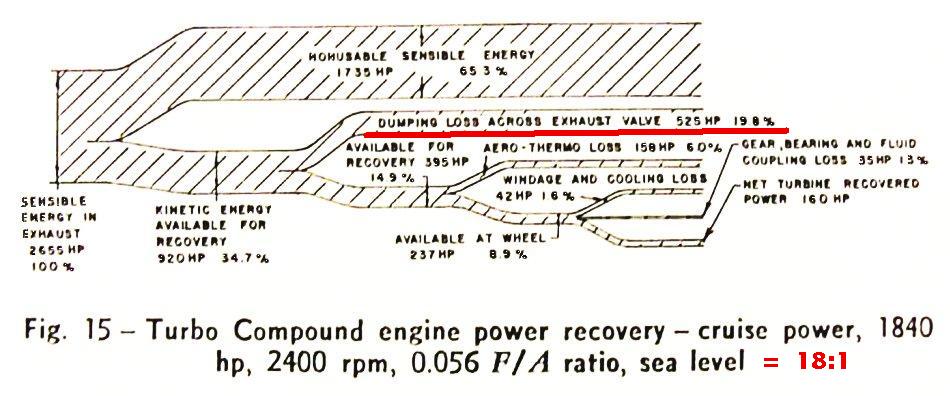
Here is an excerpt of the text with the graphic.
"Total fuel energy burned in a 200 HP rotary is about 760 HP worth.
With exhaust valves you would have only about 6% or
45.6 HP available for the turbine."
"Without exhaust valves you would have about 16.5% or 125 HP!!!!
Almost three times the HP available to drive the turbine!!! No wonder
you can boost a 13B rotary to 800 HP!! There is lots of kinetic HP to
be had in the rotary engine exhaust. Much, MUCH more than I had at
first thought. We always knew there was a lot of waste heat in
the rotary exhaust."
"The power in the Mazda Wankel rotary engine exhaust has been talking to us for
30 years. It has been saying. "Hook me to turbine, hook me to a turbine, hook
me to a turbine." Anybody that has been around a Mazda rotary powered race car
without a muffler can understand the tremendous kinetic energy in the exhaust.
I have a race car driver friend by the name of John Morton who claims he
has permanent hearing damage from driving rotary powered race cars."
--
Paul Lamar ...No rotor no motor.
The Rotary Engine NewsLetter. Powered by Linux.
ACRE NL web site.
http://www.rotaryeng.net
Copyright 1998-2007 All world wide rights reserved.