Can someone one the list point me toward a
rugged, NASCAR type, oil to
water heat exchanger AND the heat transfer
coefficient data for it?
Thanks,
Aubrey Thompson
Do you have Compact Heat Exchangers Aubrey?
Lots of theory
and coef.'s.
As far as hardware is concerned I was unaware
NASCAR race cars used
oil/water
heat exchangers. I see one small one on ebay
Something to do with cooling the valve
springs?
Sounds like a good idea if they are breaking
due to heat:)
Here are some sources.
http://www.crracing.com/custom_built/external_heat.shtml
http://www.sen-dure.com/
http://www.trola.com/prod_standard.asp
http://www.mkivsupra.net/vbb/showthread.php?t=139765
http://www.amfmotorsports.com/prod/cr1.1.htm
Put "oil to water heat exchanger" in google
advanced search.
Paul Lamar
Aubrey,
Also, try Fluidyne. They make lots of custom and
racing stuff.
Mark S.
Aubrey,
The ford trucks with a 5.4 with the towing package
have an oil to water heat
exchanger. Unit works well and you should be able to
find one at a good
price at a salvage yard. The Expeditions with the
tow package also have it.
Larry
Aubrey
I have this one reputed to be from a Ford Crown Vic or
maybe a police car. It has a cast alum shell, inside
looks like radial fins, wt is 5#. Braided lines look
to be oem.
regards, Robert
Some of the car racers are are building their own.
They take a stock oil to air heat exchangers (oil cooler) and weld it
inside a box. The box is then plumbed to the water supply.
Lets say your water cooling system is marginal. For most Mazda rotary
installations that is probably true. It won't get any better if you add the
oil cooler
heat load to the water cooling system. It can only get worse. If you get a
leak and you dump all the glycol coolant overboard you will have less time
to get the airplane on the ground as the oil will over heat as well.
The engine may seize due to overheated melted e-shaft bearings.
With an air to oil cooling system it is working in parallel. You still
have one third of the overall engine cooling and you may have more time to
get the airplane on the ground.
Paul Lamar
Laminova, Laminova, Laminova...
http://www.thinkauto.com/laminova.htm
I forget the name of the parent company, but their website isn't much better
than this link. Not cheap, IMHO not a good idea, but deffinately the only
thing to think of for an aircraft installation where size, weight, and
efficiency is at a premium.
Tom Lee
Tom,
Size, weight and location are advantageous perhaps, but as for efficiency I
am not so sure. When the water temperature is below 85 degrees, OK sure.
Marine applications are like this but they dump the BTU overboard along with
the cooling water. In aviation more than likely on T.O, when cooling loads
and engine stress are greatest, the water temp. is going to be over 185F.
With oil temps. at 200F + degrees, the delta T to water will only be 15
degrees, 200 minus 185 degrees. If we use an oil-to-air heat exchanger, the
delta T with an 85 degree ambient air temperature would be 200F minus 85F or
115F degrees.
Heat moves towards the lower potential, so a higher difference in
temperature (higher delta T) would result in a higher rate of heat transfer
and be more efficient. Of course this entails designing proper intake and
exhaust ducts (Paul's forte') that insures all of those fins on the
oil-to-air heat exchanger are free of insulating air boundary layers, and
whole air mass moves through the duct in a timely and orderly fashion.
The same criteria applies to the water to air heat exchanger.
As for why Ford trucks would offer the oil-to-water-to-air heat exchanger
in a towing application where the engine is under a heavy duty cycle I
haven't a clue. Perhaps someone could explain it to me. Keeping the engine
oil warm in the cold north? :)
Doug in Japan
One factor is the small amount of heat transfered to the oil in most
piston engines. Some piston engine squirt oil
at the under side of the piston to cool them. Many aircraft piston
engines do this as do some diesels. Never the less the heat dissipated
by the oil is usually less than 10% of the total.
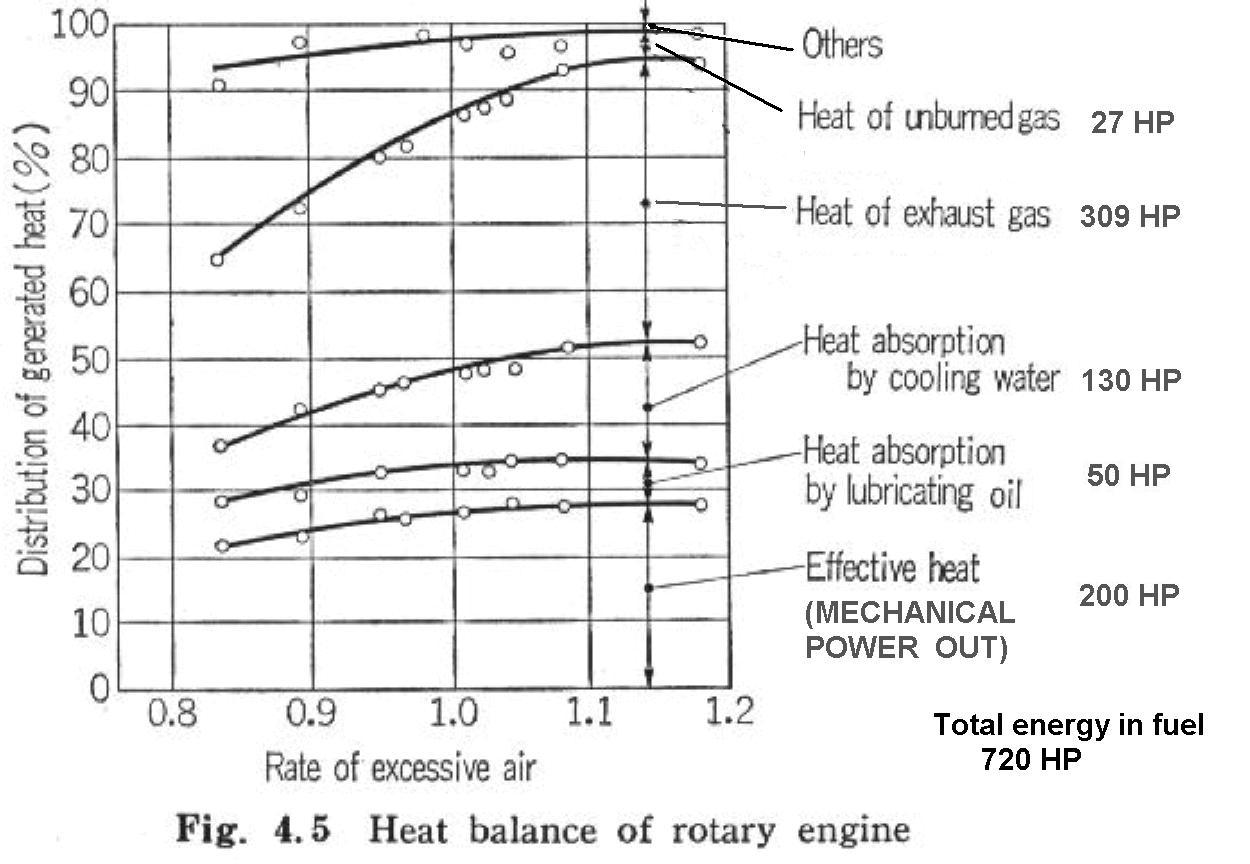
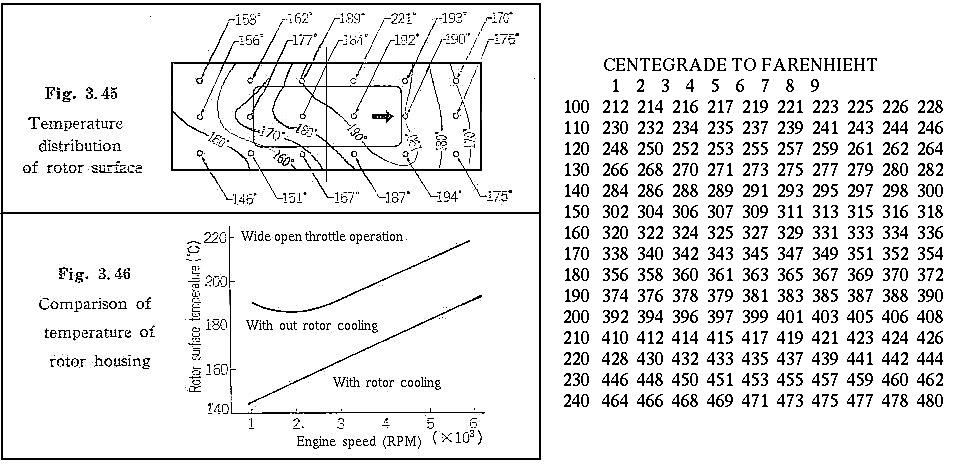
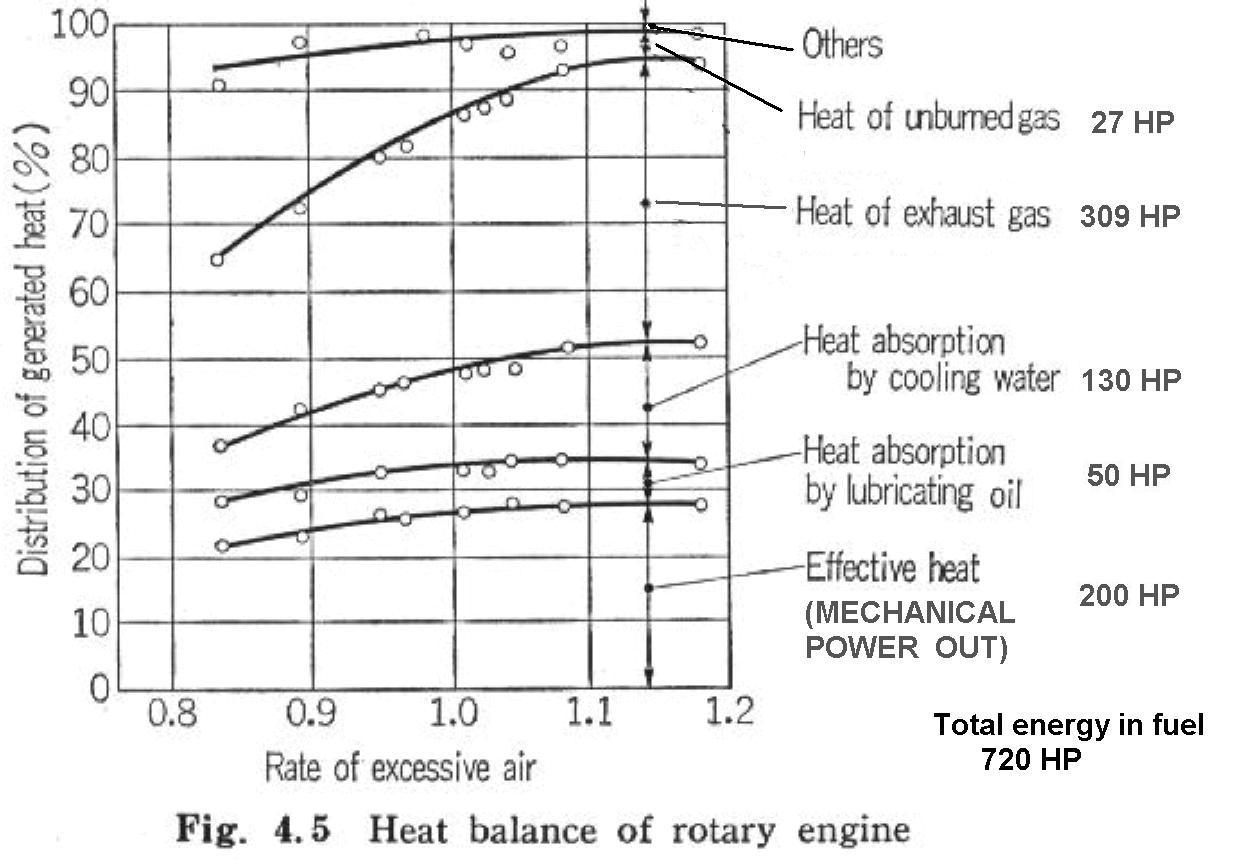
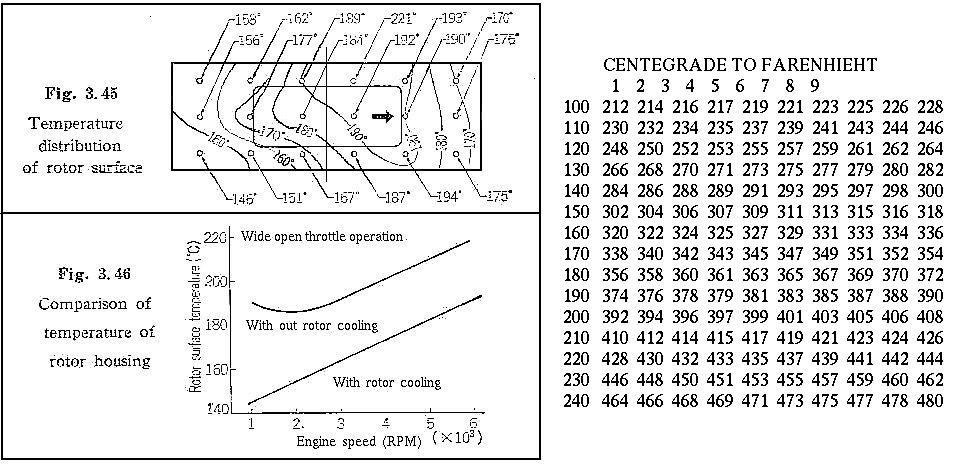
The rotary on the other hand has this oil cooled rotor that forms about half
of the area of the combustion chamber. This results in one third
of the total heat rejection to the cooling system. As you can see, from this
heat balance chart, 50 HP or 25% of the HP out of the e-shaft during lean cruise is rejected
by the oil heat alone. At rich mixtures, typical during take off and climb out, the
percentage becomes greater. If the oil is cooler than the
glycol coolant it is not a good idea to transfer heat to the oil from the glycol.
One needs to delay heating the oil as long as possible with a good oil to air
heat exchanger and proper air ducting. More oil helps this process as it takes more heat to
heat a larger quantity of oil. The difficult history of the Mazda rotary installation
in aircraft has been mostly about keeping it cool both oil and glycol.
Paul Lamar ...No rotor no motor.
The Rotary Engine NewsLetter. Powered by Linux.
ACRE NL web site.
http://www.rotaryeng.net
Copyright 1998-2007 All world wide rights reserved.