I went back and checked some old messages prior to
installing the
oil water
HX but you never mentioned OAT or climb. Do you remember
what that
may have
been?
"To answer your question on water temps; the water temps
were never
a problem.
They would stabilize around 135-150, depending on MAP."
Sounds like your glycol system was very effective if not
over kill.
Do you recall the size of the rad?
Paul Lamar ...No rotor no motor.
Paul,
The application was Ford Galaxy (probably w/390ci engine, but not
stated). Core size is 18 x 22.5 x 2.5, best I recall. Initial
flight
was in August and the temps were in the mid 90's.
Mark S.
You obviously did a great job on the rad ducting. Core volume
appears to
be about 1000 cubic inches where our rule of thumb call for 300
cubic inch
per rotor or about 900 at the max for a 3 rotor.
What I can't understand is why the oil cooler is not working better.
Perhaps you have some air leaks in the front duct or the back side
of the oil
cooler is too hot. Can you make some air temps measurements behind
the oil cooler?
What brand of oil cooler is that?
--
Paul Lamar ...No rotor no motor.
Paul,
The exhaust manifold is now shielded with 321ss so the oil exchanger
should see minimal radiated heat. My guess is that the water radiator
duct is working so well it is pressurizing the cowl and inhibiting the
air flow through the oil cooler. Could the location of the water inlet
be slightly higher pressure than that of the oil cooler inlet? Does oil
cooler's higher fin density drop the pressure even further? Whatever
the answer, I believe the water radiator is flowing more than its share
of air and is causing the oil cooler to choke.
Another thing, after first flight the oil temps were 240*+ even on
shallow climb. Obviously, this would not do for hot Texas summers. The
first thing I did was to increase the cowl exit area. That helped some
(supporting the above theory). I put a baffle along the lower edge of
the oil exchanger because the exit air from the oil cooler was at a 90*
angle to the air exiting the water radiator. This seemed to help a
little. Still, I couldn't climb at full power on a 90+ day due to high
oil temps. I guess I could have added a second oil/air cooler on the
other inlet, but it seemed worth a try to take advantage of some of the
excess water cooling capacity with the oil/water exchanger. My only
regret is that there isn't enough excess cooling capacity that would
allow me to remove the oil/air exchanger completely.
Mark S.
What are the core dimensions for the oil cooler and the brand name.
Is it new? It sure looks big enough. Fins per inch and tubes per inch
are a good way to characterize heat exchangers.
Cut the water supply to the oil/water HX during cruise and put a couple
of cowl flaps on it to warm the water. Engine eff. will go up.
That is perhaps as much as .02 down on the BSFC and .2 to .4 on the GPH.
There will be less aero cooling drag so MPG will go up significantly.
Matt may have hit on something by using a dedicated exit duct and
cowl flap
for the oil cooler. It could converge down to the area of the scoop
or less.
Paul Lamar ...No rotor no motor.
Paul,
The oil cooler is made by Fluidyne. As I recall, it is 11 x 9.5 x
2-7/8. It is a dual pass and has turbulators inside the tubes.
The dedicated exit duct sounds like it could work. I'll give it some
thought. Its hard messing with success though.
A question... would an equivalent sized dual pass glycol exchanger work
better than what I now have. I'm referring to the design that puts two
cores back to back. If so, do you think it would dissipate enough heat
to handle both the total heat load of a 3-rotor?
Mark S
The heat transfer from oil to metal is not as good as from
Glycol to metal. That is why some oil coolers have turbulators.
That is also why oil is not used as the primary coolant.
It would be great if it did as the boiling temperature is much higher.
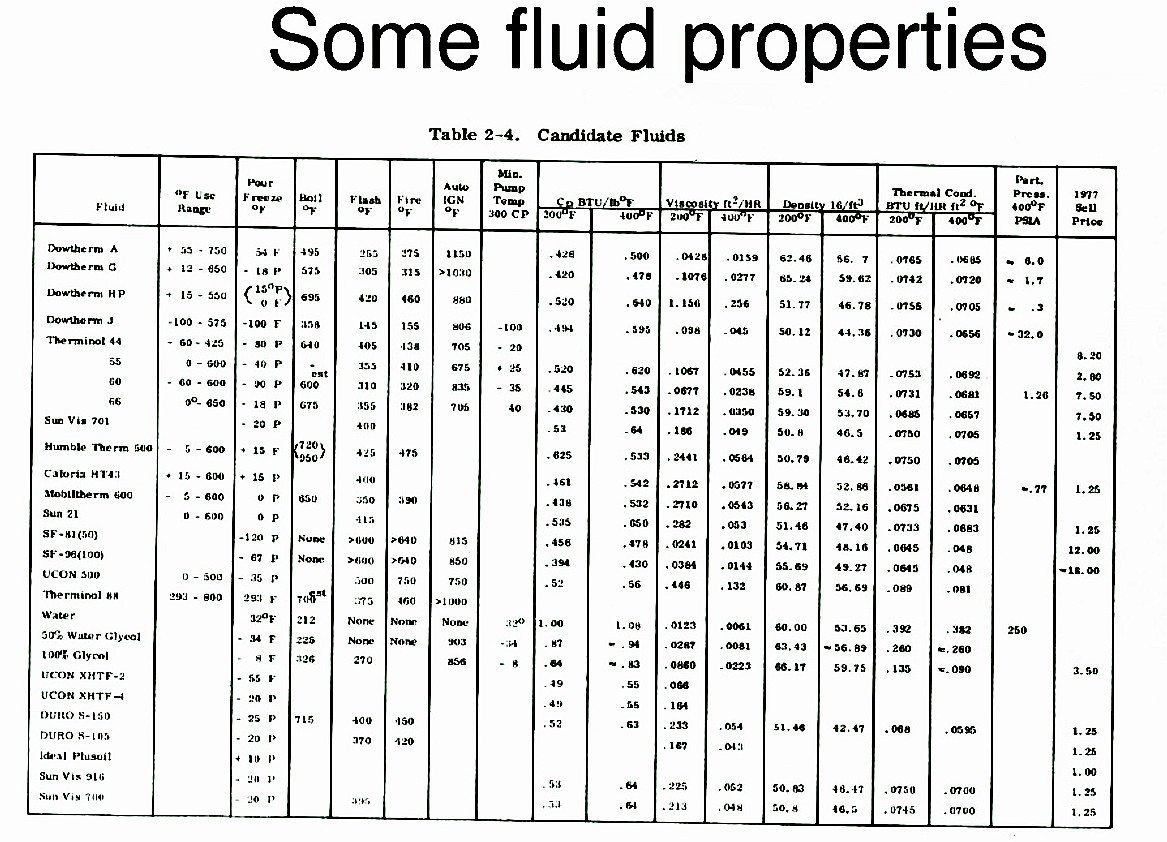
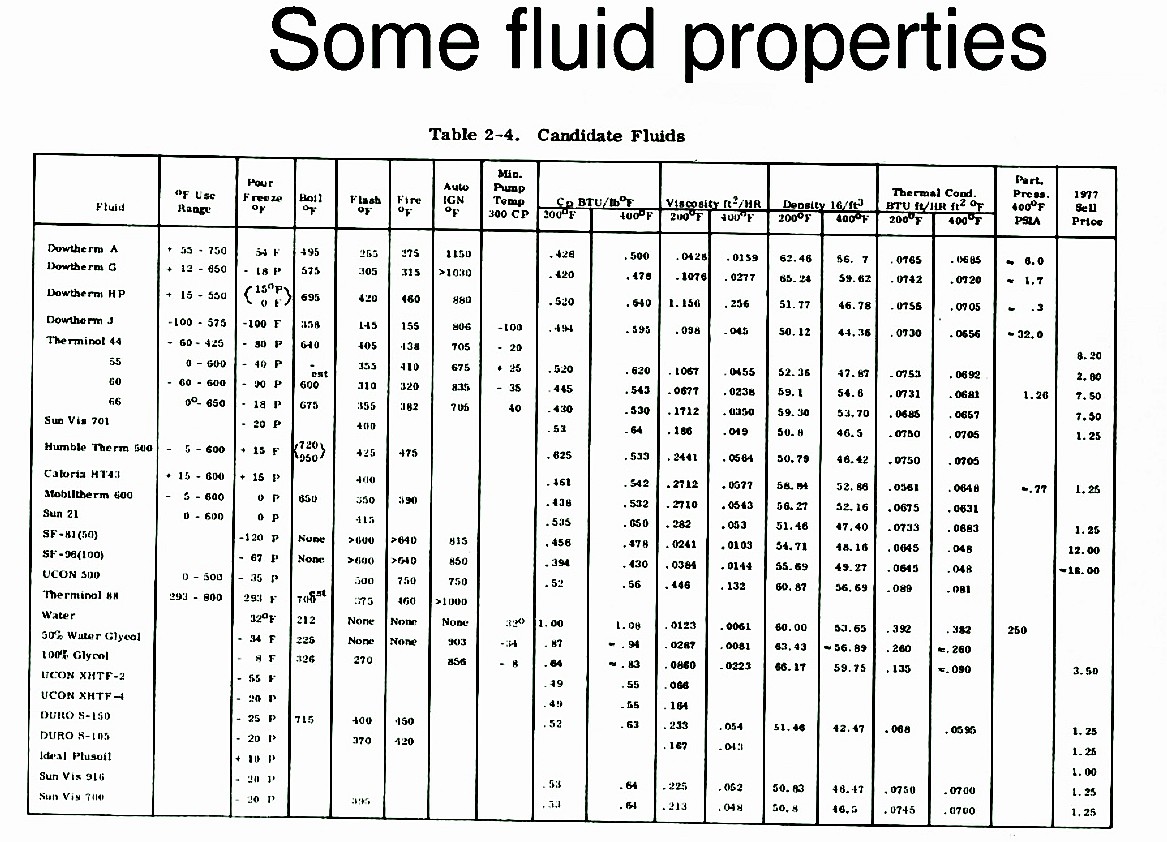
This chart is from Bill Schertz.
IMHO the thermal Conductivity Coefficient column is what is really pertinent.
As you can see water (.392) is the best. 50/50 glycol (.262) is not
as good and oil is way down the list. Pure glycol is (.135).
It appears to be inversely proportional to viscosity but
maybe not.
Bill do you have any similar units data for oils?
My guess is it is .10 based on the ratio of these units.
http://www.engineeringtoolbox.com/thermal-conductivity-d_429.html
Oil, machine... 0.15
Olive oil...... 0.17
Water.......... 0.58
Kerosene ...... 0.15
Mark, You should wait until the heat of summer hits before you change anything.
BTW guys please set your left margins to 0 in your email editor programs.
Paul Lamar ...No rotor no motor.
The Rotary Engine NewsLetter. Powered by Linux.
ACRE NL web site.
http://www.rotaryeng.net
Copyright 1998-2007 All world wide rights reserved.