> > All this is moving further and further away from Bill
> > Jepson's KIS.
> > -- Paul Lamar ...No rotor no motor.
> >
> > Paul,
> > From your comment you obviously "got" my idea. The idea here
> > is a
> > proof of concept ULTRA SIMPLE idea using NO
> Turbocharger, only
> > an axial flow turbine. Accepting that the system would only
> > be optomized
> > at one RPM and altitude and being happy if it didn't
> mess up
> > the rest.
> > Just concidering the turbine as an exhaust restriction the
> > rest of
> > the time.
> > On another front here, why would it be advantagous to
> be in
> > line with
> > your turbocharger with your power turbine? They are
> > independent shafts.
> > A very short connector from the TC's outflow on a
> > turbocharged machine
> > is desireable, but otherwise who cares? The idea here
> is almost
> > stooopidly
> > simple. The paddlewheel in the millrace type of thing.
> ANY power
> > recovered
> > is a bonus and you can get by with a much simpler muffler.
> > Since we
> > would
> > normally run the engine up to at least cruise RPM
> static before
> > takeoff you
> > would always be recovering some of the exhaust hp.
> Think of
> > it as a
> > "magic
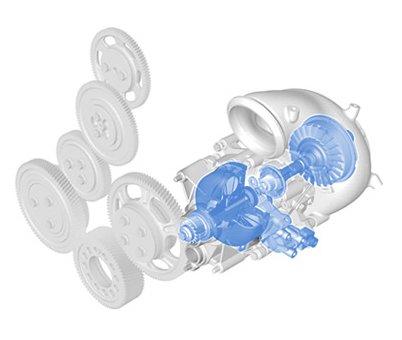
> > muffler." Paul you found a great cutaway of an axial flow
> > turbine, which
> > I lost.
> > Do you still have it? This could be done on a normally
> > aspirated engine,
> > in fact
> > it would be easier that way.
> > Bill Jepson
> >
> > Is this it?
> >
> > Paul Lamar ...No rotor no motor
> >
> > No Paul,
> > Though the drawing you have there is helpful you had an
> actual > physicalexample. A cut away in the metal so to
> speak. It may
> > have been combinned
> > with the photos of the Senica (sic) turbo compound diesel.
> > Bill
> >
> >
> > Senica does not ring a bell. I need some key words. I have
> > upwards of
> > 100,000
> > files. You mean Scania?
> >
> > Paul Lamar ...No rotor no motor.
> >
> > Yes Paul that is what I meant. That isn't the picture I was
> > hoping for
> > though.
> > I'll see if I can find it and post it to you. Thanks
> for the
> efforts.
> > Bill
> >
>
> Hi Paul and group,
>
> This link sell different parts for bottoming engines. Il
> it could help
> you guys
http://www.bowmanpower.co.uk/
>
> Marc J.
> NexusMustang
>
>
>
> Hi Paul and all
>
> I thought one of the benefits of a electrical generator
> connected to a
> turbo shaft (save the efficiency losses associated with
> conversion to
> electrical and then back to mechanical) might be doing away with the
> wastegate to govern turbine rpm and instead adjusting the load
> on the
> generator electrically thereby governing the rpm of the turbine.
>
> Just thinking
>
> Steve Izett
> Perth West Aust
> Glasair SII RG Renesis
>
> A couple of problems. We are dealing with at least 30 HP here.
> 30 HP is 23 KW. One HP is equal to 746 watts.
>
> A 23 Kw alternator is a big and heavy alternator. At 12 volts that
> is 1,916 amps!!!! That is a lot of amps. At 36 volts it is still
> 638 amps. The solid state components necessary to deal with 638 amp
> alternating current are real expensive.
>
> If we fed that into a 36 volt electric motor that would be a big
> and heavy electric motor. A starter motor is about 3 HP for a short
> period of time until it over heats.
>
> Now every time you convert mechanical HP to electric
> HP there is some loss.
>
> Lets say the eff. of the alternator is 85% and
> the eff. of the motor is 85%. The over all eff. of the system is
> 85% times 85% is 68%. We are throwing away 32% of our 30 HP or
> 9.6 HP and we are now down to 20.4 HP net.
>
> It is best to stick to mechanical HP when ever possible.
>
> Paul Lamar ...No rotor no motor.
http://www.energy.gov/news/1581.htm scroll down for turbo compounding
research
And how much for the rotary engine? :((
Marc J.
NexusMustang
Thanks Marc.
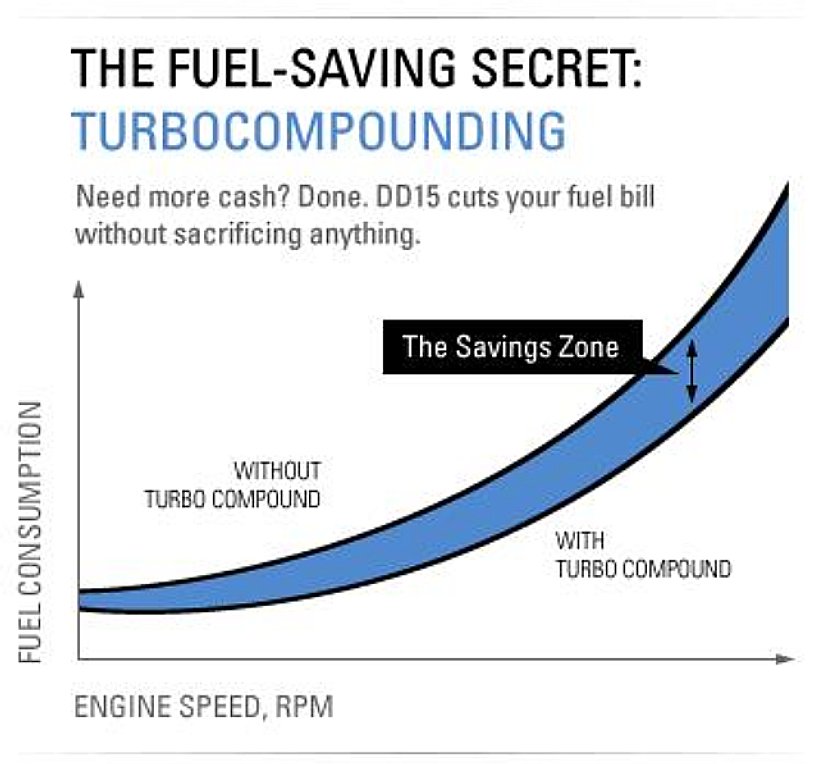
This stuff was published in February 16th 2005. Detroit Diesel
took the simplest... Curtiss Wright style.... conventional approach and actually
produced the only workable hardware in only 3 years. Everybody else in this
group failed so far to produce any usable hardware. So typical
of engine development. Start with what worked in the past and go
from there.
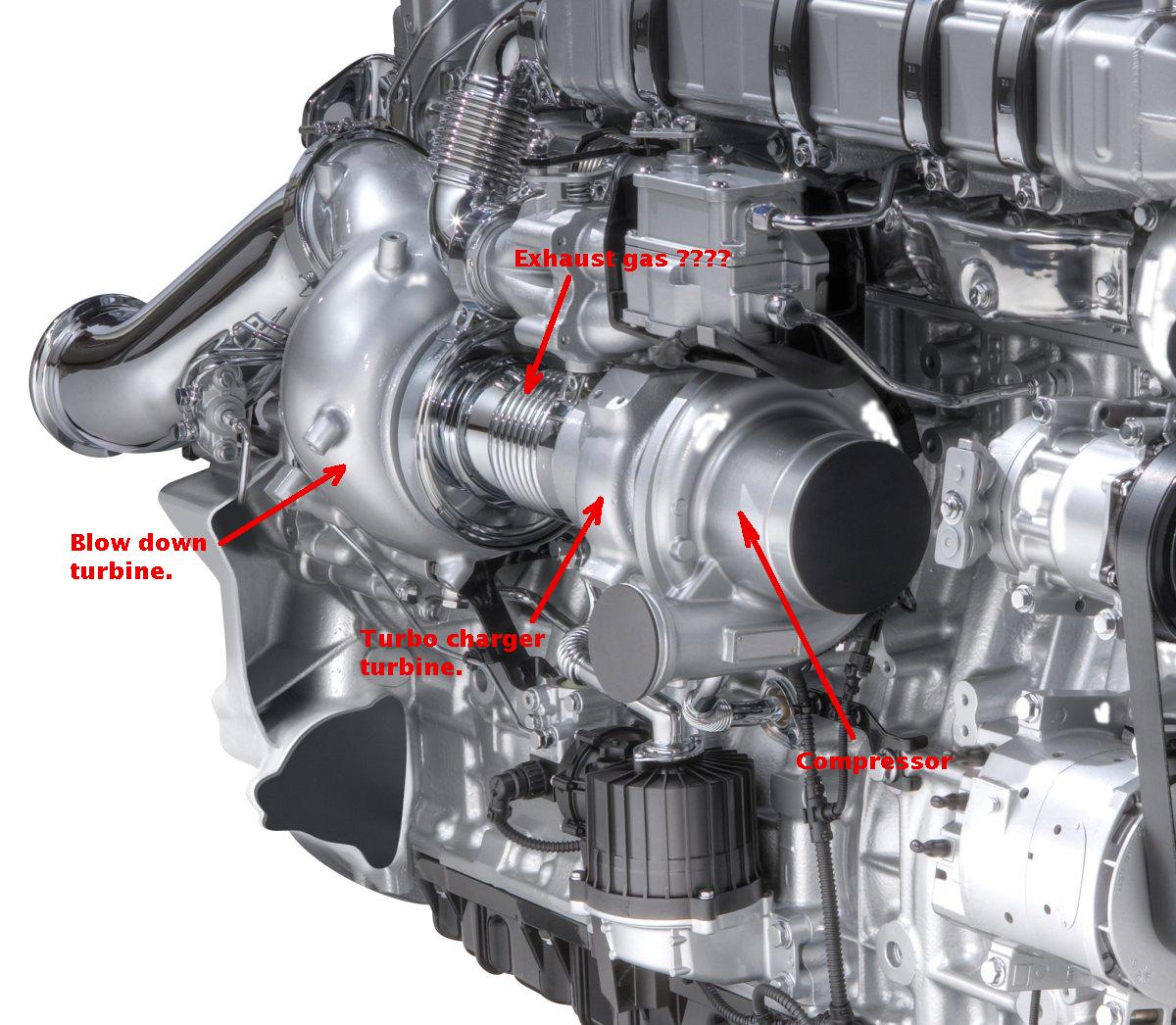
>>>>Notice: Don Sherman that Holset did the turbo charger and
probably the blow down turbine. <<<<<
http://www.holset.co.uk/files/
Also note
http://www.cummins.com/ is a part of Holset or vice versa.
One big happy family.
Paul Lamar
The Rotary Engine NewsLetter. Powered by Linux.
ACRE NL web site.
http://www.rotaryeng.net
Copyright 1998-2007 All world wide rights reserved.