> > Hi Paul and all
> >
> > I thought one of the benefits of a electrical
> > generator connected to a
> > turbo shaft (save the efficiency losses associated
> > with convertion to
> > electrical and then back to machanical) might be
> > doing away with the
> > wastegate to govern turbine rpm and instead
> > adjusting the load on the
> > genertor elecrically thereby governing the rpm of
> > the turbine.
> >
> > Just thinking
> >
> > Steve Izett
> > Perth West Aust
> > Glasair SII RG Renesis
> >
> > A couple of problems. We are dealing with at least
> > 30 HP here.
> > 30 HP is 23 KW. One HP is equal to 746 watts.
> >
> > A 23 Kw alternator is a big and heavy alternator.
> > At 12 volts that
> > is 1916 amps!!!! That is a lot of amps. At 36
> volts
> > it is still
> > 638 amps. The solid state components necessary to
> > deal with 638 amp
> > alternating current are real expensive.
> >
> > If we fed that into a 36 volt electric motor that
> > would be a big
> > and heavy electric motor. A starter motor is about
> 3
> > HP for a short
> > period of time until it over heats.
> >
> > Now every time you convert mechanical HP to
> electric
> > HP there is some loss.
> >
> > Lets say the eff. of the alternator is 85% and
> > the eff. of the motor is 85%. The over all eff. of
> > the system is
> > 85% times 85% is 68%. We are throwing away 32% of
> > our 30 HP or
> > 9.6 HP and we are now down to 20.4 HP net.
> >
> > It is best to stick to mechanical HP when ever
> > possible.
> >
> > Paul Lamar ...No rotor no motor.
Hi Paul
I wasn’t thinking in terms of KIS principles or backyard engineering.
As far as I’m aware the Prius uses a 50KW AC motor/generator running at
288V battery system.
I’m not sure what signal they drive the motors at nor their weight,
though at least this motor would get rid of the starter.
Steve Izett
Perth WA
The higher the voltage the less the current. It also saves motor and alternator
weight. Controlling and converting such high voltage to DC however adds a lot of cost
to the semiconductors required.
A 30 KW DC motor is about 40 HP. The neat thing about DC motors is they have very high
torque at low RPM so the acceleration from a dead stop is excellent. However acceleration
at 50 kilometer per hour or 30 MPH on up is strictly a function of the power to weight
ratio of the vehicle and to a lessor extent the aerodynamic drag and tire rolling drag.
This is why Prius's are not popular except in the large southerly moderate climate cities
like LA and Perth where people drive around on the freeways at steady speeds. Actually at
the head of every moving traffic jam in LA there is a 80 MPH top speed Prius. In the
northern and in hot southern cities you need a lot of extra electrical power to heat
and cool the car which subtracts from the MPG.
Toyota spent big bucks reducing the weight, tire rolling drag and aero drag on the Prius.
If the same measures were applied to all cars the MPG would also be improved.
Electricity is not free. The over all eff. of the electric car depends on where
the electricity comes from. In those countries like Europe and Japan that generate
most of the juice from a nuclear power plants there is no direct impact on the environment except
for what do you do with the waste? However in the US and China most of the juice comes from
burning coal and oil. The over all eff. of the electric car then does not look so good.
A good power plant can get 50% of the heat energy out of coal or oil using bottoming cycle
engines. A bottoming cycle engine recovers waste heat in the exhaust similar to turbo
compounding. Then you must convert the heat in the form of mechanical energy to electricity.
Lets say that is 90% eff. We are now down to 45% OA. Then you must transfer the electricity
to where it is needed which could be hundreds of miles away. Give it another 90%. We are down
to 40.5% OA. Then you must convert it from thousands of volts down to 220 AC volts. Give
that 95% so we are down to 38.5% OA. Now you must jack it back up from 220 AC to 288 volts
DC to charge the batteries. Give that 85%. Now we are down to 32.7% OA. About the same as a
diesel engine or turbo compound Wankel powered car but without the drawbacks of poor high speed
acceleration, extra weight (natural resources like copper and iron) and the heating and
cooling limitations. You can argue with the exact numbers but the conversion steps
required are facts. There is no free lunch.
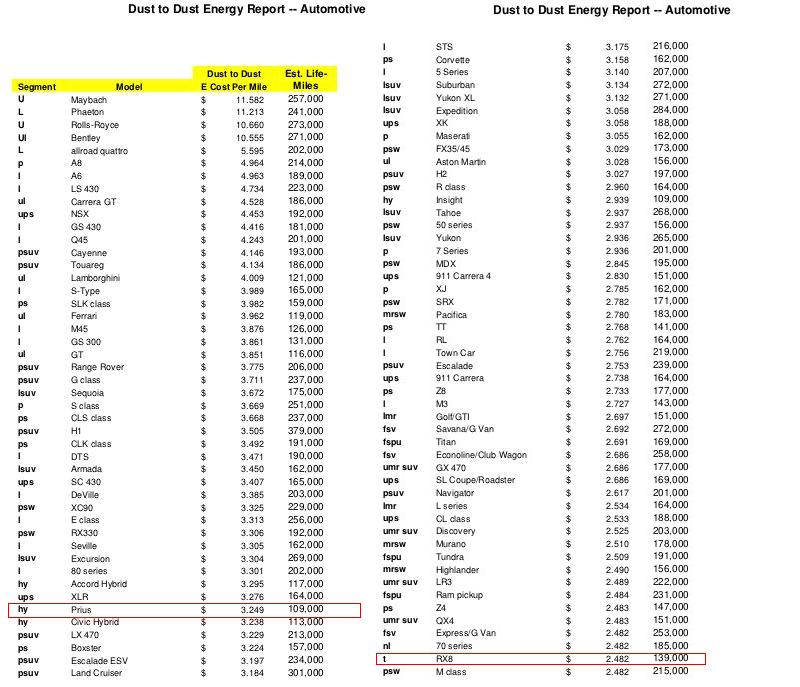
In the Dust to Dust study the Mazda RX8 rates higher than the Prius. Think how much better
it would rate with a turbo compound rotary. Here is a car that is 500 pounds lighter
than other four passenger cars with similar HP. This illustrates the big advantage of
the high power to weight ratio of the rotary engine in it's reduced use of natural
resources like iron and aluminum.
BTW My 1973 RX2 was 500 pounds lighter than the RX8 with the same weight rotary
engine but that is another story having do with crashing.
Paul Lamar ...No rotor no motor.
The Rotary Engine NewsLetter. Powered by Linux.
ACRE NL web site.
http://www.rotaryeng.net
Copyright 1998-2007 All world wide rights reserved.