Paul,
I have noticed that on the variable intake trumpets on the 4 rotor that
they were limited to the longest length runners which made the low end
suffer. I would assume they did this since they would never run that low
in the rpm range at LeMans and also their transverse space limitation
since they mounted the engine longitudinal. Do you think that if they
continued to lengthen the runners that there would be addition area
under the curve to make up and if so how low before the benefits would
become negligible or mass airflow got to low render good charge
velocity?
Rob
Hard to say without running it on a dyno. Why would you want a lower
RPM?
6000 RPM is a sweet spot in a rotary. Bearing loads are the lowest
at that RPM.
Paul Lamar ...No rotor no motor.
Paul,
Lower than that for driveability purposes on land vehicles.
Rob
That is an interesting take. Mazda just raised the rear axle ratio
on the 2009 RX8. From what to what I can't say yet.
In superficial theory the higher the axle ratio the higher
the rear wheel torque and the better the low speed acceleration.
Assuming of course you don't rev the engine to 8500 RPM and side
step the clutch. That is usually done at the drag strip.
What people are looking for on the street is good
acceleration without spinning the rear tires from a dead stop
and low RPM.
The limit to this approach is the rotational inertia
of the engine. In other words lets say you nailed it
in neutral from idle. How many seconds would it take the engine
to reach red line RPM. That is going to be a major factor on
the acceleration in first gear regardless of how high the axle
ratio is. I'll have to run that test on my RX8. This is where
you could use a lot more low speed torque.
The other scenario is: lets say we are cruising along at
4000 RPM in sixth gear doing 80 MPH and suddenly you
want to pass somebody as quickly as possible. In the RX8 engine
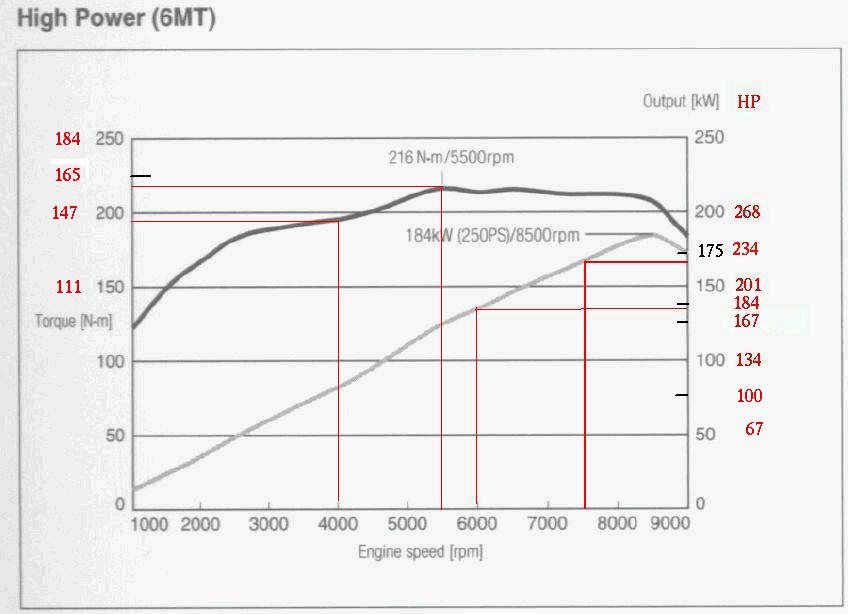
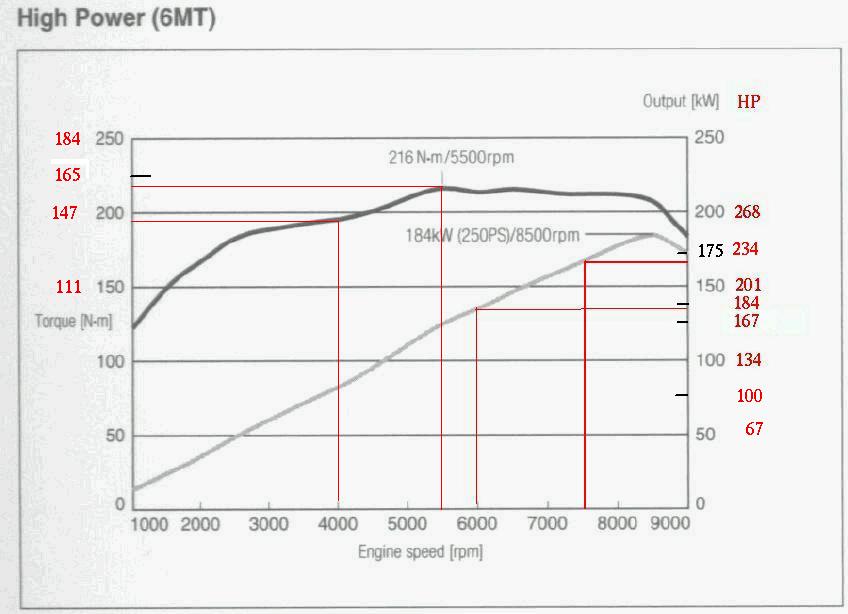
the torque is about 145 foot pounds at 4000 RPM. Even if we moved
the torque peak down to 4000 from 5500 RPM we would only gain about
10 or 15 foot pounds more torque. One will never get more torque
out of a 2.6 liter NA rotary engine unless one goes to a p-port
and then torque will be limited to about 200 foot pounds.
However a p-port engine runs like crap below about 4500 RPM.
That is why I would like to see Mazda add a Trap Door p-port
to the RX8 engine for use over 6000 RPM only. See the attached pdf.
Torque in any NA engine is more or less ultimately limited by
the displacement and the RX8 engine is only about 2.6 Liters.
The 16B if and when it comes along will be about 3.2 liters
which will help a bunch at low speed but not as much at high
speed as I don't think they will be able to keep the HP per cubic
inch at the same high level as it is in the RX8 engine.
Acceleration at medium speed on the other hand has very much
more to do with HP to weight ratio. The HP at 4000 RPM WOT is only
about 110 HP or so. Not much. Lets say we shifted down to fifth
gear and the RPM went up to 6000 and 180 HP. That would be a huge jump in
the power to weight ratio and a significant increase in acceleration.
If we shifted down two gears to fourth and 7500 RPM we would have
about 225 HP to work with.
Obviously lowering the axle ratio or the torque peak
RPM is not going to help much. What we really need is a smart Formula
One style gear box that shifts down to the best gear instantaneously
on demand perhaps automatically. You want to keep the RPM as close to
the HP peak as possible for good medium and high speed acceleration.
Mazda does not have a Formula One style gear box so they did the next
best thing and raised the numerical axle ratio.
Paul Lamar ...No rotor no motor.
The Rotary Engine NewsLetter. Powered by Linux.
ACRE NL web site.
http://www.rotaryeng.net
Copyright 1998-2007 All world wide rights reserved.