I found an old SAE paper 730119 on the OMC engine.
A very interesting paper.
I noticed that OMC had good luck with aluminum
side housings made from hypereutectic aluminum.
The same process used by GM on the Vega engine.
Does anybody have any direct experience with
OMC snow mobile rotary engine side housing wear problems?
I wonder how Silicon Nitride ceramic
side seals would work on hypereutectic aluminum.
Perhaps OMC was better able to control the casting
process than GM.
Paul Lamar ...No rotor no motor.
Paul,
I mentioned this before, and perhaps you heard differently through
your
Chapparal contacts, but I was told the engine blocks on the Vega
engine
worked fine by people in the know. Many other problems including
valve
guides which caused most of the smokers rather than the block.The
Porsche 928 V8 and many of the current MB V8's use the same
technology.
I thought this might be a good possibility, but I doubt that Mazda
would
have missed it if that had been the case.
Bill Jepson
BMW had problems with the sulfur content in US gasoline eating
up the
bore in their aluminum blocks on the 3L V8 (530i cars) - 10 years ago.
I haven't heard of more recent issues.
Other question.. It's my impression that the apex seals take more
abuse than the side seals, and similarly the rotor housing wear
surface needs to be tougher than the side housing wear surface. Is
this correct? Does that allow using a coating that's less tough on
the side housing? It's apples to oranges, right?
Regards,
Matt-
I would say yes Matt. Just an impression I get. However the side
housings
wear more than the rotor housings. Once the ridges are over a couple
of
thou the housings need lapping or replacing. I suspect the cast iron
side
housings could benefit from the same chrome treatment given to the
rotor housings.
The wear on the rotor housings are well within acceptable limits
as long
as the apex seals remain intact. With the Mazda system of chrome over
steel.... cast iron apex seal wear is projected to be about 3,000
hours.
With Silicon Nitride ceramic apex seals wear is projected to be
30,000 hours.
Of course no one has worn out a ceramic apex seal yet.
-- >> Paul Lamar ...No rotor no motor.
Paul,
Ethanol fuels will dissolve unprotected aluminum.
Doug
Looks like it is out for Porsche's, BMW's and Mercedes.
Not to mention all the other companies that are planning to
switch to un lined aluminum cylinder bores.
Paul Lamar ...No rotor no motor.
Paul
Anodized aluminum works.
Doug
I don't think so. That is a very thin coating.
I also don't think anodizing works on silcon. I could be wrong.
Paul Lamar ...No rotor no motor.
Paul, You are correct. The anodize would be very blotchy. I am at a loss
though
as to how the aluminum in the block would be effected (by ethanol) when
the bores are
prepared for final hone by hydrocloric acid.
Bill
Paul, regarding your question about experience with aluminum side housings,
in our Powersport prototype engines, we made our own aluminum housings for
over 10 years. Various configurations were used as the design was developed
over years. Various wear surfaces were also tested over those years.
We made our patterns and core boxes. I made most of the sand cores by hand.
We started experimenting with aluminum housings casting included Reynolds
390 (hyperutectic aluminum-silicon alloy) in the 1980's. The tricky part of
these was the proper surface finishing/lapping. We ground the surface then
flat lapped with silicon carbide compound. My notes show that OMC used a
LapMaster machine and silicon carbide slurry with a final lap with aluminum
oxide. We consulted with Reynolds on the casting and surface preparation
process and they were very helpful. The folks with whom we talked at
General Motors at the time told us the factory processes worked very well
but when engines requires disassembly/machining/assembly in the field, the
precision surface required created too many field service problems. I
think they went to the Iron Duke at that point and shelved the Vega aluminum
engine due to these field service consistancy issues. For the rotary
housings we did, the 390 lapping process would work fine on one housing but
not as well on another. Our results were just too inconsistant. Based on
our experience it is clear this process can be made to work but it requires
a very precise approach using the best equipment and technique.
Rather than mess spending a lot of time and also money on equipment to get
it right on a consistant basis, we went to arc then plasma sprayed housings
which we could simply grind and flat lap. Vendors we used for these
included Flame Spray Northwest in Seattle and Miller Thermal in Appleton,
WI. These castings included 356 and other for the metal sprayed wear
surfaces. We experimented with various wear surfaces materials (usually on
the same engine). A thin metal sprayed surface appears to be what Jim
Mederer at Racing Beat is using on his new housings. I looked at a set of
these this week. We were using a thicker application ( machined a .024
recess in the housing, then grinding and lapping to final finish).
The last of our aluminum housings were for our "short shaft" engine for the
RV-3. This was first assembled in 1991. I found a photo of this engine on
our dyno with the test club installed and will try to get it scanned and
sent to you with other photos of the dyno. These last iteration aluminum
housings were anodized .002 with nickel-carbine by Tiodine in Huntington
Beach, California. They had a propriety process called Hard-Tuff where they
used a teflon overlay to fill in the anodizing porosity in the anodizing.
For race engines coming through the shop we had been using pistons they were
doing with this process for JE and Venolia (JE called it KoolKote). That
same year we also used Progress For Industry in Saegertown, PA to do
electroless nickel with silicon (i.e. Nikasil) that worked very well. Their
propriety process was called Prowear Plating. And Mahle/major manufacturers
have used Nikasil for years in cylinder liners and pistons.
The upshot of all this is these aluminum housing wear surfaces can work very
well. But they do add to the cost of the engine. We put these efforts on
hold to develop the lower cost Mazda conversion engine with the internal
spur gear reduction drive using as a reference the Allison of WWII. Just as
the Reynolds 390 parent material was its own wear surface, so is the iron
Mazda housing. But with those Mazda iron housings we simply used our same
lapping machine we had used for the "Vega" type housings. But so much
easier with the iron vs. 390 housings. We could do the Mazda housings
easily. And if necessary these were nitrided again if more than .002. Here
in Portland, Met-Tek did most of our nitiriding on gears, housings, etc.
The other day Phillip Groelz called them and I think Phillip told me later
they said the cost to nitride a full set of housings would be only $150.
Eric Wagoner here on the airstrip has a precision grinding shop and as an
experiment the other day took one of our old junk front housings and
precision ground it. It was .002 out of parallel when he started and had a
nice precision surface when he finished. As a test we are going to have
Eric grind some old housings and then have Met-Tek nitride them. Will then
run them on the dyno to see how they work without lapping.
A final note on the aluminum housings. Based on our experience, these
suffer from the same design challenge as did all the aluminum block V-8 race
engines that came through the shop. At sustained high power settings both
the the aluminum block V-8's and rotary end housings experienced creep
distortion. The engines with the closest duty cycle to our aircraft engines
were the off-shore race boats and as you can imagine, these were the worst
due to sustained how power setting. At the end of the straight stretch, the
automotive engines get a rest.. But even then, the oval-track engines would
have the main line move around. As you know this is generally not a problem
with the automotive iron block/ the stock Mazda iron housings. But hopefull
with further development these issues can be addressed in the aluminum side
housings. On his new aluminum housings, Jim Mederer significantly increased
the number of gear retention bolts in his end housings. Probably also
beefed up the center section of the casting also. Sure hope they can be
made to work at sustained high power settings. The weight savings is
significant.
Steve Beckham
There is a fairly large market in LSA for all aluminum one rotor Mazda
engines.
Paul Lamar
Thanks to Steve for writing up all of this interesting background information.
When talking about creep, has there been much study of what the source
is (other than sustained temperature)? We've talked about bolt
tension and lack of stretchiness (too high modulus)... Has anyone
actually tried the Ti bolts we were talking about before.
When talking about sustained high power levels, how hi is it? Would
there be significant/detrimental creep at 250hp on a two rotor?
Does the problem depend on cooling?
Regards,
Matt-
I think Steve means deflection rather than creep. The modulus of elasticity of
aluminum is one third that of steel and 2/3rds that of cast iron. Creep
happens
when there is a significant static load on a part over time and it becomes
permanently deflected. Some times at room temperature.
Aluminum does not suffer from creep. Aluminum yields and takes a permanent
set if over heated and loaded. Many plastics do however suffer from creep.
Aluminum engine blocks do move around under combustion loads. Especially if
the
wall thickness is the same as the cast iron part it replaced. It must be
thickened up to compensate for the lower modulus of elasticity.
BTW the old Rolls Royce V8 aluminum block was considerably thicker than the
cast iron block it replaced. This was done for noise reasons as the walls
of the cast iron block were vibrating and radiating noise.
Panel stiffness was the main design criteria. The stiffness of a panel
is proportional to the cube or fourth power of the thickness while
the weight is only directly proportional. An aluminum panel two or three
times as thick as a cast iron panel is much much stiffer. The weight
may be the same or lower as aluminum is one third the weight of cast iron or
steel.
I think Steve is probably referring to aluminum Chevy blocks. More modern
aluminum
engines have girdles to stiffen the main bearing area of the block. In line
engines
and V engines are always trying to shove the crankshaft out the bottom of the
block. Consequently they are inherently heaver than horizontal opposed
engines where loads from opposite cylinders balance out more or less.
Honda engines are famous for main bearing girdles :) In some cases they
are cast iron or even steel. The aluminum Jag V8 has a cast aluminum oil pan
with steel inserts that doubles as a girdle.
I drove both a Corvette with an aluminum block and a Jag XKS with an
aluminum block. There was a world of difference at 6500 RPM. The Chevy
felt like a hand grenade while the Jag engine was still smooth.
This was part of a sports car test we did for Pop Science about six or so
years ago.
Paul Lamar
Paul,
So in light of this information, are R.B. alum. side, middle and end
housings thicker than their iron counter parts?
My friend is just at this moment having his all R.B. all alumunium (except
the large intermediate house) 20B assembled. It should be running this
Spring.
About Matts request about titanium bolts. Here is what I found in my files.
Doug in Japan.
Hello Paul
just wondering if you received the pics of my engine with the titaniun studs
in it ? I would appreciate any ideas you might have. I talked with a few
people at Timet here in Nevada.one of the gentleman I talked with was head
of plant operations some white coat with an accent nice man. I told him what
I wanted to do with the studs and asked about thermal properties and he
assured me that I had the right material for the job (6al-4v).I was worried
about expansion rates and harmonics. Though I'm not sure of the harmonics
issue. He was adament that even though titanium is a very hard metal it does
stretch and that the iron aluminum sandwitch that we have in the rotary
engines will expand faster than the titanium, the pressure would'n't be so
great as to warp the block unless they where over torqued. Let me know what
you think.
Tony
Yes I did. Did you did not see them?
I am still thinking about it.
Old message
----------------------------------------------------------------------------
----
Subject: Titanium studs
Date: Fri, 01 Apr 2005 16:09:43 -0800
From: ACRE
<rotaryeng@earthlink.net>
Hi Paul
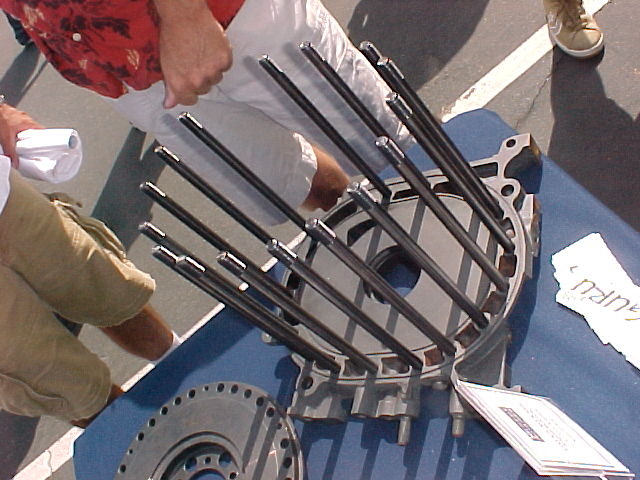
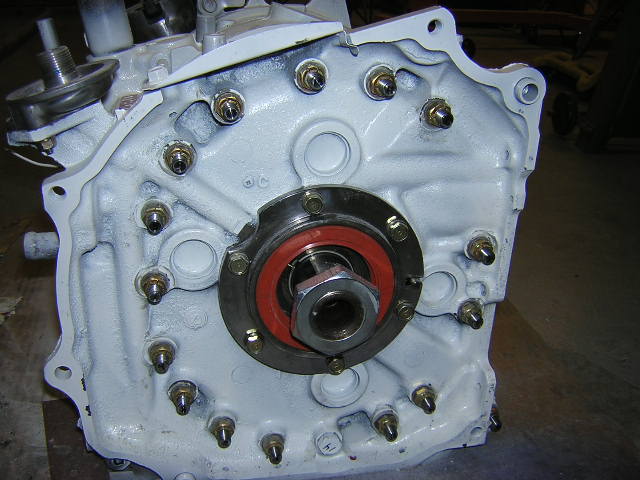
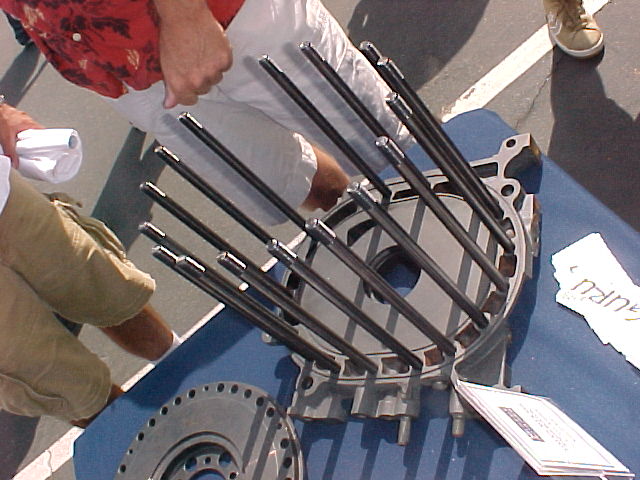
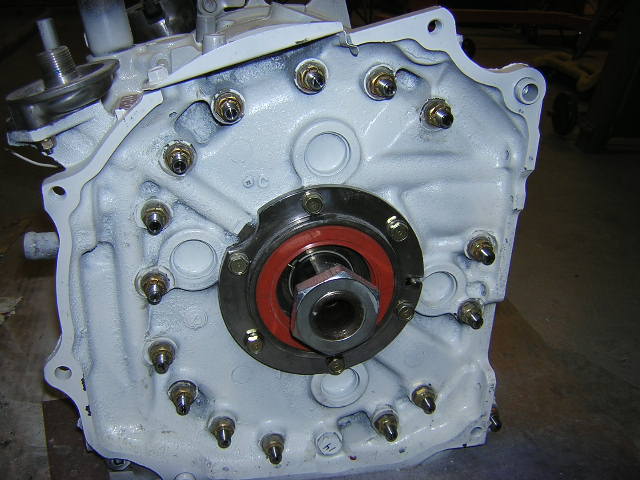
Just wanted to share a picture of my engine with the titanium studs in it. The
nut that you see on the back is a 3/8-24 aircraft nut and the threads are
rolled. The material is 6al-4v grade-5. I'll let you know how they are
working out when we start running the thing. I e-mailed you the other day to
see if you had anymore manifolds I sure could use one of those. let me know
when you get the chance.
thanks, Tony
Wow! That is interesting Tony. I will have to think about that.
Saves a bit of weight for sure. It would be really trick if
you went up on the size like the Aussies do. I'll have to check
the modulas of elasticity and the coef. of thermal expansion.
Might be the cat's meow.
Paul Lamar
The Rotary Engine NewsLetter. Powered by Linux.
ACRE NL web site.
http://www.rotaryeng.net
Copyright 1998-2007 All world wide rights reserved.