The charge cooling on the rotor was not very effective with the
rotor running almost 1000 F at 5500 RPM WOT. This had a strong
affect on the VE which was 60 to 70% partially due to an increase
in charge temperature of 100 F. A water cooled version would be
some what better in this regard. The OMC rotary was air cooled.
OMC felt the VE could have risen to 85 to 90% if it were not
for the 100 F higher heated charge. That is a hypothetical situation
as then the rotor would not be cooled.
The best BSFC was about .68 from 3200 to 4000 RPM.
EGT's were 1800 F in the exhaust port.
They did use a throttle plate close to the rotor housing intake
port similar to our slide throttle device to effect better running
at idle.
They used a very beefy and thick outer steel race for the
rotor roller bearings to help the well known problems with
those types of rotor bearings. Midwest engines also discovered
these problems. Here is a shot of the Midwest/Diamond
rotor and one of the Wankel Gmbh rotors. Both charged cooled
rotors.
All,
Pardon my naivety in terms rotary, or engines in general.
I assume that by charge cooling you refer to the intake charge( air or
air/fuel combination) cooling the mechanism thence entering the
combustion chamber to be burned. If I am wrong, discontinue reading
this post.
I am not familiar with the OMC but am very familiar with the Midwest. (I
have one which powered my dragonfly for a couple of years.)
In the Midwest/Diamond, the fuel-air charge does not, at any time see
anything other than the combustion chamber. The carburetors or the
injectors are right next to the intake ports on the engine. The intake
air goes from the filter into a plenum (on top of the engine) then
through two tubes to either the carbs or injector bodys. The trochoid
lubricating oil is injected directly into the ports (intake)
The rotor cooling and internal lubrication is something totally
different. The bearings are fed (gravity/metering pump-same as the
trochoid lubrication) with premix oil. They weep into the internals
(internal rotor, cooling veins, gear, main bearings, etc. On the back of
the engine is a belt driven turbine (looks like a turbocharger but is
not) the output of which picks up the wept oil and blows it through the
mechanism cooling and lubricating the internals. The air/oil mixture
exits overboard into an air/oil separator and then overboard. The oil
that is caught by the separator is then scavenged and pumped back into
the oil reservoir.
As I said before, at no time does the air/fuel charge, or the air used
in the combustion process go anywhere other then into the trochoids. It
is not used, in any way for cooling.
Rich
You are absolutely correct Rich. My mistake. The Midwest rotor is
air cooled by a blower. That turbine you refer to above. The Midwest BSFC
is much better than the OMC engine.
Only the Wankel Gmbh rotor is charge cooled.
Paul Lamar ...No rotor no motor.
Paul and others,
we sometimes have problems with overheating the Sachs charge cooled
rotor engines at steady state operating. It is absolutely no problem on
europaen country roads or in motorcycle (or Kart) racing. But on Highway
Cruising with WOT the rotor gets temperatures up to 250..300 °C (?
F) after a quarter of an hour. It seems, that it takes so long to heat
up the iron rotor with its 2 kg weight. In this state the oil in the
rotor burns away. If you open the engine after that the bearing will
be completly dry. Anyway, with a little bit of luck it will run for
hours and hours and hours - dry or nearly dry! But this kills the steel
liner in the rotor, not the bearing.
The Norton 2-rotor bikes have more or less the same problem, but mostly
the Highways are not long enough (without traffic) for WOT cruising
with a 80HP bike. So no problem for them. The Mid West/Diamonds are much
better with their fan, but it needs a lot of space and weight.
Cruising with the Hercules/DKW/Sachs 1-rotor bike at 5000 with 120 kph
(may be 23 HP) the BSFC is 250 g/HPh (0,6 lb/HPh ?). But the motor cycle
carbs are always full rich. With leaning it to lambda 1.1 I could
decrease it to 220 g/HPh (0,52 lb/HPh ?).
Would be interesting to see such an Aixro at such a (flight) operation.
Reiner
Here are the rotor temperatures on the OMC engine and the Mazda Reiner.
It does not seem all that expensive to but in an oil pressure
system that could and would cool the rotors. The Mazda rotors are much
cooler.
--
Paul Lamar ...No rotor no motor.
Paul,
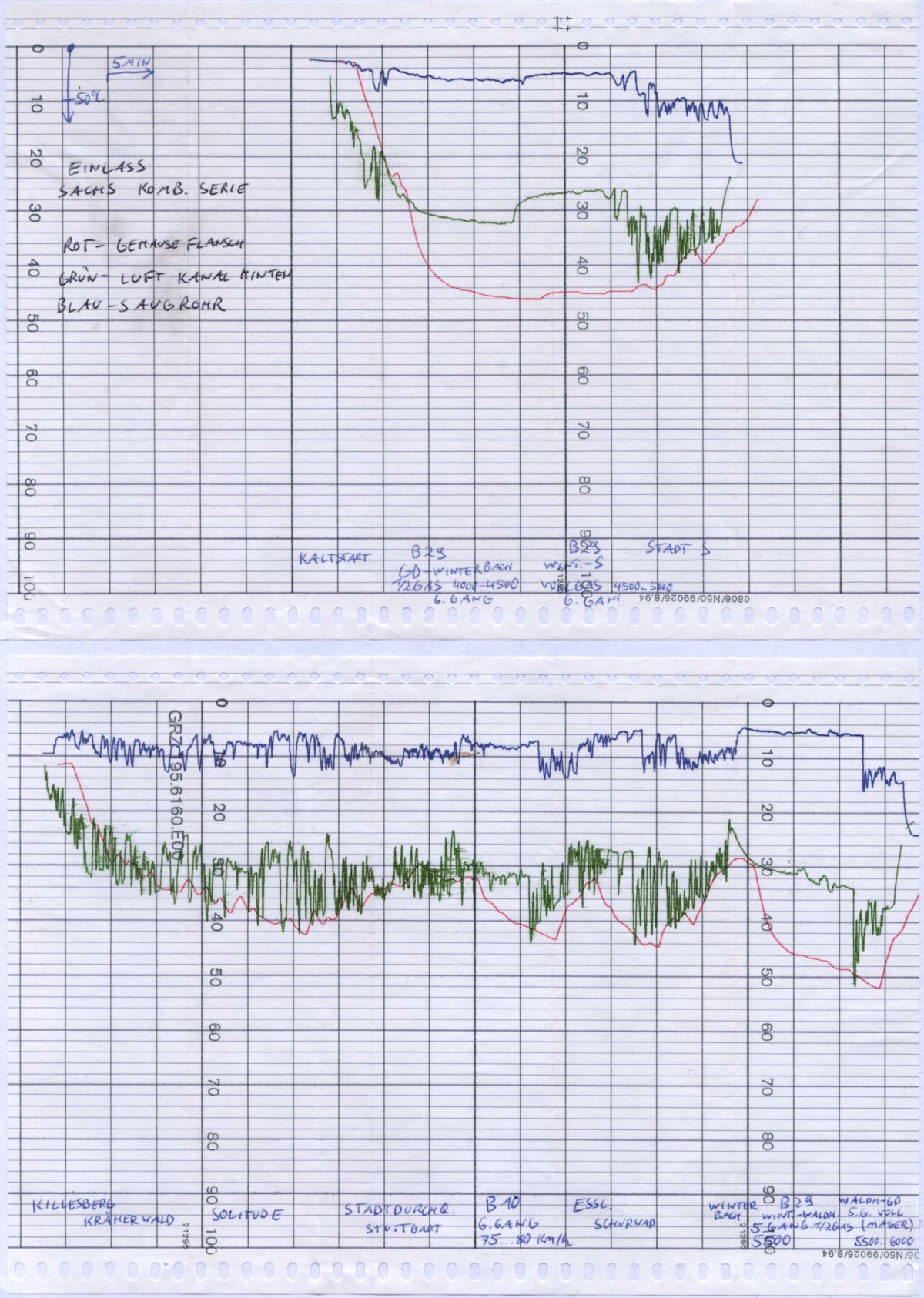
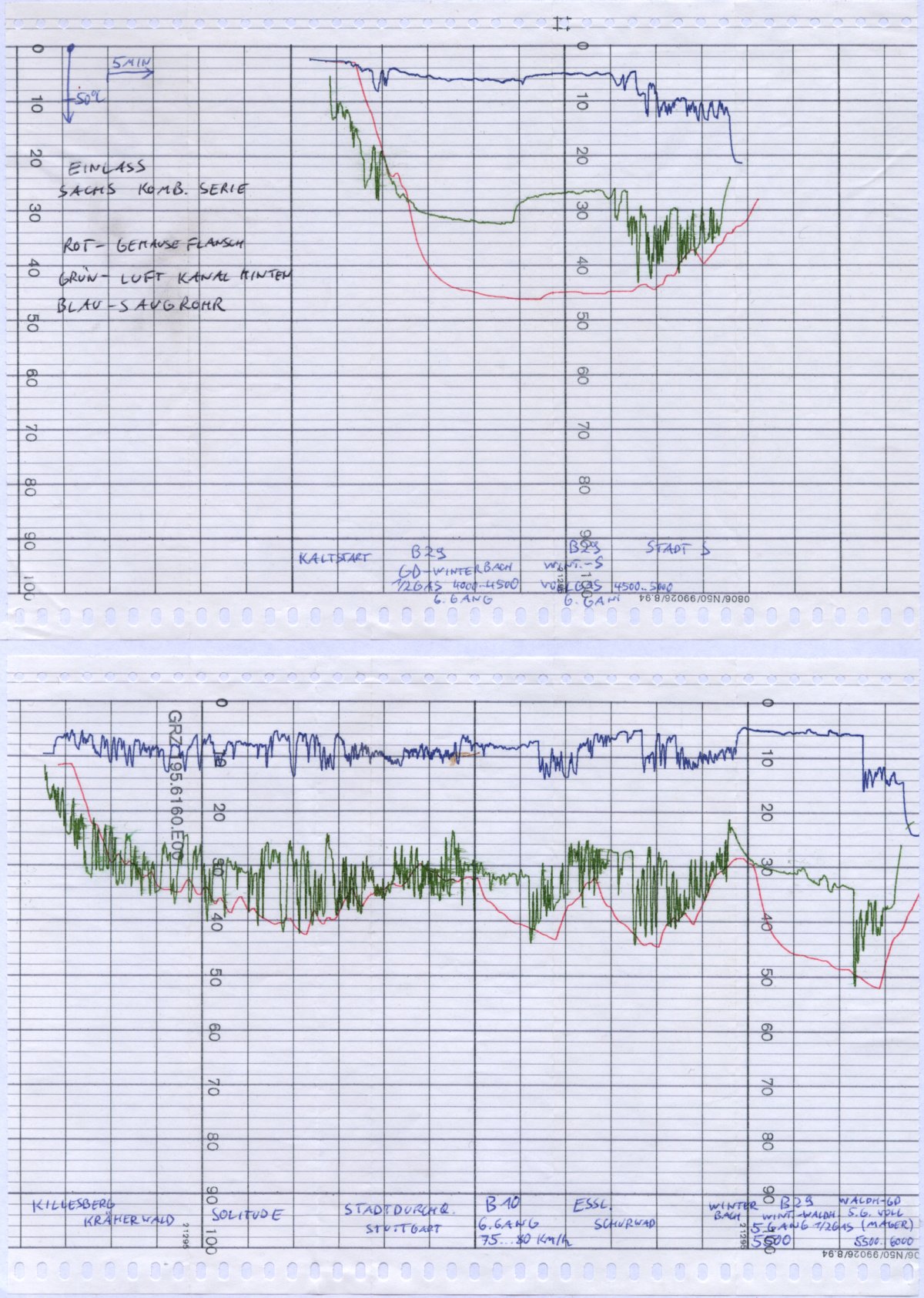
here is a measurement of us. The 0 on the paper scale is 0 °C, every 10
of the paper scale is 50°C. So 50 on the paper is 250 C (which is 482 F
?). The red line is the rear housing near the bearing, the blue one is
the mixture after the carb and the green one is the charge after passing
the rotor before entering the chamber.
Mysterious: At cruising with half throttle in 6th gear (which is almost
80..90% of the power) the temperature is higher than with full throttle
("Vollgas") - shown on the upper part.
Extreme: At the end of the lower part of the sheet is max power 30HP at
6000 in 5th gear ("5 G voll"). The housing is at 260 C (500 F ?) and
still rising.
The "Solitude" is a former racetrack. Temperatures there are much lower
than on highway.
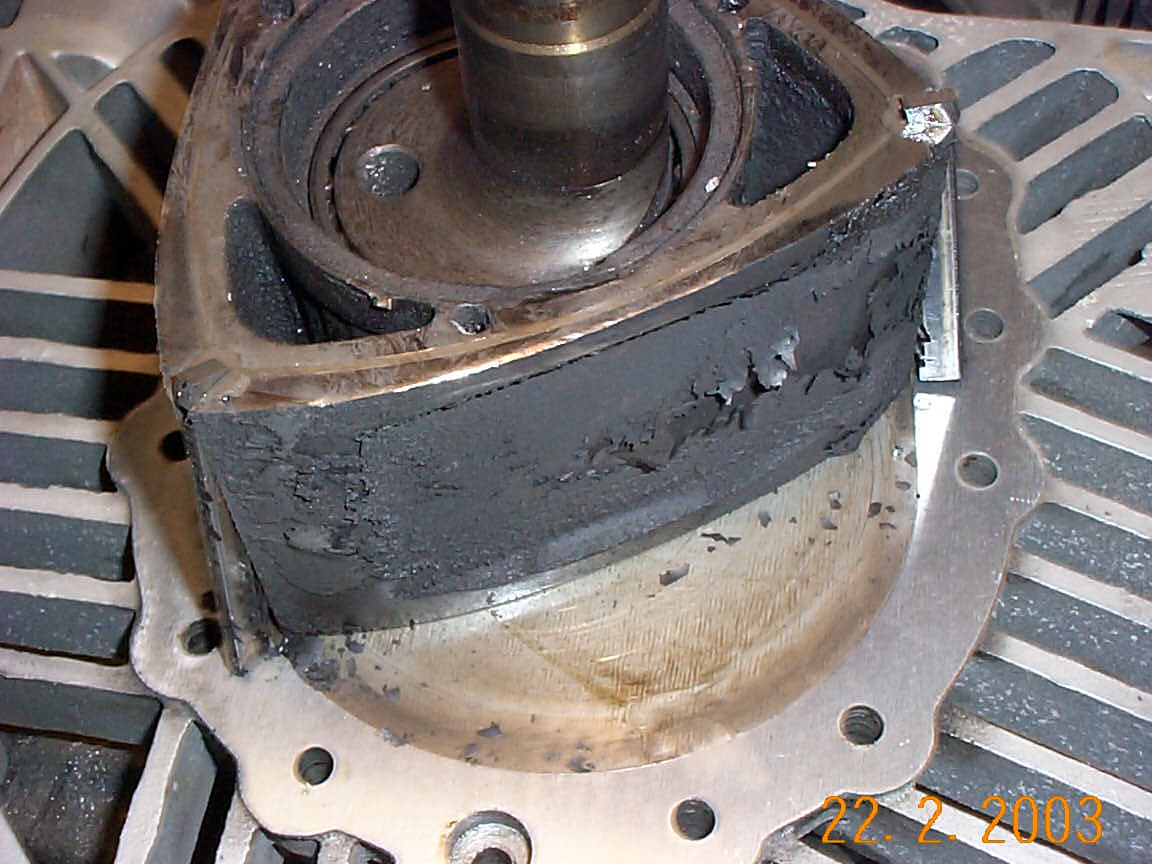
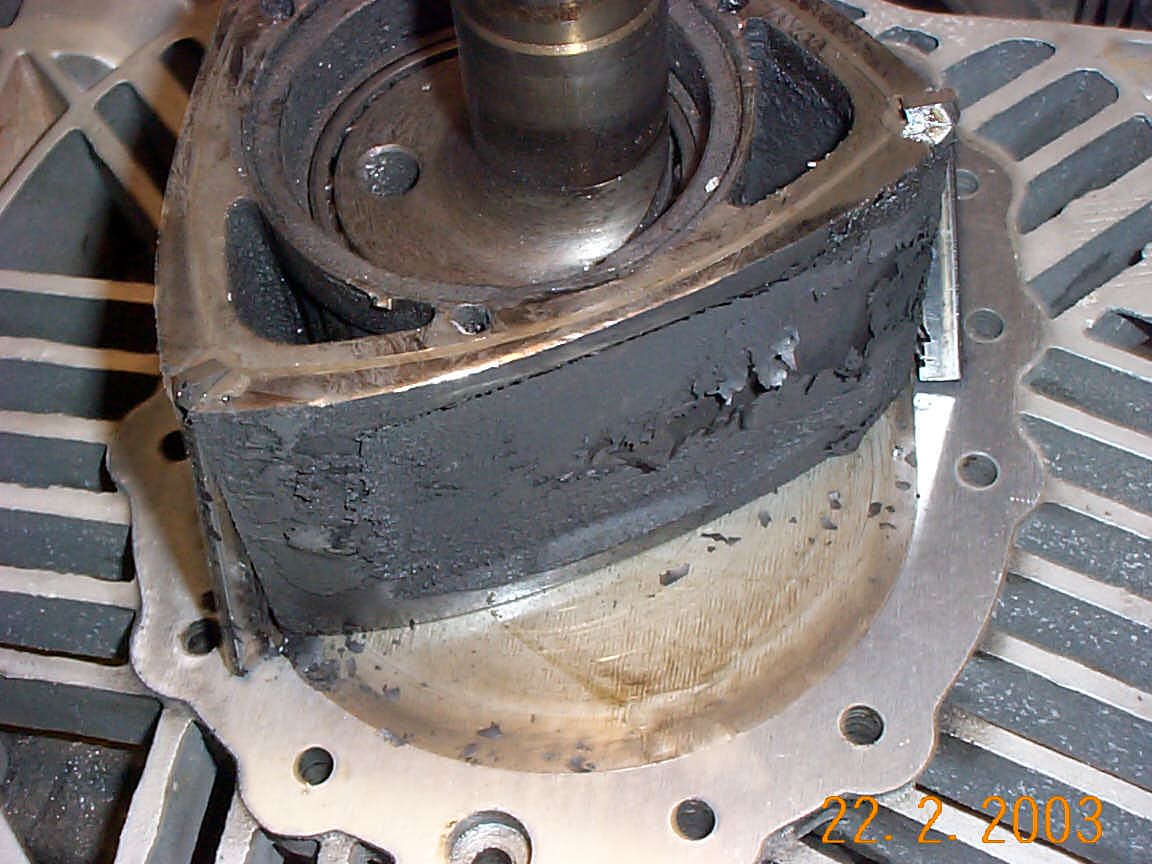
On the photo is such a "dry" rotor. But this one died on a "flown away
circlip", not because of overheating. So such a thing still runs more or
less properly!
I only know the NSU engines with their rotor cooling system. Compared to
this the charge cooling is much much simplier and lighter.
Reiner
The Rotary Engine NewsLetter. Powered by Linux.
ACRE NL web site.
http://www.rotaryeng.net
Copyright 1998-2007 All world wide rights reserved.