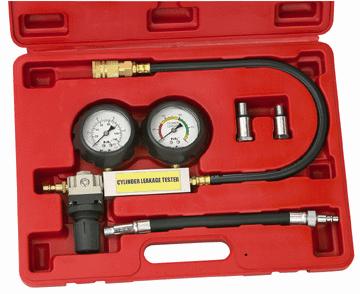
> How many people on here have differential compression testers?
> I am trying to get some baseline numbers on rotary engines.
> http://www.skygeek.com/ats-2em.html
>
> They cost about $84 from this source.
>
> This is a rock solid way of finding out if your new after
> market apex seals are junk. If they leak more than stock Mazda
> seals you can be sure the people that made them do not know
> what they are doing.
>
> It is of course also a good way to gage the condition of your
> engine.
>
> When I get a chance I will do the engine in my RX8.
>
> Paul Lamar ...No rotor no motor.
>
>
> I have one of these testers.
>
> Almost all A&P/IA's (which I am not) will have one too.
>
> I think that's about the going price.
>
>
http://www.chiefaircraft.com/airsec/Aircraft/Tools/CompressionTester.html
>
>
> Matt-
>
> Thanks Matt. Anybody authorized to do an annual on a certified
aircraft engine
> must have one... I think. I bought mine about 15 years ago to
check the
> O-470.
>
> --
> Paul Lamar ...No rotor no motor.
Paul,
Yes you are right but aren't they calibrated for the specific type of
engine?
Doug
Everything is relative. They work on O-200 to R-980 so the cylinders
will be widely different. The engine manufactures give you a
standard for their
engine. That is why we need base line numbers for the rotary.
both new and old.
Matt can probably confirm that anything less than 73 psi
for the O-470 is a bad cylinder with a 80 psi supply pressure as I
recall.
My shop manual for the O-470 is out in the hangar.
I'll have more info on this in the future.
http://www.sacskyranch.com/faqcontinental.htm
90% is acceptable and within wear limits. 80% is borderline, and 75%
is ready for over haul with 80 psi in.
--
Paul Lamar ...No rotor no motor.
TCM (and Lycoming) have revised the compression inspection procedure and
mostly gotten away from specifying any minimum compression value. The
big failing criteria is leakage around a valve. None is allowed -
listen through the exhaust stack (common point for leakage) or carb
(less likely). Leakage around past the rings is allowed as long as the
compression for the cylinder isn't significantly less than the others,
and as long as the oil consumption isn't "excessive". If I recall
correctly the oil consumption that they allow is something like 3 hours
per quart, which I consider excessive, even if they don't. Ring leakage
isn't likely to cause low compression unless you break a ring, which
often causes grooving of the bore.
TCM (probably Lyc too) has a service bulletin (SB) which explicitly
describes the procedures and specs. It supersedes the original overhaul
manuals in most cases. I've got a copy of it floating around somewhere
- it can be downloaded from tcmlink.com <http://tcmlink.com>
Regards,
Matt-
<<<<<<Yes you are right but aren't they calibrated for the specific
type of
engine?
Doug
Everything is relative...... >>>>
No,
only testers for Continental engines are different, and that is a recent
change. They use a different size orifice.
The actual numbers for a passing grade are somewhat up to question. It
would be good if several people did tests on new or recently overhauled
rotaries to get a base line. Once this is established the lower end of
the spectrum must be determined to show the tthreshold of good vs not
good.
So much pressure
Rich
Here are the numbers for the OMC engine.
Paul Lamar
Paul,
The Harbor Freight Leak Tester, #94190, is a well made unit that I
bought for around $17, I think. (Sign up for their e-mail notices and
you will receive coupons two or three times per month for discounts of
50% to 75% on certain items.) But, it is not intended to be like the
aircraft units. The "zero% leakage" set point on gauge #2 (full
pressure) is at about 15psi. Gauge #2 is marked in %leakage without the
usual pressure units. It would be easy to convert it to an "aircraft"
standard unit by changing gauge #2 and the orifice. The orifice size is
not specified anywhere in the documentation that comes with the tester.
Aubrey Thompson
Looks like a real deal. I have had pretty good luck with most
of the stuff I buy from them. Their warehouse is in my neck of the woods.
Paul Lamar
The Rotary Engine NewsLetter. Powered by Linux.
ACRE NL web site.
http://www.rotaryeng.net
Copyright 1998-2007 All world wide rights reserved.