> > > Hi Paul and group,
> > >
> > > A question regarding kinetic energy. How do one measure the
> > > level of
> > > kinetic energy at the exhaust. An instrument placed at the the
> > > two or
> > > three exhaust exit. Is it just that simple?
> > >
> > > Marc J.
> > >
> > > Kinetic energy is just the blast of exhaust gas coming out of
> > > the engine.
> > >
> > > You can get one of these wind speed meters and hold it
> near the
> > > end of the exhaust pipe. Put the car on a chassis dyno and run
> > > it up
> > > to full power. Note the airspeed of the exhaust. That
> would be
> > > the airspeed
> > > coming out of an annular shaped orifice in front of a turbine
> > > with the
> > > same cross sectional area as the exhaust pipe tip.
> > >
> > > If you consider the turbine blade a wing
> > > with a lift coef. of one.. the force on the blade would be
> .0026 times
> > > the relative air speed squared in MPH times the area of the
> > > blade in square feet.
> > >
> > > The torque is the number of blades times the force on each blade
> > > times the radius of the blade. Good turbine blades can
> have lift
> > > coef. up to two. Max turbine power is generated when
> > > the tangential velocity of the blade is about half the max
> exhaust> > gas airspeed.
> > >
> > > The gas speed out of the exhaust pipe tip will be reduced by
> > > the heat loss in the muffler and the rest of the exhaust system.
> > > --
> >
> > > Paul Lamar ...No rotor no motor.
> >
> >
> > Has anyone have a measured total value of the amount of
> kinetic energy
> > from the exhaust port of a Renesis engine for example?
> >
> > Marc J.
> >
> >
> > Not yet to my knowledge. I just recently had the idea in the last
> > couple of hours of using the wind speed meter on the exhaust pipe
> > of a car on a chassis dyno. As far as I know that is an
> original idea.
> >
> > You can get a good idea however from the measured heat
> balance. Usually
> > about one third of the waste heat/HP is kinetic. The RX8
> engine is not
> > significantly different than the old 13B.
> >
> > BTW we have a new youtube video on the Detroit Diesel turbo
> > compound engine.
> >
> >
http://www.youtube.com/watch?v=luoUHrX6DeQ
> >
> > Everybody please click on the furthermost star to the right.
> > Paul Lamar
>
>
> Is this for turbocompound energy calculation? Seems like there's
> going to be a fair amount of frictional and cooling loss in the long
> tailpipe and automotive muffler - loss which a turbocompound shouldn't
> have to suffer. I guess as a worst case method of estimation is would
> still be interesting.
>
>
> Matt-
>
> True Matt
> --
> Paul Lamar ...No rotor no motor.
Sorry I wish to know the kinetic energy at the engine exit not at the
end of the tail pipe (remove the tail pipe all together. Just as it
exit the engine to enter the turbo for a better visual explanation.
Marc J.
So do we all :) The problem is: it is harder to measure as the exhaust
gas temperature is 1600 to 1700 F so it is quite difficult and expensive to install
a turbine connected to a dynamometer. What has been done in the
past is to install a complete turbo compound system and measure
the HP of the engine with and without the turbo compound functioning.
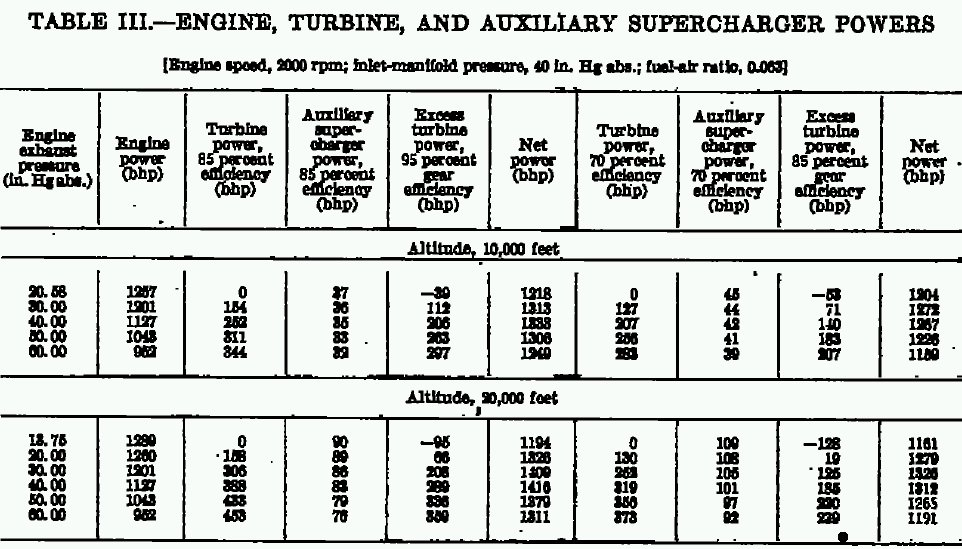
You might be interested in this old data measured back during World War II.
This engine had exhaust valves of course.
--
Paul Lamar ...No rotor no motor.
The Rotary Engine NewsLetter. Powered by Linux.
ACRE NL web site.
http://www.rotaryeng.net
Copyright 1998-2007 All world wide rights reserved.