> Hi Paul and group,
>
> A question regarding kinetic energy. How do one measure the level of
> kinetic energy at the exhaust. An instrument placed at the the two or
> three exhaust exit. Is it just that simple?
>
> Marc J.
>
> Kinetic energy is just the blast of exhaust gas coming out of the engine.
>
> You can get one of these wind speed meters and hold it near the
> end of the exhaust pipe. Put the car on a chassis dyno and run it up
> to full power. Note the airspeed of the exhaust. That would be the
airspeed
> coming out of an annular shaped orifice in front of a turbine with the
> same cross sectional area as the exhaust pipe tip.
>
> If you consider the turbine blade a wing
> with a lift coef. of one.. the force on the blade would be .0026 times
> the relative air speed squared in MPH times the area of the
> blade in square feet.
>
> The torque is the number of blades times the force on each blade
> times the radius of the blade. Good turbine blades can have lift
> coef. up to two. Max turbine power is generated when
> the tangential velocity of the blade is about half the max exhaust
> gas airspeed.
>
> The gas speed out of the exhaust pipe tip will be reduced by
> the heat loss in the muffler and the rest of the exhaust system.
> --
> Paul Lamar ...No rotor no motor.
Dear Paul and all:
Since "(m)ax turbine power is generated when the tangential velocity of
the blade is about half the max exhaust gas airspeed", does that mean
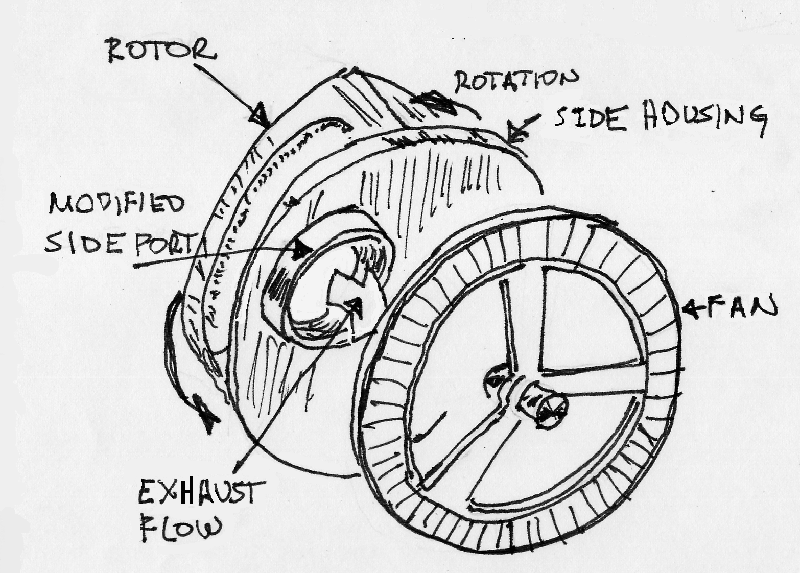
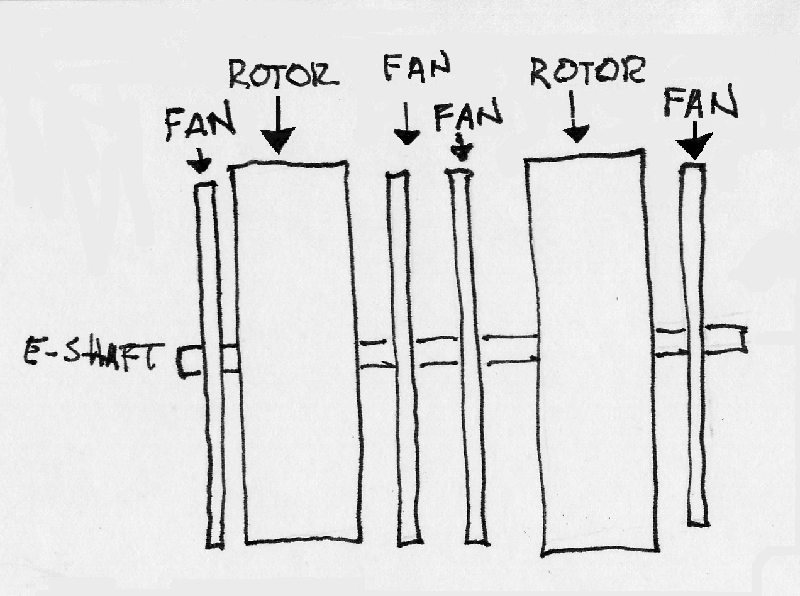
that my idea of several turbocompound fans, each hit directly by one
Renesis side exhaust port, each fan directly connected to the e-shaft,
would not work? See the first attached simple diagram.
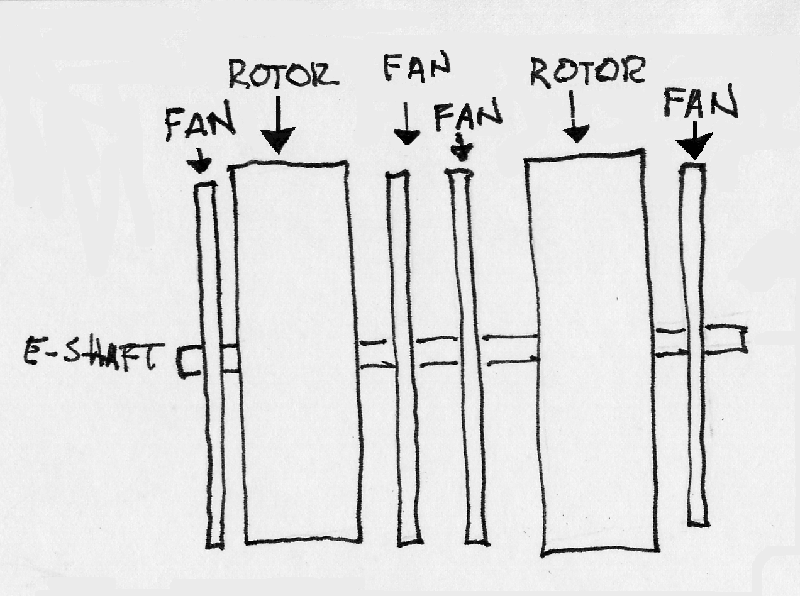
I designed my turbocompound fans to be generally the same size as the
rotors. See the second attached simple diagram.
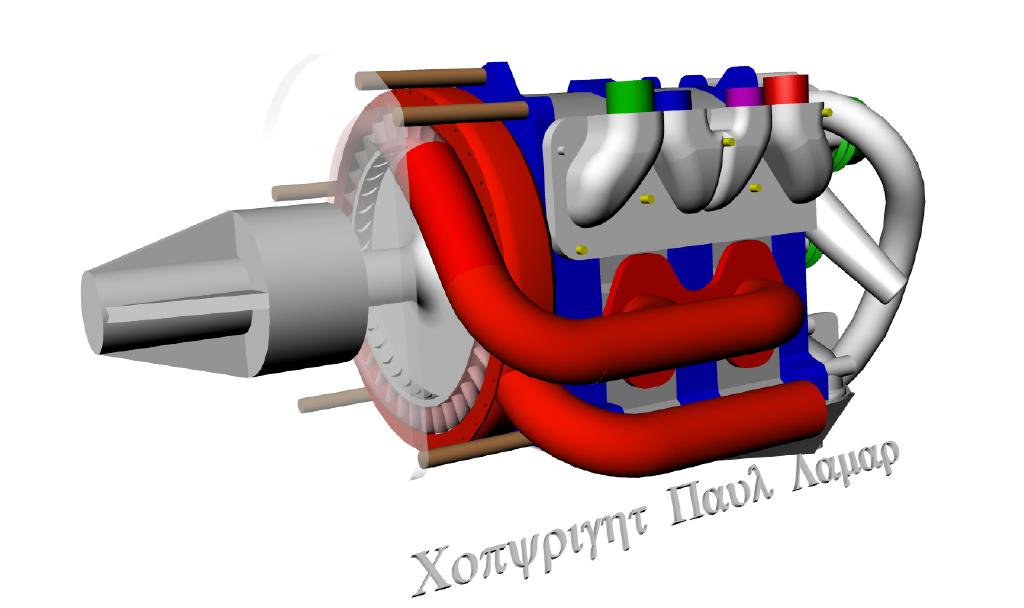
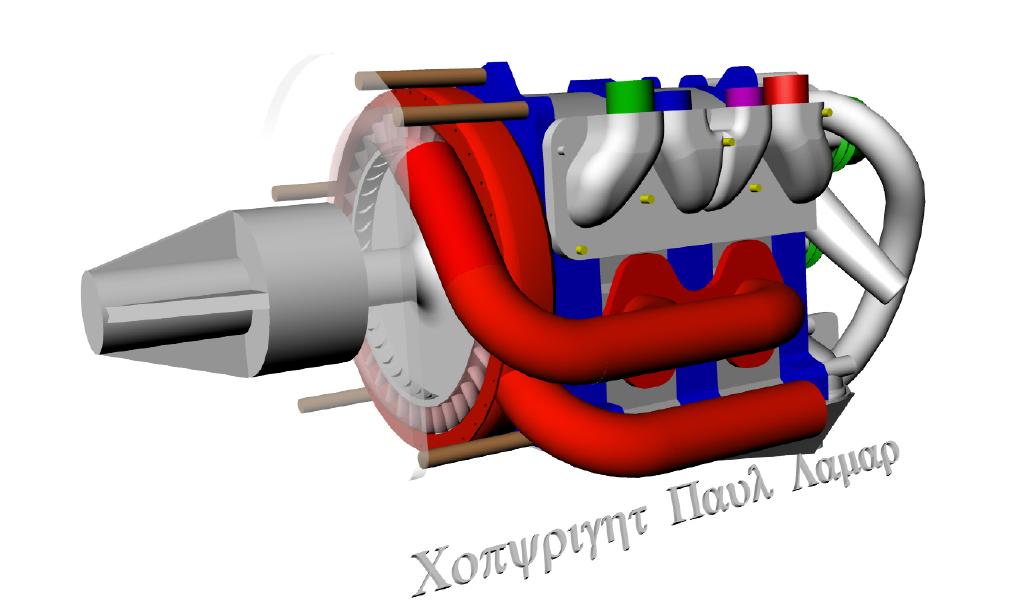
I based my design on your end-on turbocompounder design, Paul (see fancy
3-D image {attached} :-). It seemed to be about the same size as the
rotors. But, I could be in error about your 3-D drawing, Paul, and am
open to correction. :-)
It sounds like, for the turbine to generate the maximum amount of power,
it must be twice (or at least, a much greater diameter than) the
diameter of the rotor, which accelerates the exhaust gas to its maximum
speed. The exhaust gasses would, therefore, be ducted out of the rotor
up to the turbocompounder fan(s). What is the correct view on this matter?
Thanks!
Les Nordman :-)
Interesting idea. It will be a cooling challenge as the entire end housings
will be subject to the exhaust heat. The exhaust port must converge into a 360
degree nozzle with roughly the same area as the port. That suggest some
excessive heat lost to the cooling system. Keeping the exhaust as hot as possible,
up to the turbine, consistent with the max TIT capabilities of the turbine blades,
is desirable.
If you significantly separate the two rotors you then may have a torsional
vibration issues with the E-shaft. Then of course you have a cost issue with
four turbines instead of just one.
I can't really say what is the optimum diameter of the turbine until we
measure the average exhaust gas velocity. There is no doubt a supersonic pulse
emerges from the exhaust immediately after the port opens but what is the average
exhaust gas velocity? This supersonic pulse has not proven to be a problem for
turbo charger blades so far. I suspect the main thing killing turbo chargers,
besides the high heat, is over speed.
BTW I will be in Florida for the next 20 days so the newsletter will
be published sporadically. I hope to be in the pits for the
Rolex GT race at Homestead this coming week end. If you want to
contact me send me private email to this email address.
Paul Lamar ...No rotor no motor.
The Rotary Engine NewsLetter. Powered by Linux.
ACRE NL web site.
http://www.rotaryeng.net
Copyright 1998-2007 All world wide rights reserved.