--
Paul Lamar ...No rotor no motor.
Interesting.. I believe it's widely accepted that as the bore-stroke
ratio decreases for a given displacement, the peak torque increases.
This kind of flies in the face of what it sounds like you are saying -
that the wider rotor would make higher peak torque... The piston
area gets smaller and yet the torque increase. I don't think the area
of the push has as much effect as the volume of the chamber and the
eccentricity of the shaft.
Also, with a narrower aspect ratio the chamber gets more square
(lowering the surface area to volume ratio) as compared to the
exaggerated wide rotors on the Aixro. For best thermo efficiency, I
would think that the width of the rotor vs. the distance between the
rotor face and the opposite side of the chamber wall while at about
1/3 through the power phase should be about 1:1. The temperature is
probably at it's peak about there, or a little later, while the volume
of the chamber is fairly low - so minimize the surface to volume ratio
at that point.
Regards,
Matt-
> Keith,
> I did note your comment in regard this issue and believe the phenomenon of
> the heavy molecules being flung out by the centrifugal forces, go hand in
> hand with your arguments. I like your description of a 'Typhoon on fuel
> laden air flowing past the plugs'. I will use that as well
>
> Still we can't escape the fact that with the 13B ( non renenis) and
> especially the PP which has a larger overlap we have contamination issues,
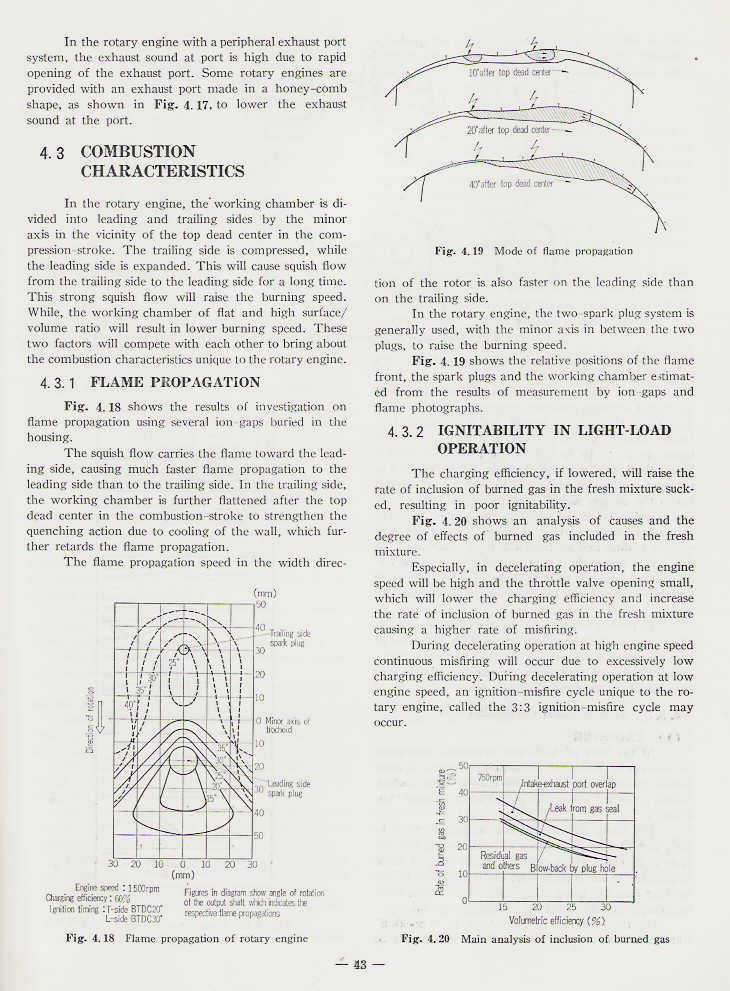
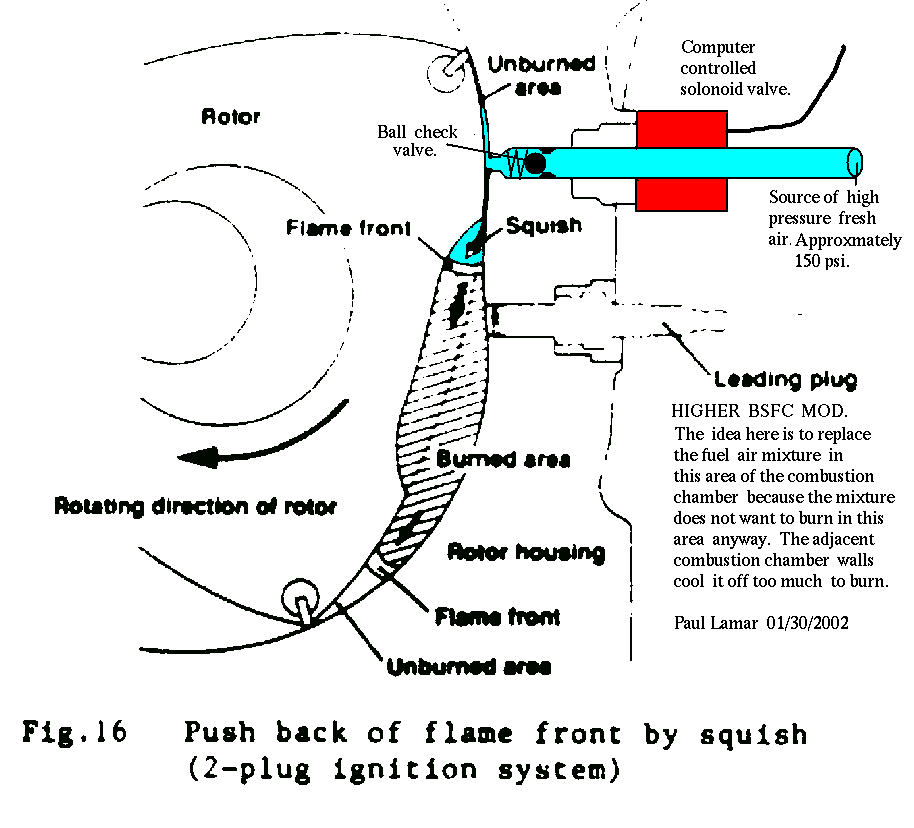
> but more importantly, we have unburned fuel in the squish areas because the
> flame front is extinguished before it can reach those areas - still
> nothings
> perfect.
>
> So Keith give us your objective estimate on how well the rotor combustion
> area shape stacks up against the piston combustion area - in terms of
> overall better or worse by ? percent, considering all the differences
> between the two.
>
> George (down under)
That would take math that I don't have time to work out. I will just say that
I'll take a rotary over a Reciprosaur any day if it ever comes down to a contest
for airflow and combustion efficiency.
BTW, there is squish space in a piston cylinder, too -- around the pistol and
in the top corners, where the flame front is forced to slow down.
Something else that most people don't think about is that what you learned in
high school physics about "pressure equal at all points in a closed system"
refers to a closed STABLE system, not one with a pressure wave loose inside.
Ask any dive shop that has had a tank explode while filling about the effects
of a rapidly-moving pressure front (that's why the smart guys start a fill at
a fraction of the flow, then open up the rest of the way after a couple of seconds).
They had a problem with the A4 rocket engines related to this -- the pressure built
up far to rapidly, blowing out the sidewall while the rest of the engine was well
below dangerous pressure, and they were OPEN AT ONE END! They ended up putting a
metal "waist ring" around the engine, and problem solved.
It's possible that the little bit of squish in the Wankel protects the apex seal,
by cushioning the pressure wave blasting toward it from the spark plug, before
the rate of change stabilizes.
Keith W
The Rotary Engine NewsLetter. Powered by Linux.
ACRE NL web site.
http://www.rotaryeng.net
Copyright 1998-2007 All world wide rights reserved.