>
>>> No easy answers. Like with many tough questions, where you
stand depends
>>> on where you sit.
>>>
>>> Zeke Smith
>>
>> Hi Zeke,
>> I have a book "Understanding Aircraft Composite Construction".
best I
>> have ever read on the subject.
>> Are you the author?
>> BR, Dave McCandless, Perth, Australia
>
>
> Hi, Dave!
>
> Yes. But the second edition is better.
>
> Best is "Advanced Composite Techniques", where I discuss using vacuum
> bagging to make thin-skin, thick-core, sandwiches and say why we
would
> want to do that.
>
> Right now, I am working on infusion techniques that would be suitable
> for the home builder.
>
> See my website:
www.aeronautpress.com.
>
> Zeke
>
>
> Hi Zeke
> Just ordered a copy of your books... Looks like they will be a great
> read.
>
> Mike C.
Zeke, Perry or others--is there a relatively inexpensive way for
builders to
make carbon fiber or other epoxy/composite "J" and or "U" tubes of
approximately 1 3/4" diameter with, at a minimum, smooth inner wall?
Steve Beckham
Paul, you had instructions to "Make your own Silicone rubber hose"
on June 22, 2007. I would think the method could be applied to
using a carbon fiber layup.
Joel
Over the Hill Materials Engineer
Yes. Those instructions are now in my book.
The problem is getting the male mold out. We discussed this years ago
at length for intake tubes when Steve B was not on the list.
One of the most interesting was developed by Berni Kerr. He used
a bicycle or small motorcycle inner tube filled with sand.
He claimed the sand held the inner tube in shape while the composite was laid
up on the outside. When cured you pour the sand out and remove the inner tube.
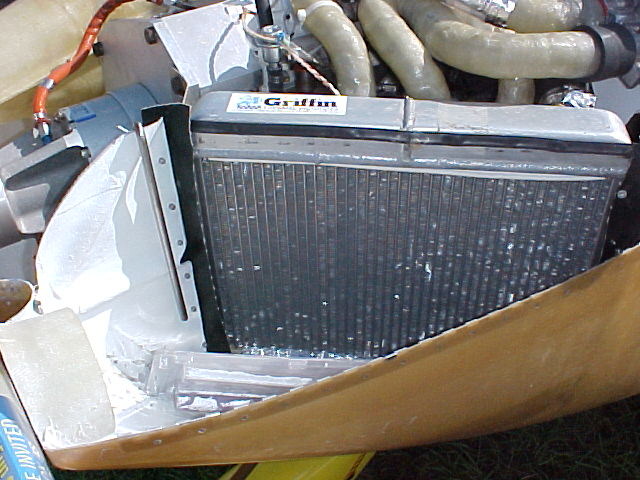
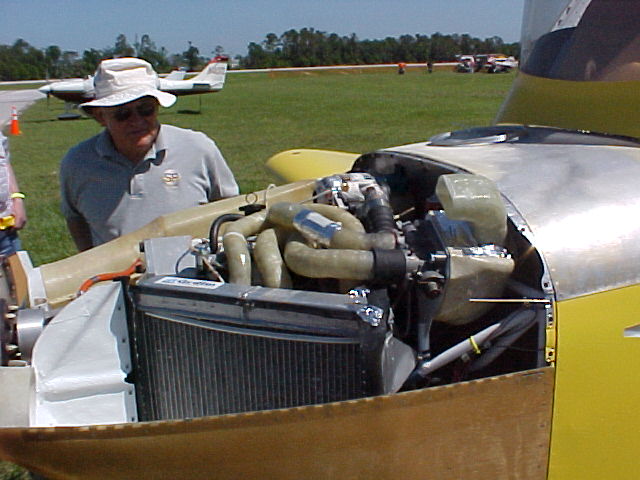
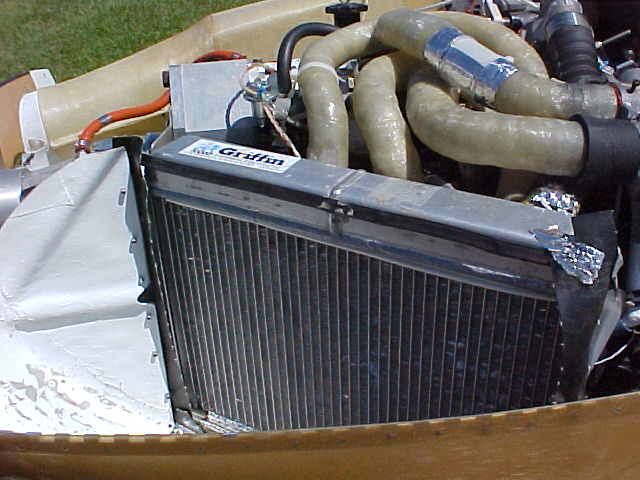
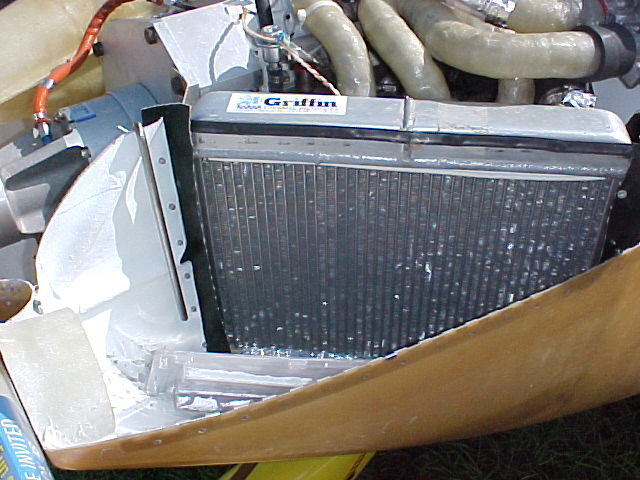
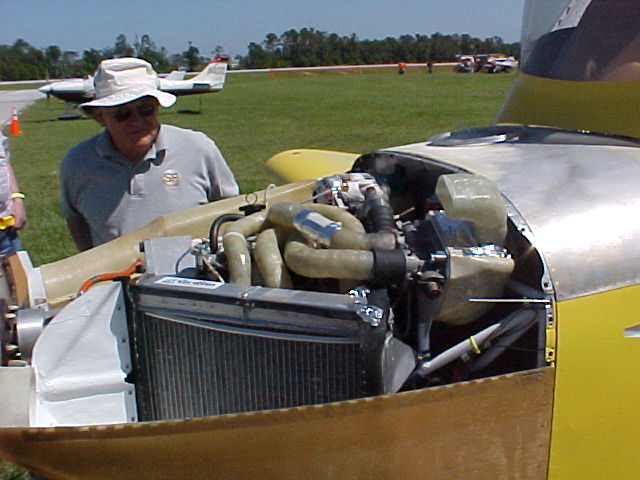
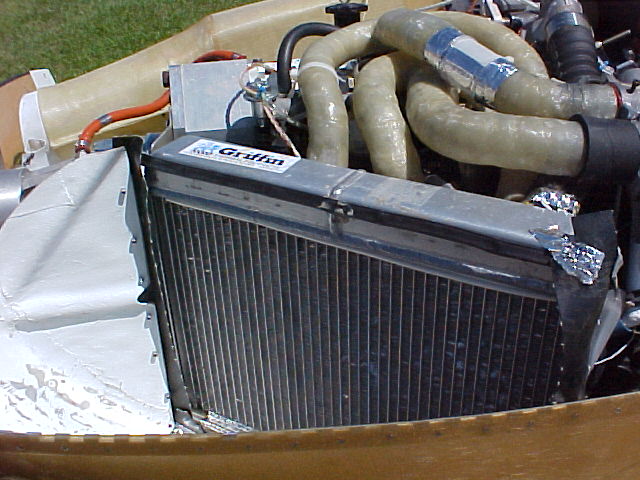
Here are some pictures of his manifold. I hesitate to publish these pics as there
are a few common engine installation mistakes shown. The rad installation is not a good
example of how to do it. It leaks air pressure big time. The four long intake
tubes are also not a good example of how to make a manifold but my friend Berni
Kerr is the epitome of the "Not invented here" type of guy. "Don't bother to
show me the facts. I am smarter than anybody!" :)
Carved Styrofoam can also be used with epoxy and dissolved with acetone.
First wrap the Styrofoam with strips of plastic to form a smooth surface
and act as a release agent.
Foam pipe insulation can also be used if held in shape with soft copper
wire strands. Remove the copper wire when cured and dissolve the foam or just
dig it out.
IMHO the weight savings for a composite manifold are not worth the labor.
A couple of 180 degree bends of 2 inch OD .065 wall aluminum tubing is much more
practical as it does not burn in a fire and it can be tig welded to all
the other parts you need. It is also pretty much the same dimensions
as the Mazda Lemans p-port engine for max power and minimum fuel burn or BSFC.
You won't beat the .46 BSFC.
Paul Lamar ...No rotor no motor.
The Rotary Engine NewsLetter. Powered by Linux.
ACRE NL web site.
http://www.rotaryeng.net
Youtube key word UTUBPLEASE
Copyright 1998-2008 All world wide rights reserved.