There has been a lot of discussion lately about prop thrust and how
it affects aircraft performance so I started a dissertation on
the subject.
It all has to do with the definition of HP.
In theory one HP could move a mountain.
Rather surprising result I would think.
The definition of HP is force times a speed.
Namely 550 pounds moving at 1 foot per second or 1100 pounds
at .5 FPS or 2200 pounds at .25 FPS or 5500 pounds at .1 FPS
or 55,000 pounds at .01 feet per second. You get the picture.
So if it is going slow enough the force could approach infinity.
The same thing applies to thrust.
In theory a 200 HP aircraft engine could put out tens of thousands
of pounds of thrust at 1 MPH. This would in fact happen
if we were feeding the engine HP into a gear box and used a super large
prop. In other words a hovering helicopter.
What happens in aircraft application is poor slow speed prop efficiency
rears its ugly head. More about that shortly.
I'll let you think about this while I work on refining this spread sheet.
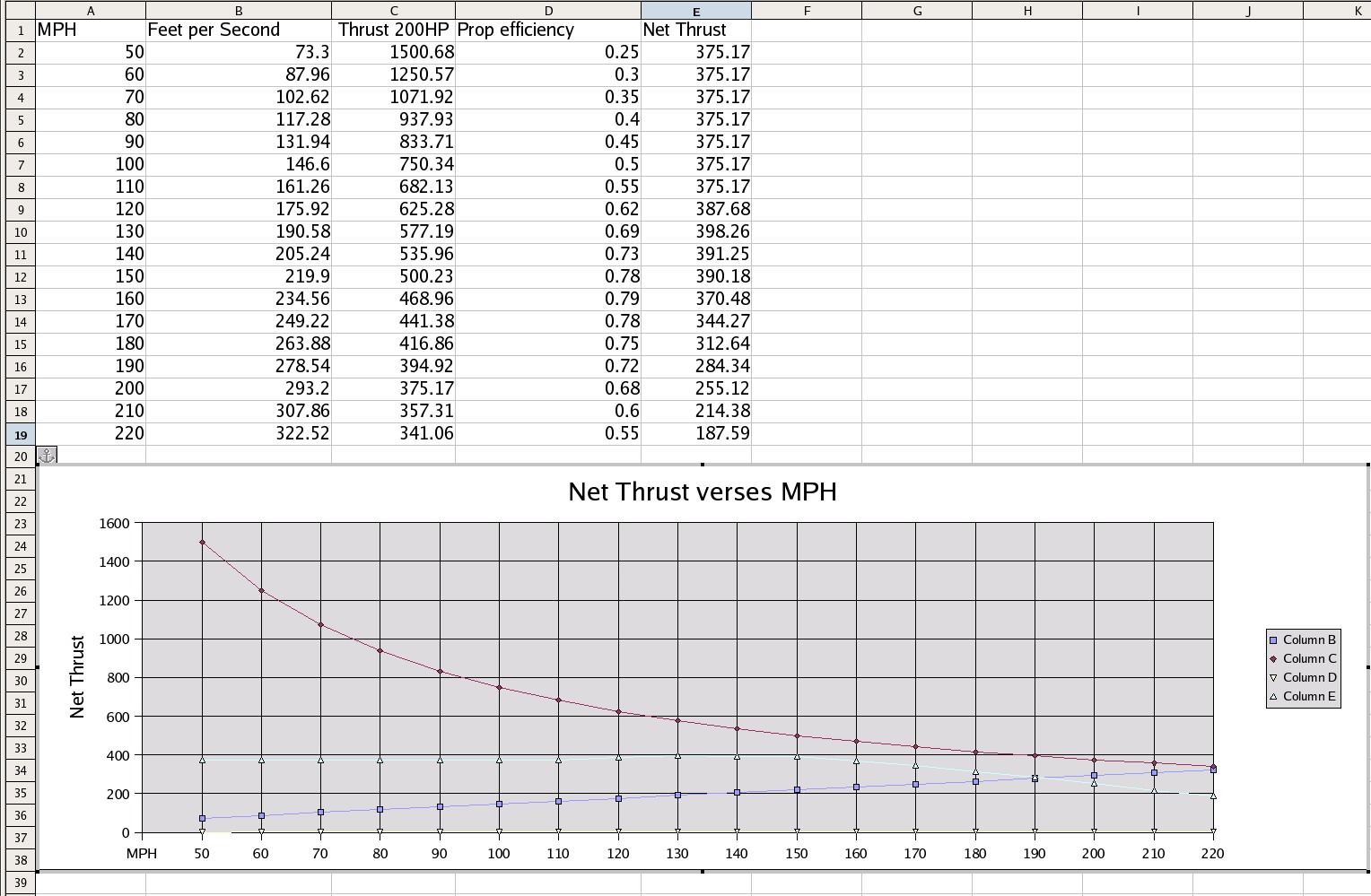
The graph shows THEORETICAL thrust as a function of MPH for a 200 HP engine.
The blue curve is feet per second. The red curve is theoretical thrust.
---------------------------------------------------
Part II
Propeller efficiency is characterized by a term called advance ratio.
http://selair.selkirk.bc.ca/aerodynamics1/Performance/Page8.html
Simplifying that so mere mortals can understand it is the ratio of what
the prop would do if screwed into wood instead of air.
A high pitch prop will screw into wood faster than a low pitch
prop at the same prop RPM.
In air, prop efficiency depends on how fast the airplane is moving. At static
speed or zero speed the airplane is not moving and the prop is slipping
100%. Theoretically the prop efficiency is zero despite the fact there is
a blast of air and thrust is being developed. We will ignore that for the
moment as it has no real interest for prop performance at speed.
In the real world prop RPM is constant more or less. Static RPM is only
a few hundred RPM less than cruise RPM so for all practical purposes,
and for the purpose of understanding what is going on, RPM can be considered
constant at 2500 RPM.
Let's just say we are choosing a prop that gives maximum efficiency at
a chosen cruise speed of 160 MPH. At lower than cruise speeds the eff. will fall off
and at speeds higher than cruise speeds the prop eff. will also fall of.
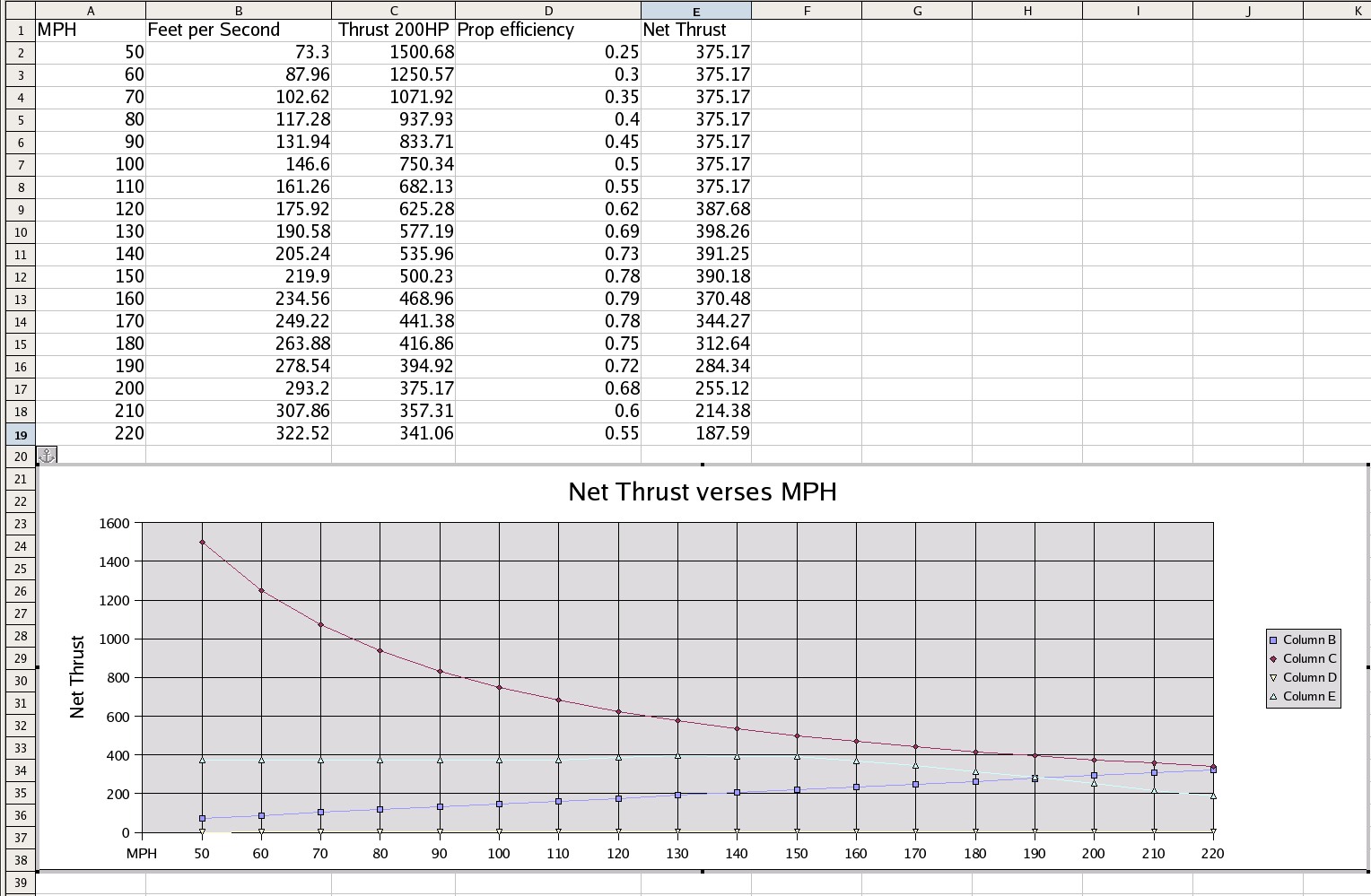
Here is a simple chart of the matter.
---------------------------------------------------------------
Part III
I calculated the net thrust with the given prop eff. curve
and plotted it. The light greenish blue line is the net thrust given
the prop eff..
Interesting. Rather unexpected as the net thrust is constant in the lower
speed ranges and begins to drop off at 150 MPH as pretty much expected.
The next step is plot the drag of the airplane and see where the drag
intersects the net thrust curve.
Paul Lamar ...No rotor no motor.
The Rotary Engine NewsLetter. Powered by Linux.
ACRE NL web site.
http://www.rotaryeng.net
Youtube key word UTUBPLEASE
Copyright 1998-2008 All world wide rights reserved.