The following was posted on the Mistral-Engines web site. It is
another data point on the very harsh environment of the exhaust
system, particularly in the NA engines.
Giff Marr
LIV-P/Mistral 70%
More fear than harm
07 June 2008
On Tuesday morning, 3rd of June, our test pilot, Mr Stephen Roth,
took off for a first one-hour flight that went flawlessly. He
landed at Palatka?s Kay Larkin Field Airport,Florida, to refuel.
Pre-take-off checks were normal and so was take-off. On initial
climb, however, the engine started to lose power while still running
perfectly smoothly. The pilot performed a 180° turn to return to the
airport. The loss of power increased, and the pilot was unable to
maintain altitude.
He landed the plane under control and at minimal airspeed in a
wooded area to avoid buildings and houses. The wings were sheared
off, one of them staying in a tree, and the fuselage fell sideways
onto the ground. Coming to his rescue, two courageous citizens
helped him out of the cockpit conscious and unharmed. There was no
post-crash fire, only smoke from engine coolant leaking onto the
heat exhaust.
MISTRAL Engines is extremely happy and most relieved to announce
that Stephen Roth suffers only from minor cuts and bruises. After a
thorough check in the hospital, which proved to be short, he was
released and able to go back to the site to contribute to the
beginning FAA enquiry.
MISTRAL Engines immediately dispatched to the site Mr Gordon
Anderson, its Chief Operating Officer. On Thursday 5th of June, Mr
Anderson, Mr Roth and the FAA investigator inspected the plane?s
wreckage as well as the whole engine data log which was retrieved
entirely uncompromised from MISTRAL?s proprietary Digital Engine
Management (DEM) system.
It was quickly evident that all engine parameters were normal from
the moment of take-off to the moment of the accident, with the
exception of abnormally low propeller RPM. The cause of the power
loss was subsequently found in the failure of the internals of the
exhaust system?s muffler, obstructing the free flow of exhaust gases
from the engine.
This particular muffler was a temporary and experimental solution
developed and manufactured by a third party, which was planned to be
replaced this coming summer by a certifiable unit, developed
in-house. The FAA, acting on behalf of the NTSB1
<ttp://www.mistral-engines.com/Media2/Mistral-News#sdfootnote1sym">,
retained the muffler in order to conduct flow tests.
A preliminary report was produced by MISTRAL Engines. It will be
posted on this website shortly. A final company report will be
issued after further analysis of the engine is conducted at
MISTRAL?s facility in Geneva.
After its pilot emerging unscarred from this mishap, MISTRAL is
extremely relieved that its technology is proven uninvolved in the
cause of the accident and that, through the innovative data logging
capability of its DEM system, it was able to significantly
contribute to a prompt and thorough determination of the causes.
MISTRAL Engines is in the process of acquiring a new airframe to
resume its flight testing programme as soon as possible, and the
type certification programme of its G-300 engine model continues
unhindered.
1
<ttp://www.mistral-engines.com/Media2/Mistral-News#sdfootnote1anc"> NTSB
: National Transportation Safety Board
My opinion before reading this report was that one of the external
systems had failed and it is not surprising that it was the exhaust
system because this has happened REPEATEDLY to many rotary powered
aircraft. It is surprising that it happened to Mistral given their
technical ability. They certainly do not need advice from me. However,
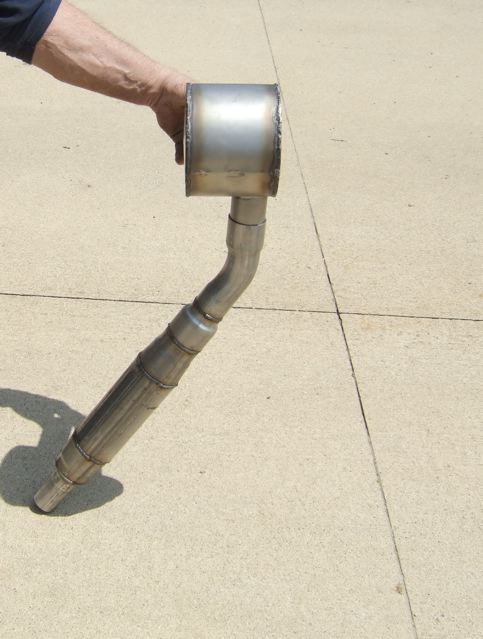
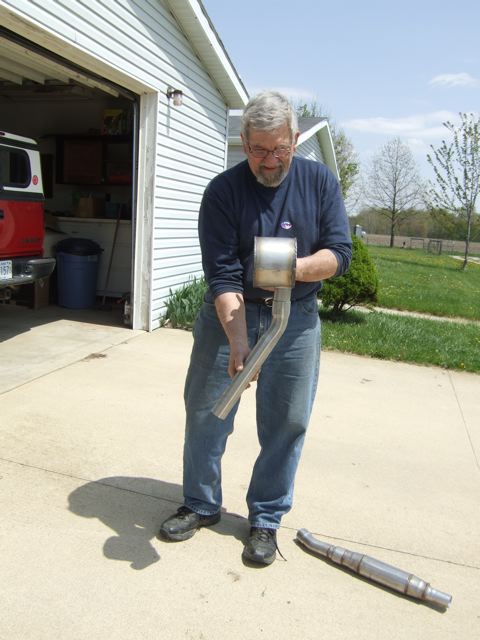
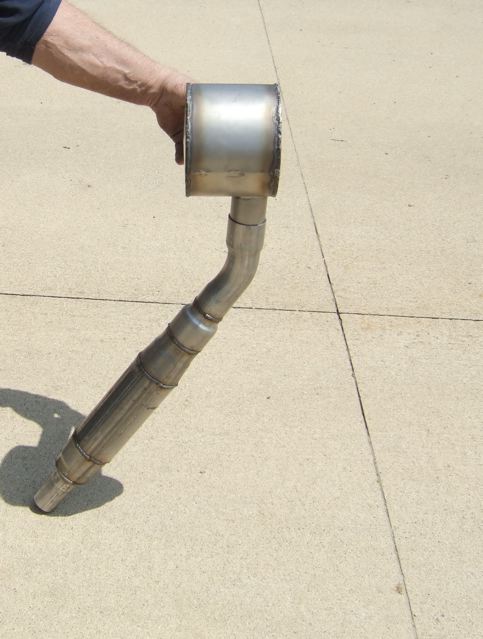
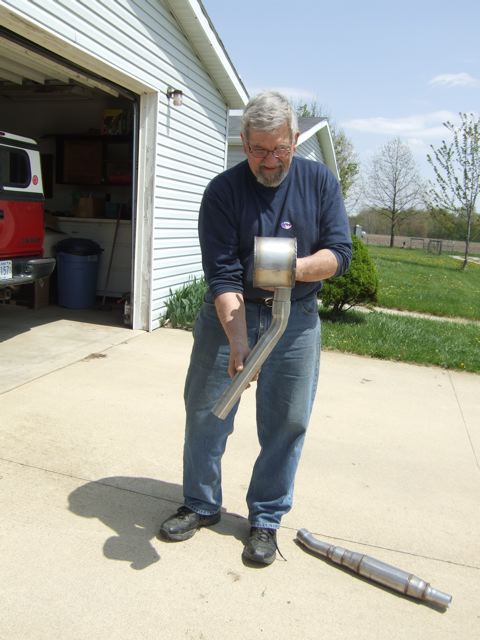
I recently tried to tame the mighty rotary exhaust by placing a small
tangential muffler ahead of the regular muffler. This seemed to work
based on exhaust note on a RotaMax single rotor. No instrumentation was
available at the time so I am reporting my subjective evaluation. It
was quite amazing how tame the exhaust immediately became and without
the creation of any back pressure. Rotamax kept the prototype for
further experimentation. I have not heard more.
The system is very compact and light weight. It will fit inside the
cowl. I can't prove it but I think this system would protect the
internals of down stream mufflers provided they were well made out of
SS. For the test a FlowMaster (I think) muffler was added to the
tangential. It was very quiet. The FlowMaster by itself was not quiet
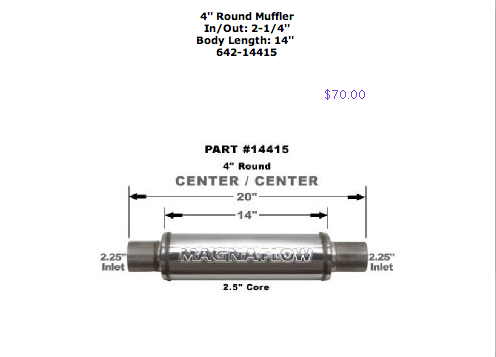
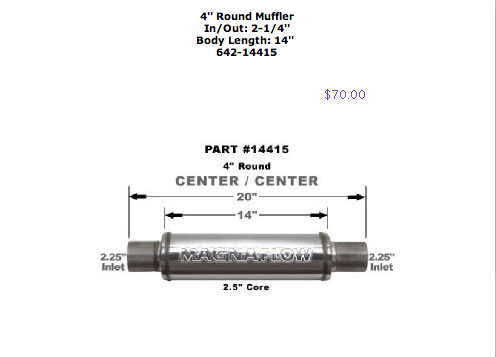
at all. A smaller all stainless steel muffler such as the Magna flow
could be used in final configuration. Burns Stainless has some small and
expensive mufflers that look to be perfect for this application. We
could easily make our own. In addition to cooling the exhaust gas
and lessening the exhaust pulse another advantage of this system is
that no muffler is hanging out in the breeze. Jerry
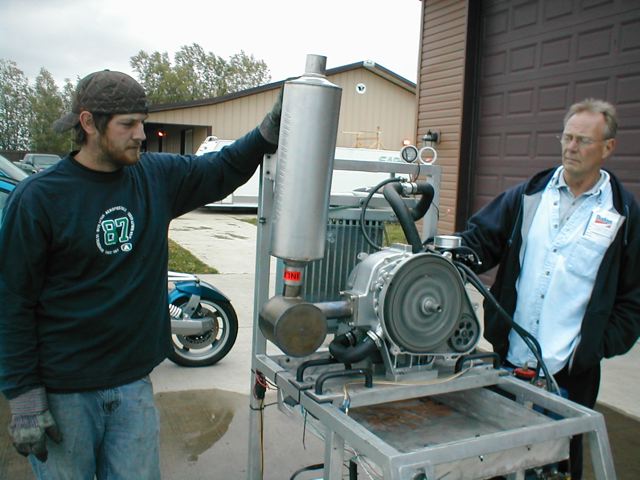
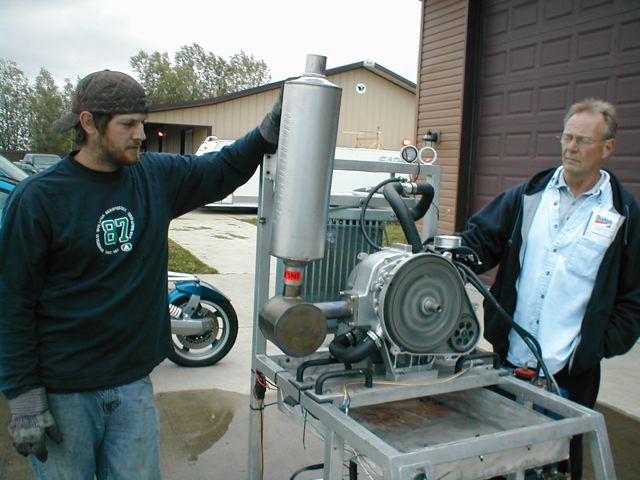
First photo. exhaust system is installed upside down to clear fixture.
engine is running at about 6000 rpm. You can see how calm it was
working next to the engine. The only difference for a two rotor would
be a longer tangential can. When the tangential system is installed in
its normal orientation, there is room for a small muffler to hang down
along side the engine.
Jerry Hey
That engine is running no load Jerry. There is a world of difference
between the amount of noise an engine puts out no load compared to full
load max RPM. Run you car engine up at idle and then listen to it at full throttle
max RPM during an acceleration run. I am not saying your muffler is not working.
There is no doubt tangential mufflers work.
However you need to compare noises at max RPM run up with full load like a prop
or on a dyno. Most of what people hear is the noise at takeoff speeds
and loads. True a lot of it is prop noise.
--
Paul Lamar ...No rotor no motor.
The Rotary Engine NewsLetter. Powered by Linux.
ACRE NL web site.
http://www.rotaryeng.net
Youtube key word UTUBPLEASE
Copyright 1998-2008 All world wide rights reserved.