I did the collapsed muffler deal at Sebring years back. The
Flowmaster (big suitcase looking thing) had all of the baffles
piled up against the rear outlet. The muffler swelled up like a
giant pillow and the power dropped off to nearly nothing. It
didn't hurt the engine at all and we raced at West Palm Beach the
next weekend.
Looking at the Mistral muffler, I am struck by the tubes with holes
right at the flange. There is no way this didn't cost them big HP.
The rotary is a 4 stroke Otto cycle engine but it tunes like a 2
stroke dirt bike.
So a bit of a run out of the engine before you do anything to the
flow will be better than anything. So, as long a tube as is possible
straight out of the port. Then either a long run to the collector if
possible in very thick walled tubing or make the first turn in each
tube a slip joint. For a long system there is a need to support the
tubes solid to the engine, if the engine can move. If the engine can
move you cannot clamp the tubing to a structure that does not move
with the engine.
One system I like for space and simplicity is a short system. Maybe
10"-11" right into a collector. The first 3"-4" inches is straight
out of the port, and the curves into the collector have duplicates
of the stubs as long slip joints. These need not be exotic balls or
bellows. Just a joint that cannot transfer very much motion into the
tubing. The header is held to the stubs with stiff springs. The
springs have safety wire run through them, so if one should fail,
the header still cannot escape, and the pieces of broken spring are
retained. This is to allow for shape changes in the collector as the
out walls of the curved surface operate at higher temps than the
inner walls. Any leaks in the supersonic portion of the exhaust
result in air entering at the leak point. I have no gasket at the
flange, Just GE silicone. Air entering the system will get you
a popping sound on closed throttle. If you have way too much back
pressure for a rotary, you could get an exhaust leak, but the power
will be way down.
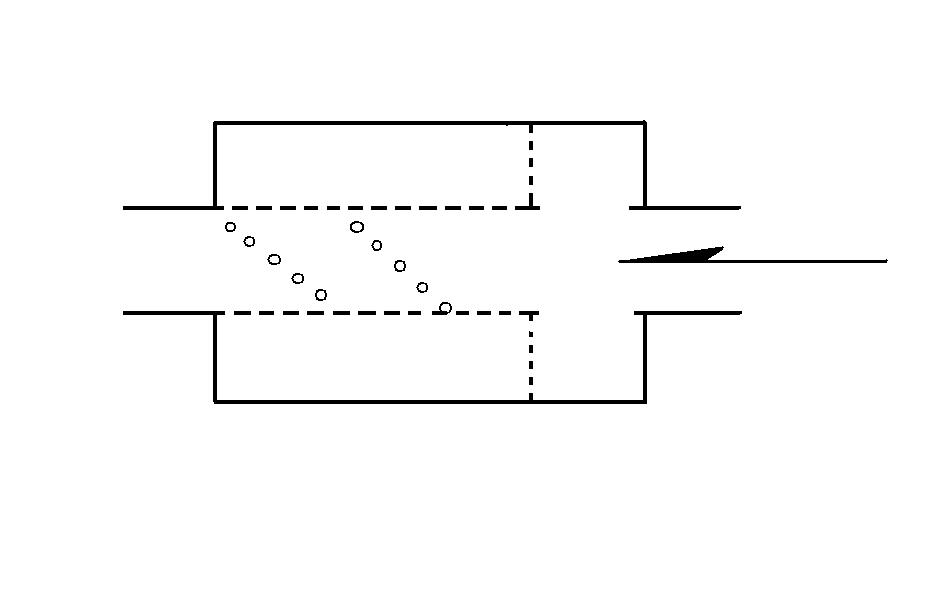
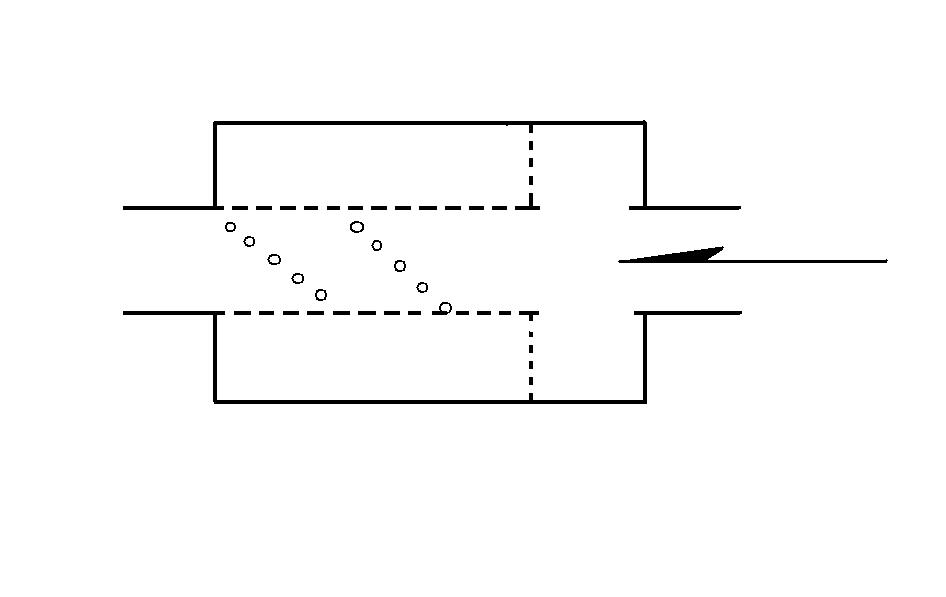
The Mazda racing muffler give you some ideas, that might help. A 4"
diameter tube through about a 10" diameter tube about 12" long.
looks like a short fat glass packed muffler. The core has the
standard perf tube but at the front end, the core stops with a
bulkhead of perf stainless and an open room with the perf tube
stopping at the perf bulkhead. So, there is a gap of about 3" in the
tube through the muffler. In this room, I suspect that there
supersonic flow drops to subsonic. They had a very nice sound,
rather unlike a rotary. They were expensive and lasted about one
season. Depending on how fast the car was. (HP used?). The muffler
mounted under the rear bumper.
So, heat was less a factor than the pounding. I don't know if they
had any kind of packing at all.
The ends were round but flat. Failure would be the whole muffler
falling off leaving the front end on the tube. Or, the rear bulkhead
and exit tube falling off.
One rule is that if it is flat it dies. The closer it is to the
engine, the sooner it will die.
Another rule might be, that if the engine moves, you must have a
slip joint close to the engine. Even if the exhaust system is soft
mounted. On race cars the exhaust systems have a saddle supporting
that last length of tubing. A half of a larger tube, with a screen
door spring over the top half, so the length can change with
temperature.
I have several sets of Indy car headers in Inconel. At $10,000 a
set, why do you have them you might ask?
I bought them at an annual automotive barn sale at the fairgrounds.
I paid $30.00 for a set on Saturday and Sunday just before closing I
bought the remaining 3 sets and some waste gate headers for $15.00.
They are from Rahal (before Letterman) here in town. The man selling
them made the trophies for CART.
He said they use these for three heat cycles and throw them into the
dumpster. They used to build their own, but found the man in England
who builds most of them for others and they just get three sets a
week from him.
They cannot afford to blow in a million on a race weekend and
loose finish positions to a cracked header.
And, Inconel cracks just like carbon steel, just at a higher
temperature. It does not tolerate poor design or workmanship.
In this picture the engine flanges are castings with the tubing welded
to them. The whole thing is a work of art. There are no bends here. They
are made from little flat sheets rolled into shape and welded. The weld
beads are nearly invisible. So little stretching is involved. The
material is very thin and the header set half the weight of a carbon
steel set.
The strange thing at the left is made of stainless rectangular tubing
and is the waste gate exhaust header.
It is flat, to fit between the rear tire and the bodywork. They have
machined off the tabs on the header set, used to hold the sections
together. A tab on each tube with a short piece of sheet stock between
and two bolts. The bolts are not tightened and allowed to spin and
vibrate at high RPM. They deform the bolts so no safety wire is
required. You can see two such links on the waste gate header.
I can produce simple picture in MS Paint if that could help anyone.
Lynn E. Hanover
Paul, and Lynn H., I would like to see some pics of this type of
exhaust. Thanks, Dave D.
Here is what I remember.
Lynn E. Hanover
Better make the guts out of 1/8 inch thick 321 SS :)
--
Paul Lamar ...No rotor no motor.
The Rotary Engine NewsLetter. Powered by Linux.
ACRE NL web site.
http://www.rotaryeng.net
Youtube key word UTUBPLEASE
Copyright 1998-2008 All world wide rights reserved.