>>>
OK Steve a couple of questions if you would respond. I can't quite get my
head around what you said about the exhaust manifold. I know someone used
4
studs instead of the two standard studs, but the material in that area
seems
a bit on the light side. I thought perhaps a standard flange with 4
threaded holes or studs to accept a 4 hole header flange might be a better
option. This would be a flange on a flange - again more weight.
On the attached drawings [Solid-Works???]which are a collaboration between
myself and Bill
Jepson, I have tried to show the cool air flow.
I take on board your comments on drag, but safety are a greater concern
for
my application and cooling the exhaust will extend the life of the
muffler - also this could be consider a mixer and a lighter muffler used
down stream and again the cooling air would make this feasible IMHO. This
would then be a very quiet set-up.
The most important part of this design is the deflectors, which was Bill's
idea. To deflect the sonic waves, which scrub around the inner can turning
into the sound into heat. The part of the design which was mine was how to
hold them in position, so I came up with the cool tube - which served two
purposes.
The rest of the design revolved around what off the shelf cones I could
get
hold of. I think it came together nicely - now only if it will work, I'm
pretty sure it will.
321 would be nice, but Inconel is too expensive for this poor man's
exhaust,
so I used 1.6 mm- 316SS which is an industry standard in a lot of cones
available. I'm now glad I did use the 1.6mm material.
I'm pretty sure you could get the cost of material down if you have the
contacts but that's the best I could do at that point in time.
I had a contact in the Aviation exhaust manufacture and the manufacture
everything from 321 SS plate but I was looking at $1,000 min. Not an
option
for my application. I know it's cheap for the racing guys but I don't have
sponsors.
George ( down under)
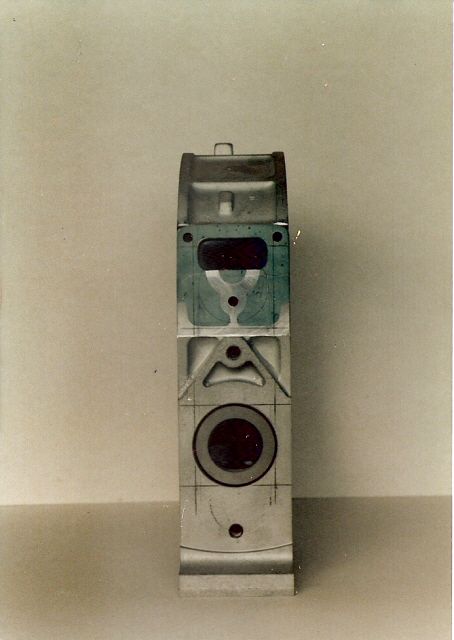
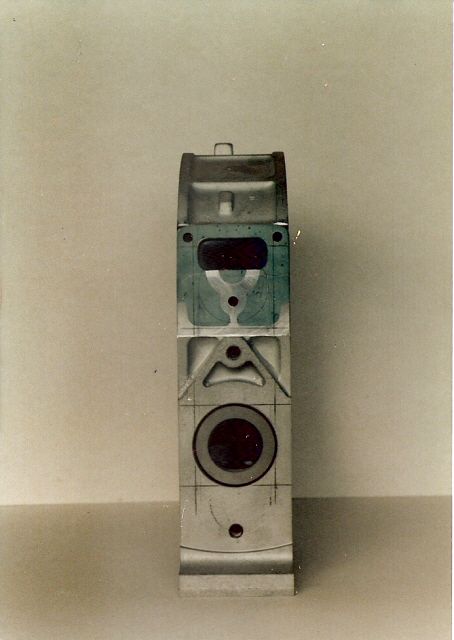
George--regarding your question, we used no exhaust manifold after the first
prototype engine, just four-stud exhaust flanges. Here is a scan of an old
photo showing stud location beginning in the late 1980's and for all
subsequent engines. Minimum spacing was 2 1/4" and maximum spacing used was
2 3/8". Have not lately measured the newer rotor housing castings to the
older ones, but don't remember that late 80's to present 13B castings were
substantively changed dimensionally in this area. We never had a problem
using this approach. If you try this, just don't go crazy putting too much
torque on nuts. Studs were installed finger tight only, with never-seize
applied lightly on threads in rotor housing and on stud threads. Flange
thickness used was from 3/16" to 1/4". Flanges were surfaced nice and flat
after welding and no gaskets used; high temp silicone only. This installed
configuration is shown on Paul's photos of the system installed on the
engine.
Steve Beckham
The Rotary Engine NewsLetter. Powered by Linux.
ACRE NL web site.
http://www.rotaryeng.net
Youtube key word UTUBPLEASE
Copyright 1998-2008 All world wide rights reserved.