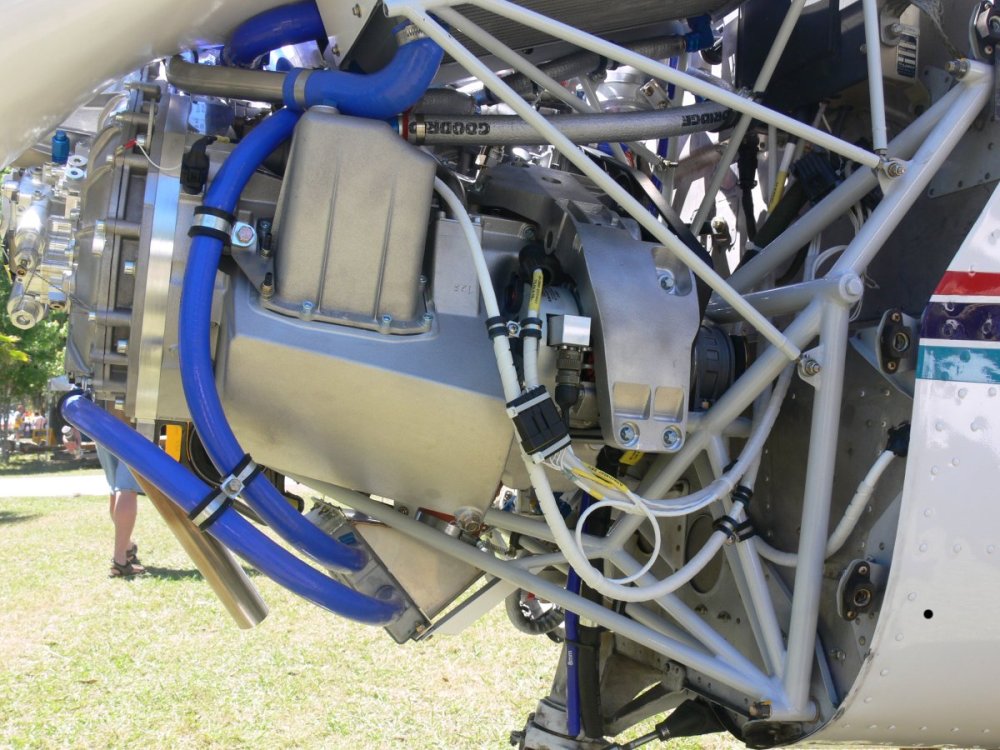
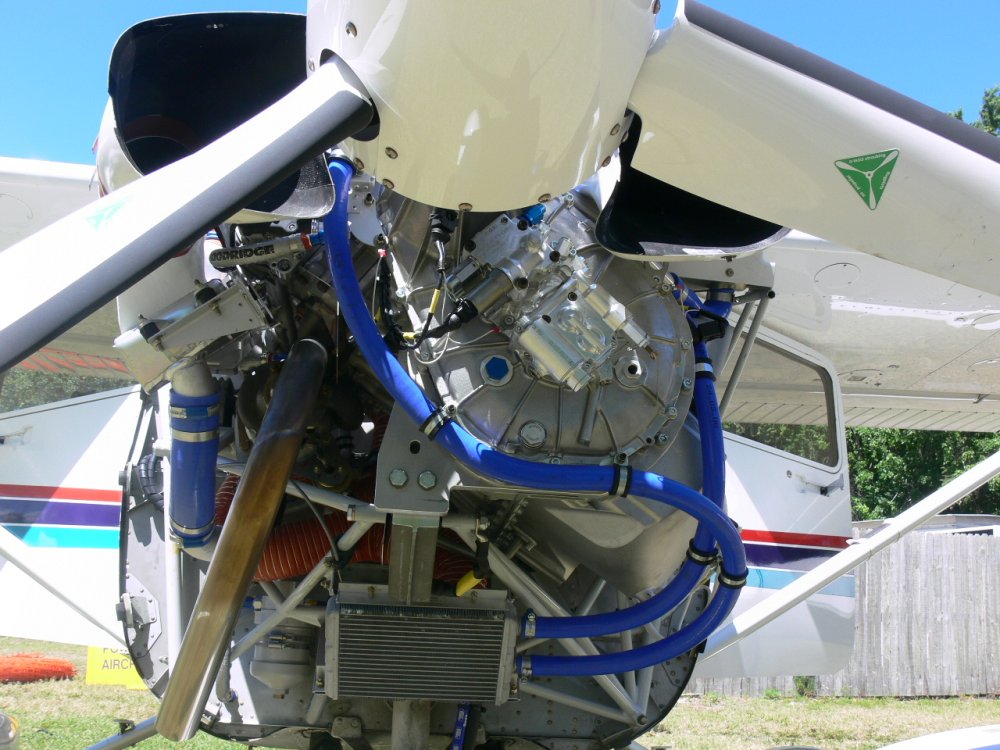
This seems very convincing....however others are waiting in the
wings...so to speak....
Marc W.
From: Paul Bertorelli
Subject: Diesel Engines
Thielert's Flawed Economics (And Why the Company Knows It)
The war of words between Diamond Aircraft and Thielert Aircraft Engines
continued this week, reaching a low arc at the Berlin Air Show. Bruno
Kubler, who heads the firm overseeing Thielert's insolvency, used the
forum to blast Diamond for what Kubler claimed was a disinformation
campaign aimed at making Diamond customers "massively insecure." Why
Diamond would want to do this is baffling, since it has on its hands
some 800 distressed owners of airplanes equipped with Thielert diesel
engines.
Diamond is engaging in a degree of brinksmanship, but given what appears
to be Thielert's disastrous economics, who can blame them? The usual
strategy in situations like this is for the companies involved to play
footsy behind the scenes to work out a deal acceptable to all of the
distressed parties. Unfortunately, Kubler's numbers appear to be so far
off the mark that I don't see how this is possible.
This week, I took some time to put a sharp pencil on how Kubler's prices
will reshape the economics of the Thielert Centurion line. I developed
this data on my own from the Kubler-derived prices and my totals don't
precisely agree with Diamond's, which it released in Wednesday. But my
research does confirm that Kubler's prices raise the engine operating
cost about six fold.
Further, the new prices raise the direct costs of operating the diesels
to four or five times that of a gasoline engine. In fact, minus the
fuel, Thielert diesel costs outstrip those of operating a turbine
engine, such as Pratt & Whitney's PT6 or even a small jet engine. Why?
Thielert still requires 300-hour removal and inspection of gearboxes,
plus numerous other expensive parts. Furthermore, all these components
have to be shipped back and forth to Germany for service and inspection.
Shipping alone comes about $600 per inspection event.
This onerous maintenance load was one complaint owners had about the
Thielert 1.7 Centurion. Thielert responded to this with the
new-and-improved Centurion 2.0, which would double the gearbox
inspection interval to 600 hours and increase the engine's time between
replacement (TBR) to 2400 hours. But Diamond and owners complain that
the documentation doesn't support this and they're still required to do
the 300-hour gearbox removals. This is roughly the equivalent of yanking
the transmission out of your car every 3000 miles and sending it back to
the factory. Moreover, if the 2.0 really is a 2400-hour engine-and no
one seems to know if it is or it isn't-the entire thing has to be
shipped back to the factory for inspection at 1200 hours, costing $4000
in shipping alone. One flight school with three Twin Stars told me that
it's probably more sensible to just replace the engine at 1200 hours
rather than shipping it back to Germany.
As the late Everitt Dirksen famously said, you're talking about real
money here. When you add everything up, Kubler's numbers just don't make
sense. The rational way to examine this-if there's anything rational
about any of this-is to compare the lifecycle costs of a Thielert 2.0
against a Lycoming at time of replacement. The numbers follow here. One
point: On many Thielert parts, owners have the choice of new or
inspected, which is basically a used component within service limits.
The parts listed below aren't elective replacement-you have to replace
them to keep the engine serviceable.
Cost of replacement engine: $51,150 Inspected gearboxes (3): $23,500
($47,118 new) Shipping: $1800 High pressure pump: $1412 ($5550 new) Rail
valve: $651 Feed pumps (3) $1255 Clutch (3) $1443 Clutch shaft (3) $1200
Alternator: $1426 ($2985 new) Scheduled labor $1800 Unscheduled labor
$5000 Total: $90,637 Hourly engine (1200 basis): $75.53 Total hourly
with fuel: $101.03
For unscheduled labor, I used 10 percent of the cost of the engine,
based on owner surveys we've conducted. These numbers, by the way,
represent the absolute best case and assume that no additional parts
other than those scheduled will be required. Further, owners complain
that the labor for gearbox changes is higher than Thielert said it would
be, but I've used the lower number anyway to give Thielert the benefit
of the doubt. But these numbers are almost certainly too low.
If new parts rather than inspected parts are used, the total comes to
$119,952 or $99.96 for the hourly engine reserve or, when you add in
fuel, $125.46. Oh, and double that for a DA42 Twin Star. This total may
be sustainable in Europe and the U.K.-although I doubt it-but it's a
non-starter in the U.S. But remember, the Centurion diesel is a world
engine, not a U.S. engine.
Here's how a Lycoming IO-360 compares. It's apples to apples, because
this is the engine Diamond uses in its DA40 Star, which also has a
diesel option.
Lycoming IO-360 REM
Cost of replacement engine: $25,160 Top overhaul at mid-time: $8000
Unscheduled maintenance: $5000 Total: $38,160 Hourly engine (2000 hours
basis) $19.08 Total hourly with fuel: $59.58
For the Lycoming comparison, I added a top overhaul that this engine is
unlikely to need and I used unscheduled maintenance of 20 percent of
engine cost, twice what I used for Thielert. Even with this lopsided
comparison in favor of the Thielert, the Lycoming's costs are a little
more than half of the Thielert's. They begin to break even at an avgas
cost of around $9 a gallon. But, of course, if avgas costs that much, so
does Jet A, so they never break even.
In some ways, the better comparison is between the Thielert Centurion
and the Pratt & Whitney PT6, say the dash 114A used in the Caravan. It's
a 675-HP free turbine engine with a 3500-hour TBO and overhaul costs in
the $85,000 to $130,000 range. The Aircraft Bluebook Digest recommends a
$37.14 per hour set aside for the PT6, or half what it takes to the fund
the Thielert Centurion and without the onerous 300-hour inspections.
How could the industry have missed such breathtakingly screwed up
economics? The companies involved missed it-Diamond and lately
Cessna-missed it and we in the press (including me) absolutely glossed
it over. In 2005, I visited Thielert's factory in Lichtenstein, in the
former East Germany, and we went over the economics of this engine. I
never got a clear explanation of how the power-per-hour pro-ration based
on a 2400-hour engine was going to work. It seemed too expensive. How
was Thielert going to make a go of it long term with all those built-in
service costs? Persistent dumb ass questions led me to understand that
the initial engine was a loss leader funded by investors who thought the
model would turn the corner with sufficient volume and, once the engine
had proved itself, the inspections would go away and TBO would increase.
They haven't. And that's what's killing this engine, more than anything
else. Shipping perfectly good gearboxes back and forth to Germany is
lunacy, as is removing them from the engines every 300 hours. Owners
I've interviewed have told me there are problems with clutches, but the
gearboxes themselves have proved durable. There's good evidence that
this is true, because Thielert offers an "inspected" gearbox for half
the price of a new one. But half price is still $7800, plus shipping,
and you need to do that three times to get to the Centurion's tender
1200-hour TBO. Seventy-eight hundred bucks to inspect a gearbox? It's an
aluminum case, some bearings and a couple of gears. How can that require
$7800?
In my view, the inspections were probably built into the model not just
as a prudent and admirable step toward proving durability, but also as a
profit center to fund the rest of this engine's expensive recurrent
maintenance needs. Logically, there's nothing wrong with that concept,
as long as going forward, the customer benefits from the proven
reliability and cost decrease.
Oddly, both Thielert and Kubler seem to be aware of this, but maintain
that Germany's bankruptcy laws force them to run the company on a basis
that shows no loss. This morning, Thielert spokesperson Christoph Moller
e-mailed me this note:
"At the moment, due to German insolvency law, Mr. Kubler cannot produce
any losses and must ask Thielert's clients for prices which meet the
company's current expenses. We know, of course, that the new prices for
replacement and inspection of parts are a burden for many of our and
Diamond's clients. As you know, Mr. Kubler's aim is to find a long-term
investor who will provide significant investments in order to push
forward the Thielert engine technology which in fact is the future of
the aircraft engine industry. To ensure long-lasting relations to his
clients this investor will presumably establish a sustainable warranty
and guarantee scheme which will improve the current situation
significantly. There is a great possibility that this will include
considerable efforts to advance Thielert engines especially in terms of
prolonging the engines lifetime which in fact is not where it should be
at the moment. This will reduce the inspection times and, by this, the
costs for owners considerably then."
I take Moller's point, but it's difficult to see how this will make the
business viable. In essence, the message to customers is this: pay us
five to seven times what you expected to pay and, if we show no losses,
we can turn this thing around and you'll maybe pay less later...if you
don't mind buying expensive engines without warranties. To me, this
looks like a negative feedback loop. The more you input rising prices,
the less revenue you generate and the more you have to raise prices
until a single customer pays $4 million for a gearbox and clutch.
(Warranty extra.)
And if Thielert hopes to find investors to fund a business running on
these rules, they'll need nerves of steel and be willing to pour in a
pile of money for several years just to gain of glimpse whether it can
be profitable. It seems unlikely that customers will stand by and fund
what I view as a fiasco, nor should they be expected to. Thielert and
Kubler can blame German bankruptcy laws if they wish, but the current
strategy seems to serve no one-not creditors, not customers and not the
industry.
On the other hand, maybe those of us who think that a Twin Star owner
will balk at paying $180,000 to take a pair of diesel engines to 1200
hours are the delusional ones. Kubler tells us owners are "relieved" to
know that parts are once again flowing. For some twisted reason, this
reminds me of the old Woody Allen joke about the brother thinking he's a
chicken. "Why don't you call him on that?" asks the shrink. "I would,"
says the straight man, "but I need the eggs."
Maybe those 1200 or so Centurion owners need the eggs, too.
Very good documentation. I would like to remind people Thielert dropped
the 1.7L and went to the 2.0L not because of any value to anyone, but
because Daimler stopped making the 1.7 and increased it to a 2.0L -
these engines are the seeds for the Thielert engines.
-dave
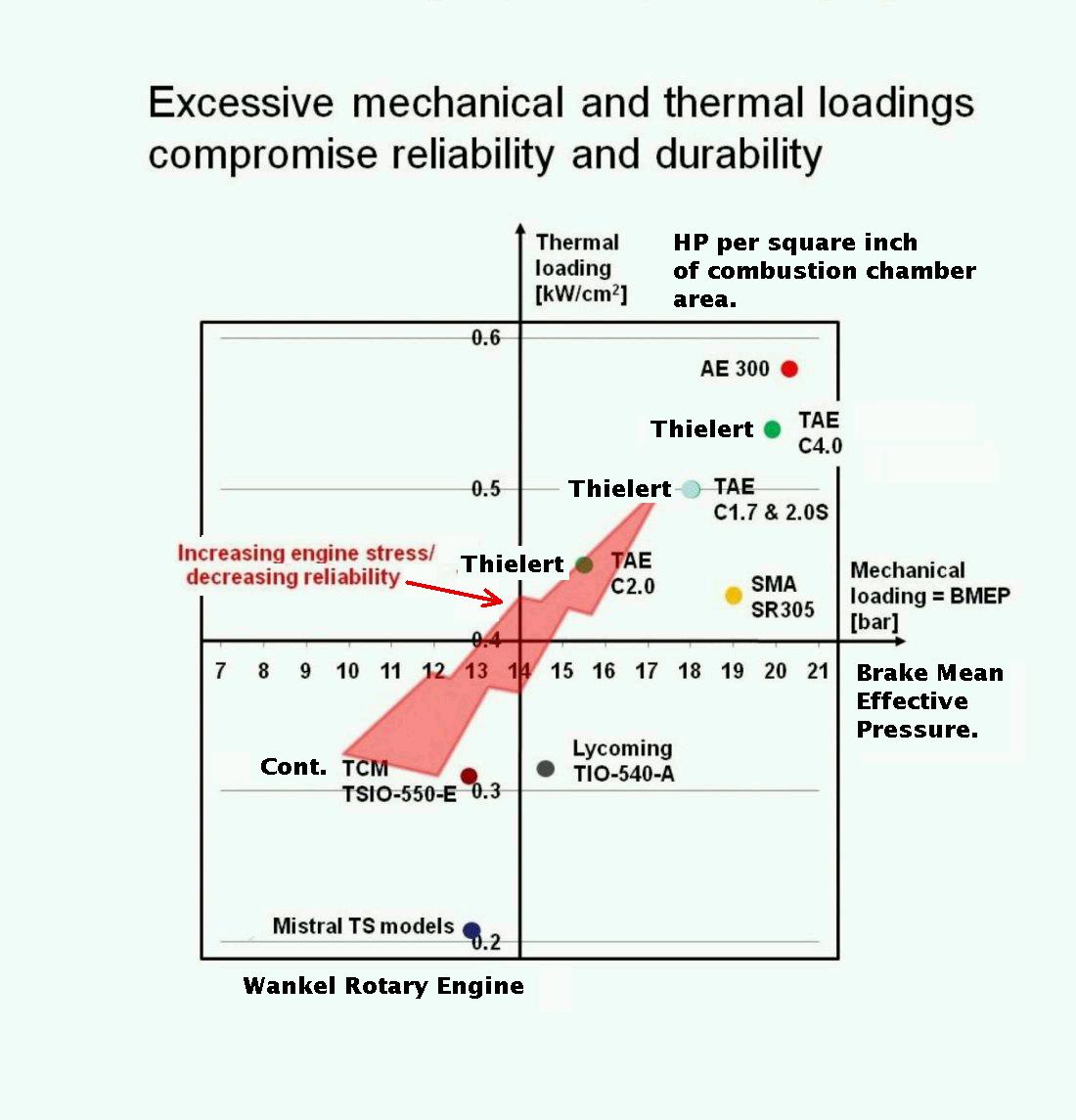
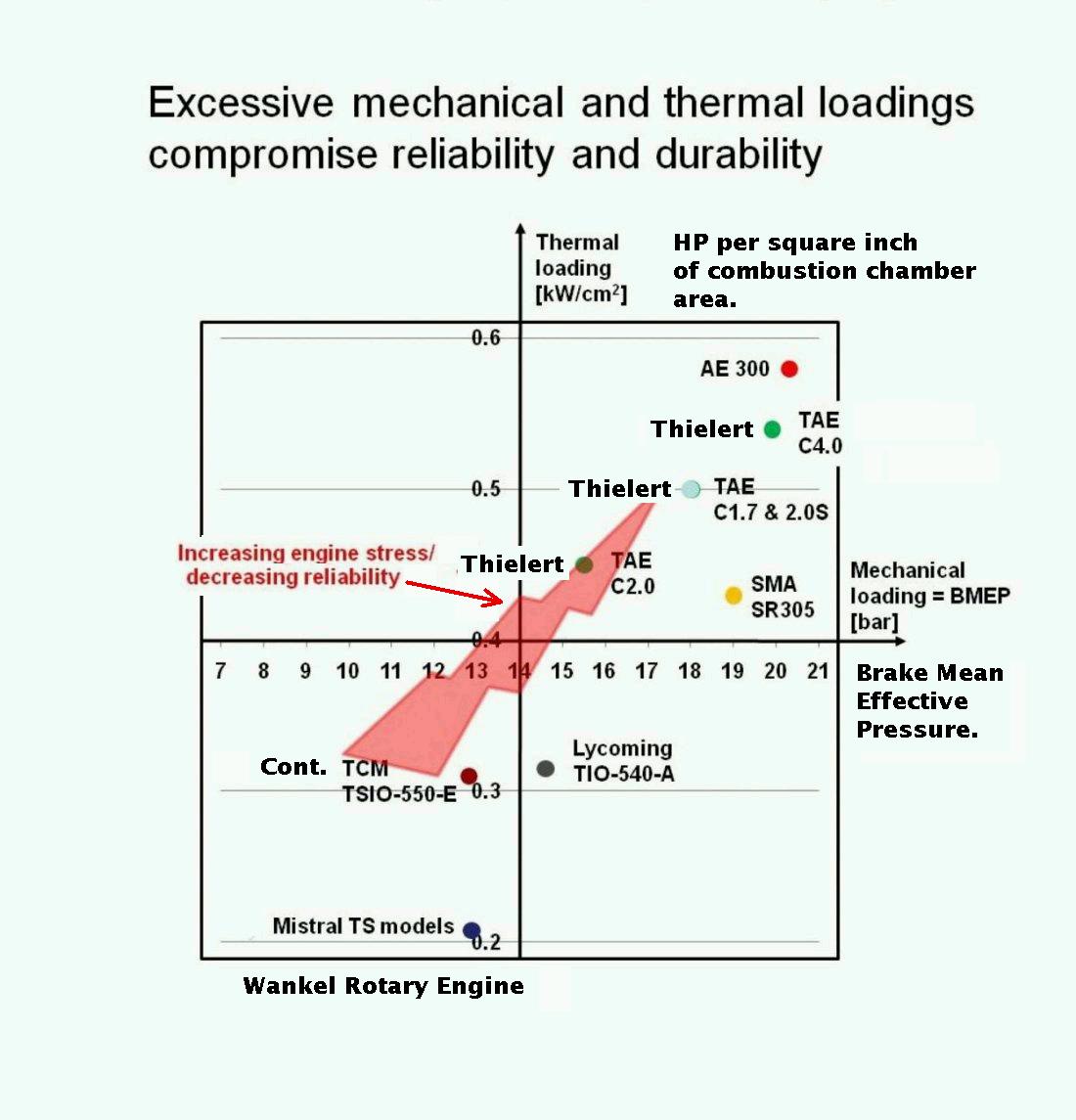
Thielert also went to the 2.0 WITHOUT increasing power to reduce mechanical
and thermal stresses on the engine, which were clearly excessive on the
1.7 (see attached chart, thermal stress is measured in kW of power per cm2
of piston/cylinder head area, one way among others to look at things...).
But, guess what? They then increased the power on the same engine to 155hp
to make the 2.0S to satisfy Cessna's power requirement for the C-172TD, coming
back to the exact same point on the chart as the 1.7. Observe where the
Centurion 4.0 is in its 350hp version (they make it in lighter-duty versions).
I know from inside sources that, although certified, Thielert was not going
to commercialize the C4.0 in its 350hp version because its lifetime would
be "a few hundred hours". Now, look where Diamond Aircraft and Austro
Engines' AE300 engine is on the chart. Sure, they kept the original MB
cast-iron block vs Thielert's proprietary aluminum block, plus a few other
improvements. But, they also increased yet further the mind-boggling
complexity of that engine. IMHO, Christian Dries [owner 0f Diamond] is
buying himself troubles. Don't you think?
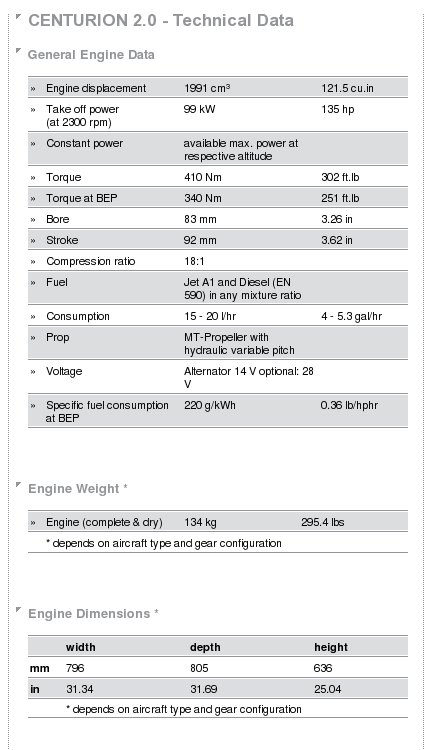
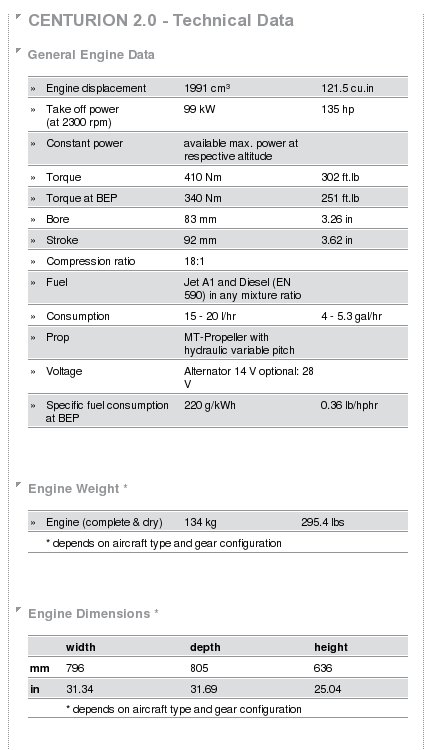
BTW, I think I know why the model number is 300. It's not displacement
(it's 1991 cm3 or 121.5 cu in), not power (165hp, 123 kW), it is torque
(304 Nm). That's a new and creative way to name engines!
Fly safely!
Francois [Mistral CEO]
Very very interesting Francois. Thanks for the report.
You don't suppose Chris Dries does not understand that airplanes fly
on HP and not torque do you? :)
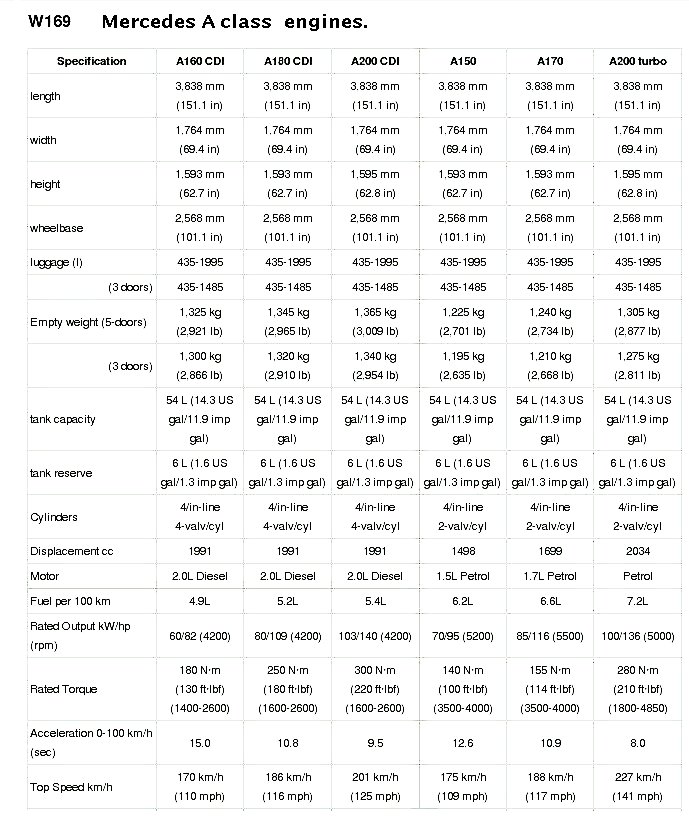
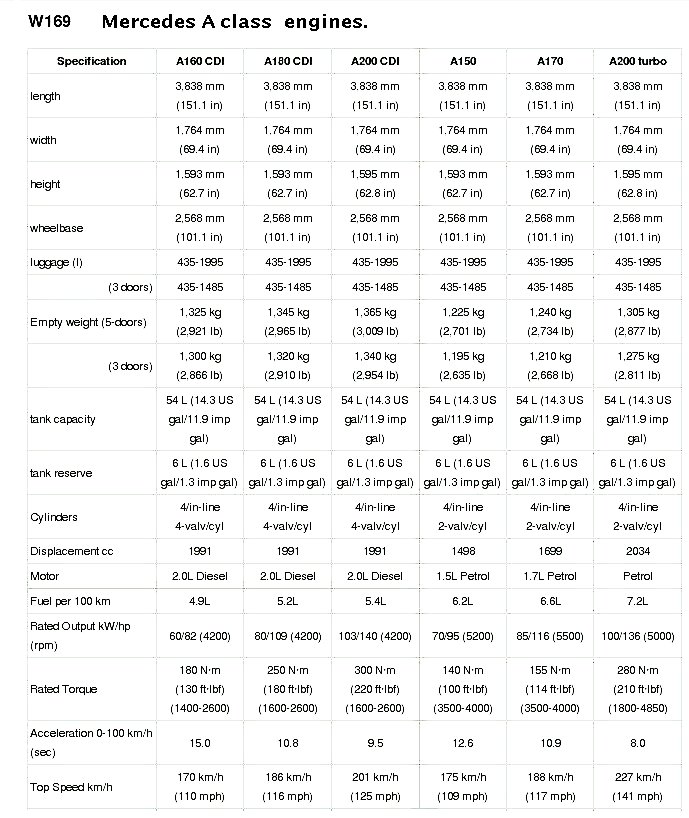
I think the "A" stems from the way Mercedes labels their engines.
All A class engine numbers start with "A" followed by the displacement
in cubic cm's.
Here are a couple of excerpts from my book "How to Cool your Wankel"
on the subject.
"The continuous HP per cubic inch of displacement and the geometry of the
combustion chamber combine to determine how much heat must be rejected
per unit time through the walls of the combustion chamber. The higher
the HP per cubic inch the more severe the cooling problem. If your
engine has 20 square inches of combustion chamber surface area to
conduct 100 HP worth of waste heat that is easier to do than conduction
200 HP worth of waste heat with the same 20 square inches of surface
area. This is the very crux of the situation in getting the heat out
of the metal and into the coolant when dealing with high continuous
(heavy duty) HP per cubic inch or high HP per pound of weight engines.
Examples of heavy duty engines are; over the road diesel truck engines,
air cooled aircraft engines and commercial boat engines. Examples of
light duty engines are car engines, recreational boat V8 engines and
light duty pick up truck engines. Light duty car piston engines are
more and more being made out of aluminum. Both the blocks and the
heads. Aluminum combustion chambers melt at a lower temperature than
cast iron but they conduct heat better than cast iron. Most really
heavy duty piston engines use cast iron and or steel combustion
chambers and cylinders. Therefore as you can imagine there is a
severe compromise in the power to weight ratio of any heavy duty
piston engine."
"A Mazda Wankel 13B rotary is indeed a small displacement engine as
it displace only about 160 cubic inches while generating 200 HP
therefore its cooling requirements appear, at first glance, to be
severe. Unlike a piston engine the aluminum combustion chamber or
rotor housing of a Mazda Wankel engine is lined with steel and is
of very large area. The steel is chrome plated which is highly
reflective and reduces heat transfer by radiation from the white
hot combustion gases to the metal combustion chamber walls. The
other very important difference is the combustion chamber moves
as the rotor turns. This is the reason the Wankel rotary engine
is sometimes called a rotating combustion chamber engine. The
metal area the combustion heat is applied too is much larger
than a piston engine."
--
Paul Lamar ...No rotor no motor.
The Rotary Engine NewsLetter. Powered by Linux.
ACRE NL web site.
http://www.rotaryeng.net
Youtube key word UTUBPLEASE
Copyright 1998-2008 All world wide rights reserved.