Hi Paul,
I'm not an aeronautical engineer, so I truly don't know the answer
to this question and it's bugged me for a long time, but now that you
have some interest in the canard (I think it was a Cozy you were looking
at, but I don't have the specific email now, so I'm not sure) perhaps
you'll roll this one over in the back of your mind in-between all the
other questions you consider. Is there any practical, simple, efficient
way to put flaps on a canard airplane?
The prevailing belief is just to "keep it simple" and land pretty
fast. The adage "When you fly fast, you land fast" still seems an
impregnable wall, but does it have to be that way especially on
composite aircraft where damned near any structural form and light
weight is possible? Everyone says "It's just too complicated, but is it
really? Looking at it through rather foggy glasses, I can see that you
would dramatically increase the potential for flutter, but are the
mechanics and dynamics of it as tough as we hear for aircraft that will
always likely be in the 200 to 300 knot range for the vast majority of
designs? If that nut could be cracked, it looks like the canard could
be a very fast heavy lifter that was also very forgiving. Any thoughts?
Robin
Flaps cause a pitch down moment on any aircraft as they move the center
of lift aft on the wing.
The canard Beech Star ship swept the canard back for flight
and forward for landing with flaps to counter the pitching moment.
It can be achieved if you mount the canard on rails and move it back
and fourth.
The energy in a crash is the square of the crash speed.
That is why the FAA specified 61 kts for the stalling speed
of single engine aircraft. If you crash a twin or a common run of the mill
canard consider yourself dead :) Yes.. they don't stall. They just fall
out
of the sky. Anything will fall out of the sky if you get it slow enough.
If
you
are too close to the ground and the canard stalls you are going
to hit real hard on the nose. If you are in a hard turn and the canard
stalls
the airplane is going to make a sharp turn towards the ground.
--
Paul Lamar ...No rotor no motor.
Wait a minute Paul, none of the Rutan canard airplanes point the nose
at the ground with the stick against the stop (if they are rigged
properly and the CG is correct). They are all about level because the
canard is generating a fairly small percentage of the total lift as
compared to a conventional airplane where the wing generates _all_ of
the lift.
With the power off, my Varieze flies minimum speed (I'd guess) about
10deg nose up. The only time the nose comes down is (as you said)
while in a turn and pulling.
Some numbers to back this up:
I think I recall my Varieze comes down at around 900 ft/min at minimum
speed (~60mph). That's 5280ft/min / 900ft/min = 5.7:1 = 9.7deg. The
canard stalls when the AoA is around 15deg which puts the nose about
5deg (so, I was off a bit) above the horizon. Some of these airplanes
have the main gear trimmed so that the deck angle is 2-4deg, so if you
touch down power-off at minimum speed you might hit all three gear at
once.
Even so, if you hit the ground at min flying speed (bobbing the
canard) without power, 900ft/min is the thing that kills you -
regardless of the attitude. It's going to wipe out all three gear and
then your back, and maybe some internal organs..
In a Cessna if you do that, you're going to wipe out the firewall -
and then your legs and then your neck. I think the BRS equipped
airplanes are the only ones that can come down safely "fully stalled."
As far as flaps on a canard airplane, I have another idea (from the
variable geometry canard). How about design the canard so that one
portion of (the span of) the trailing surface is flap (and possibly
pitch trim) (adjusting with the trailing edge surface on the main
wing) and the other section is elevator - providing pitch control.
Obviously the span of the canard (and/or the airfoil) would be
different from one of Rutan's birds, but I don't see that as a big
problem. I can't decide whether to make the inboard section of the
canard flap or elevator. Ideas?
Regards,
Matt-
Pilot eye witness account of Paul Conner's fatal crash. Makes sense
when the canard stalls at near 90 degrees as it loses the now vertical
component of the lift vector holding the nose up in a turn. The rudders
behind the CG cause the aircraft to yaw towards the ground.
Canard stalled in near 90 degree bank, airplane pointed to the ground,
he was unable to completely pull out and recover forward speed in time.
Plane sank in vertically through the trees while oriented in a
more or less horizontal plane. Buried one tire so the top could not be seen.
Fairly hard dirt when I saw it the next day. There was hardly any forward
motion to the aircraft at all. The gear deflected and the tires hit the
bottom
of the wing. The aircraft than jumped up and back when the gear gave back
the
stored energy shearing the bolts holding the axle on.
--
Paul Lamar ...No rotor no motor.
That sounds like how the Berkut went in at Santa Paula some years back. I
don't know if anyone has tried this and it would be complicated on a canard
but Handley Page type leading edge slats might work well on a Vari-Eze
configuration. You would have to have slats on both the wing and the canard
as well as balance the design so the canard quits flying first but I think
this might work. You would also have to be careful about prop clearance.
Steve Brazil
I don't know if leading edge devices are what the canard airplane
needs. My impression is that such devices increase the maximum angle
of attack but don't necessarily increase the maximum lift coefficient.
I think most of these canard airplanes really need more lift
coefficient - to produce more lift at a lower airspeed - while
maintaining a reasonable AoA. What they really need is fairly
aggressive fowler flaps - increasing effective wing area... I don't
have data to support this.. :)
Matt-
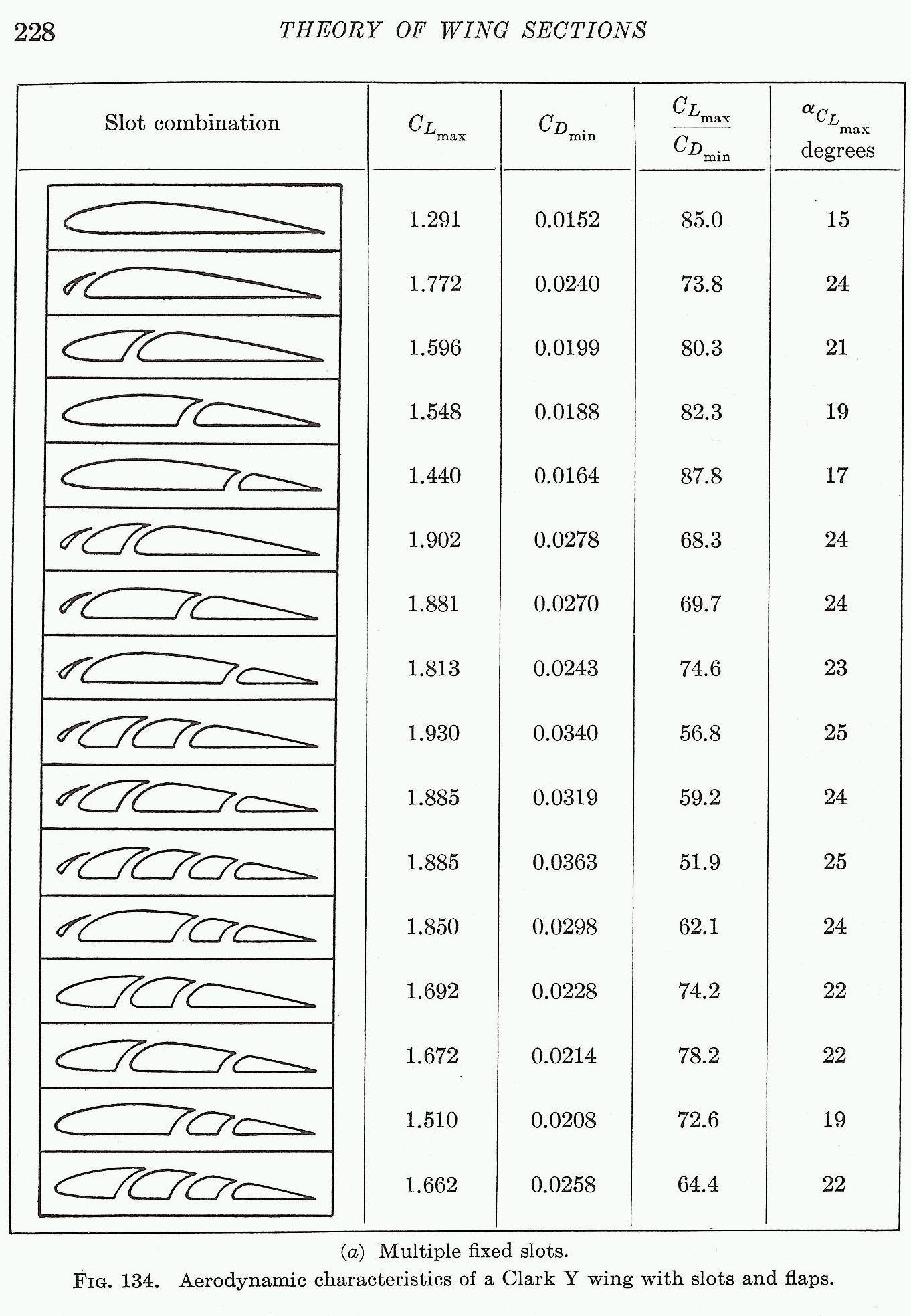
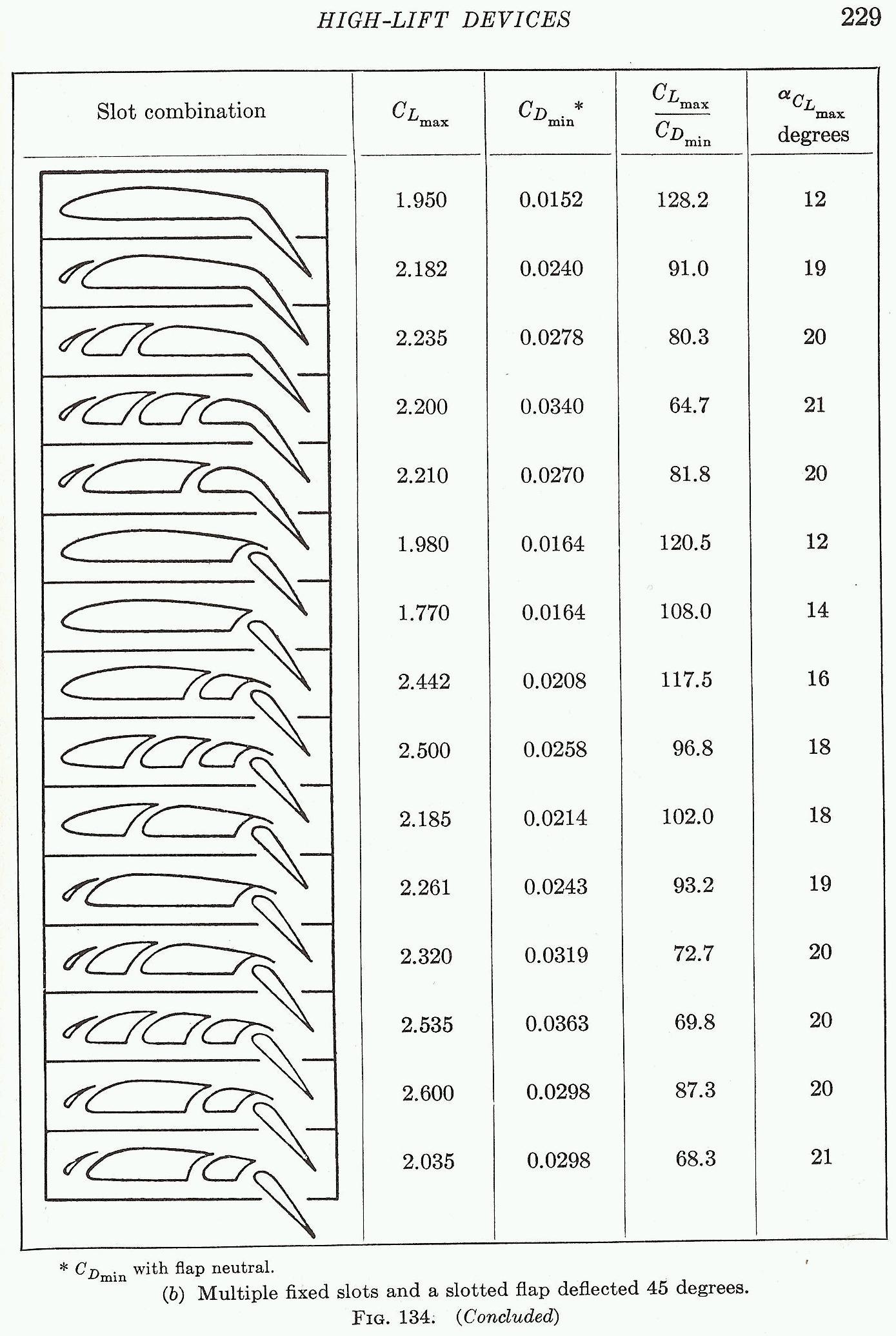
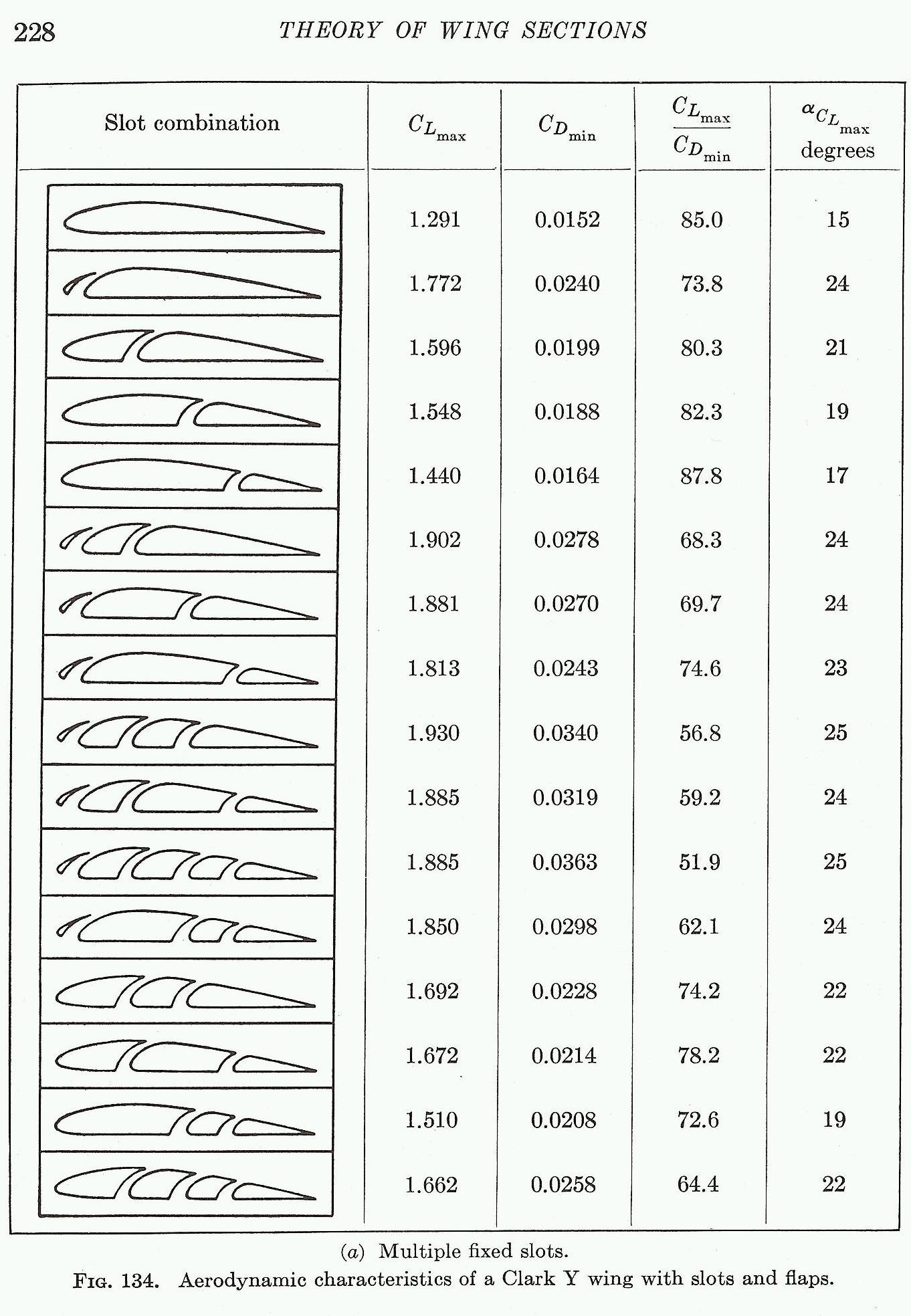
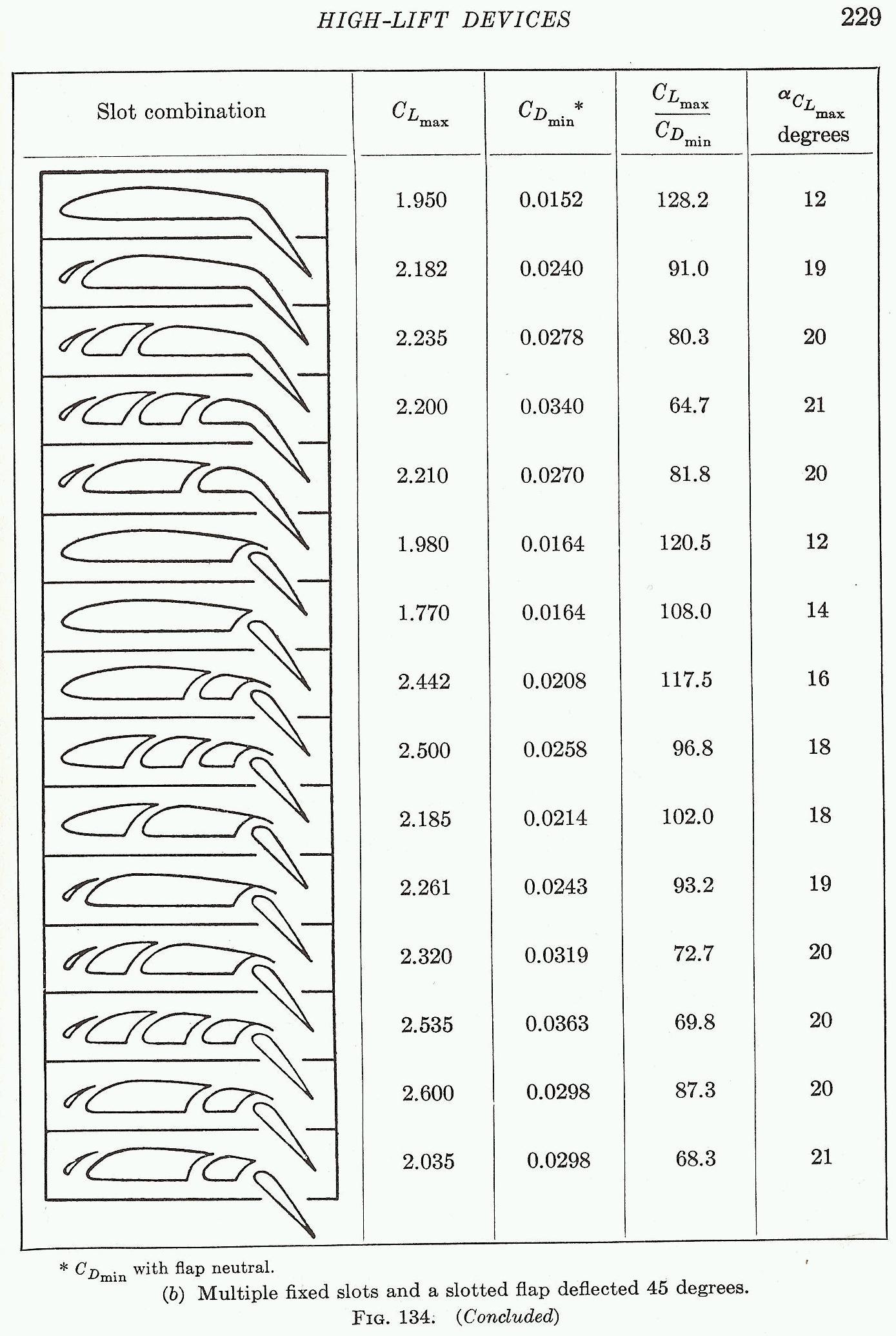
Slats do both Matt. It increase the max angle of attack and increase the lift coef.
The aft center of lift travel may not be as bad as Fowler flaps so it may be a good solution
for a canard. Here are some scans from Von Doenhoff. A fixed slat would almost double
the drag.
--
Paul Lamar ...No rotor no motor.
The Rotary Engine NewsLetter. Powered by Linux.
ACRE NL web site.
http://www.rotaryeng.net
Youtube key word UTUBPLEASE
Copyright 1998-2008 All world wide rights reserved.