Hi, gang!
I put forth this suggestion to apply it to very lightweight vehicles,
such as SLA's and light automobiles such as the Ariel Atom.
What if we turbocompounded the exhaust of a normally-aspirated Wankel
rotary engine, but did
_not_ send the extra power to a compressor
turbine to turbocharge the incoming air?
I know that you wrote in
http://www.rotaryeng.net/sum-turbo-comp.html:
"If you just want to fly without a supercharger and you can live with
20% more power and a 20% lower BSFC at that power at sea level you can
forget the supercharger and the inter-cooler and go with just the blow
down turbine."
So, an RX-8 engine weighs about 200 pounds. We install the lightweight
Mazdatrix side panels and reduce the weight to 150 pounds. If
turbocompounding by itself adds 20% horsepower, and the factory says
that a normal RX-8 engine gets 238 horsepower at sea level . . .
238
X 0.20
__________
0
476
0
__________
47.60 horsepower
238
+ 47.6
_______
285.6 hp from a 150 pound engine! :-)
with no added fuel consumption. Very nice. And we leave off the
weight, complexity and failure modes of a turbocharger and its ancillary
systems.
BUT
The NACA report stated: "Analysis has shown, however, that the waste
energy of exhaust gases is recovered more effectively by maintaining an
engine exhaust pressure higher than the minimum required for turbo
supercharging and thus increasing the work output of the exhaust-gas
turbine. The extra turbine power beyond that required for supercharging
Can be supplied to the engine crankshaft through suitable gearing
(compound operation)."
- MUST a turbocompounded rotary, for some reason(s) also be
turbocharged (as the NACA report seems to imply)?
For example, the NACA report states: "by maintaining an engine
exhaust pressure higher than the minimum required for turbo
supercharging and thus increasing the work output of the exhaust-gas
turbine . . . " That sounds like we MUST turbocharge the engine
(that is, place the intake side of the engine under pressure) for
turbocompounding to work.
Is that so?
- If a Wankel rotary engine were ONLY turbocompounded, would the
turbocompounder be the same as the turbocompounder that would
have normally be hooked to a turbocharger? Or would it necessarily
be of a different design, since it does not transmit power to
a set of compressing blades?
- Are there any issues of just turbocompounding (without turbocharging)
that we should be aware of?
Thanks,
Les Nordman :-)
I think the people that wrote that NACA report missed a point.
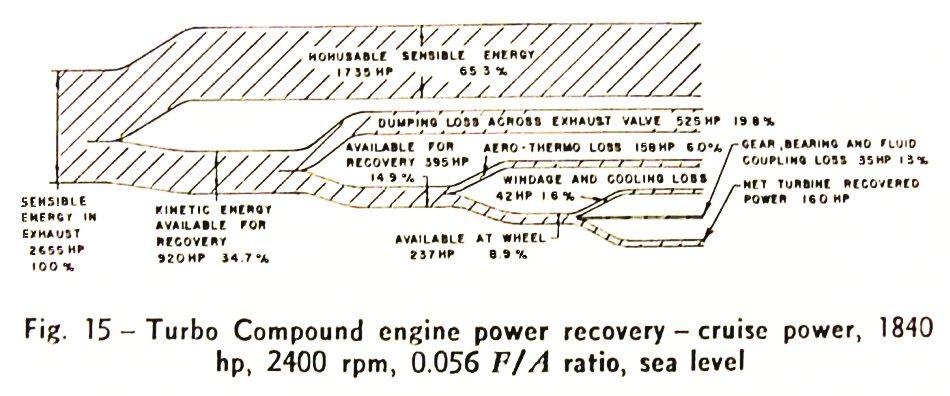
The energy from the exhaust is in two parts. Kinetic energy
and pure heat energy. Kinetic energy is the blast of air coming out
of the exhaust. The temperature has nothing to do with it directly.
It is purely the motion of the air. The best analogy is a windmill.
Think of a turbine blade as a wing. The lift on that wing is proportional
to the velocity of the air SQUARED!!!! You want to keep the speed of the air
high.
Yes if you have given quantity of air moving in a pipe and you heat
that pipe the air coming out will speed up because the air wants
to expand. Since it is constrained from expanding radially it must expand
in the direction of the pipe. This is the fundamental principle of all internal
combustion engines. If you put an obstruction in the pipe the hot air will
transfer some of its kinetic energy to the obstruction in the form of heat
and the cooler air beyond the obstruction will contract and slow down. The obstruction
will also cause back pressure in the pipe upstream.
An exhaust valve is such an obstruction. That is the point the
NACA writers may have missed when writing about a turbo compound rotary.
At a GIVEN HP the velocity of the air coming out of the pipe matters
not if the engine HP is made by a turbo charger instead of being normally aspirated.
The turbine extracting the HP for the crankshaft does not know or care.
If you reduce the pipe diameter the air will speed up. For a lower HP engine
you need a small pipe so the air velocity is still high. Variable vanes
in effect change the diameter of the pipe.
It is easier to think of the situation in terms of exhaust velocity
rather than in terms of pressure. Yes a turbine causes back pressure
and this affects the engine in a negative way as this pressure on the
rotor during the exhaust stroke works against the HP generated.
Fortunately this is a minor effect compared to the HP you get
out of the turbine.
Paul Lamar ...No rotor no motor.
The Rotary Engine NewsLetter. Powered by Linux.
ACRE NL web site.
http://www.rotaryeng.net
Youtube key word UTUBPLEASE
Copyright 1998-2008 All world wide rights reserved.