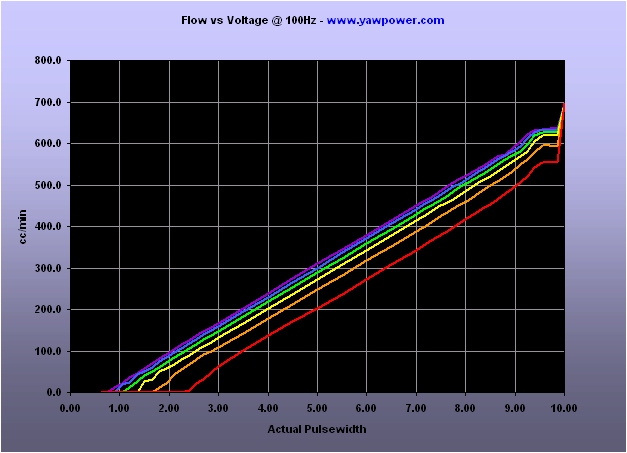
What size type of injectors should I be using? Has anyone used units
from SDS? They also have the bosses that can be welded into the intake.
I am using 2nd gen P Port configuration. Does Tracy's controler
require a specific type of injector? I believe I need 4 injectors?
Thanks for any help
Joe Berki
Limo EZ
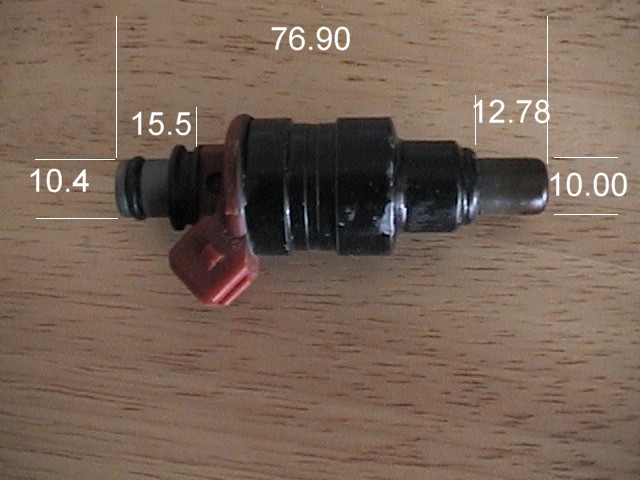
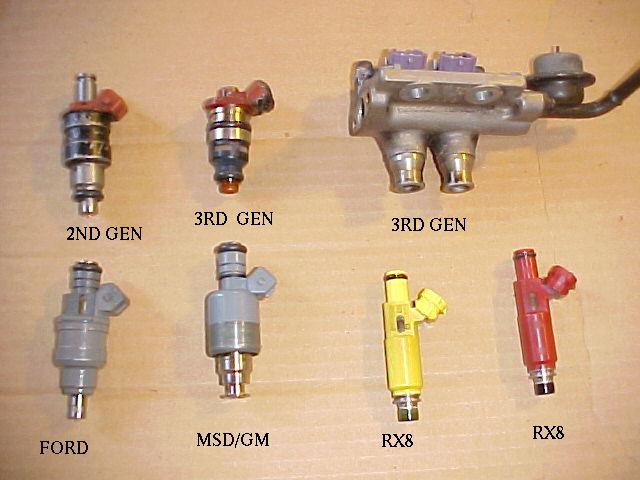
There is a whole range that will work Joe. I kind of like the new ones
that are small in diameter like the RX8 style. Easier to mount. I think
Bosch pioneered this type.
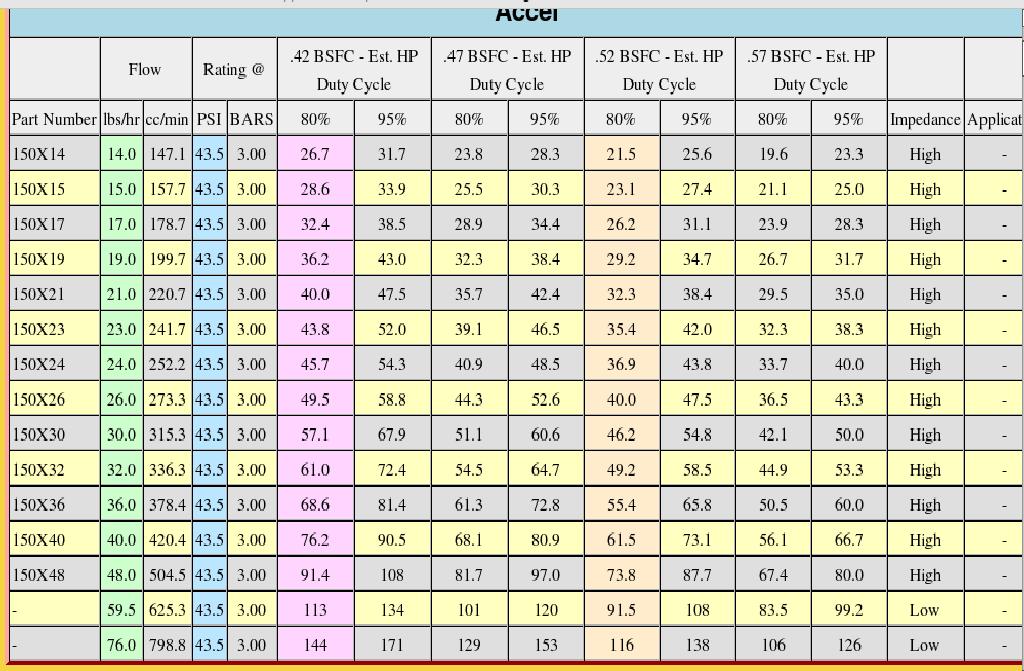
Here is almost everything you ever wanted to know about injectors :)
For a given HP injectors are pretty much the same. There are two kinds of
coils. Shock and hold and simple. Check with Tracy on which type he prefers.
You can tell by the resistance measurement.
The yellow RX8's are 14 ohms which is probably the simple kind.
The Ford is 14.6 ohms.
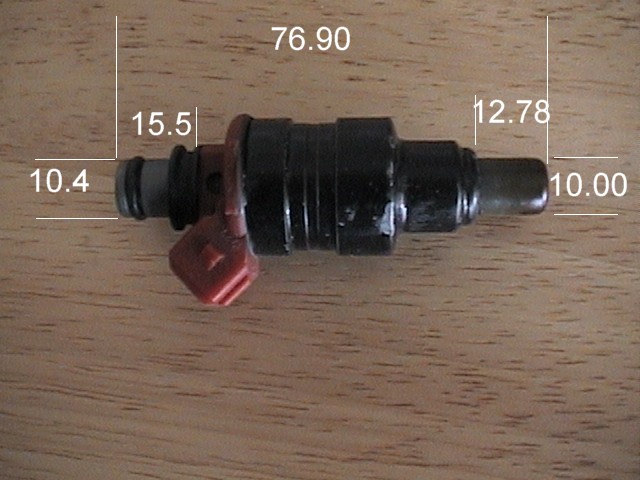
The 13B is 2.3 ohms which is the shock and hold style. Nippon Denso.
The MSD, GM, Lucas, etc., etc. is 2.1 ohms also shock and hold.
The 555 type EFI controller will use the simple kind.
Paul Lamar ...No rotor no motor.
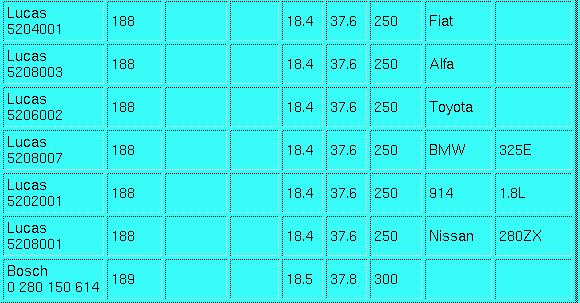
Fuel Injector Flow Rates compiled by steve@aems.com.au
Injectors listed by flow rate, from lowest to highest
Manufacturer___Part Number__cc per____Colour_____Ohms___lbs per___Est___Press__Vehicle Engine
_____________________________minute_______________________hour_____HP____Kpa
**********************************************************************************************
Nippon Denso__________________250__yellow/orange__1.7_____24.5____50.0____255___Toyota____22RTE
Nippon Denso__________________250_________green__13.8_____24.5____50.0____290--Toyota_____4AGE
Nippon Denso__________________250________violet 13.8_____24.5____50.0____290 Toyota_____4AGE
Nippon Denso__________________250_________brown 13.8_____24.5____50.0____255 Toyota_____3SGE
Nippon Denso__________________251________violet 13.8_____24.5____50.2____290 Toyota____1UZFE
Nippon Denso__________________282___light green 13.8_____27.6____56.4____290 Toyota_____2RZE
Nippon Denso__________________282________violet 13.8_____27.6____56.4____290 Toyota____2TZFE
Bosch________0 280 150 802____284_________________________27.8____56.8____300 Volvo B200Turbo
Nippon Denso__________________295________yellow___2.7_____28.9____59.0____255 Toyota_____7MGE
Nippon Denso__________________295________pink_____1.6_____28.9____59.0____255 Toyota____22RTE
Nippon Denso__________________295________green___13.8_____28.9____59.0____255 Toyota_____3SGE
Bosch________0 280 150 811____298_________________________29.2____59.6____350 Porsche__944 Turbo
Bosch________0 280 150 200____300_________________________29.4____60.0____300 BMW________
Bosch________0 280 150 335____300_________________________29.4____60.0____300 Volvo B230 Turbo
Bosch________0 280 150 945____300_____red/brown___________29.4____60.0_________Ford MotorSport
Nippon Denso__________________315_______pink_____13.8_____30.9____63.0____290 Toyota_____3SGE
Nippon Denso__________________315___light green__13.8_____30.9____63.0____290 Toyota_____7MGE
Bosch________0 280 150 402____338_________________________33.1____67.6____300 Ford________
Bosch________0 280 155 009____346_________________________33.9____69.2____300 Saab____Turbo
Bosch________0 280 150 951____346_________________________33.9____69.2____300 Porsche______
Nippon Denso__________________365____red/orange___2.9_____33.9____73.0____255 oyota____4AGZE
Bosch________0 280 150 024____380_________________________37.3____76.0____300 Volvo_____B30E
Bosch________0 280 150 036____380_________________________37.3____76.0____300 MB________4.5L
Bosch________0 280 150 043____380_________________________37.3____76.0____300 BMW__________
Bosch________0 280 150 835____397_________________________38.9____79.4____300 Chrysler____
Nippon Denso__________________430_________black___2.9_____42.2____86.0____255 Toyota__7MGTE,3SGTE
Bosch_________R 280 410 144___434_________________________42.5____86.8____300 Bosch R___Sport
Bosch_________0 280 150 400___437_________________________42.8____87.4____300 Ford_____4.5L
Bosch_________0 280 150 401___437_________________________42.8____87.4____300 Ford_________
Bosch_________0 280 150 041___480_________________________47.1____96.0____300 MB_______6.9L
Bosch_________0 280 150 403___503_________blue____0.5_____49.3___100.6____300 Ford_________
Conversion From cc per min to lbs per hour to HP.
500cc per minute is approximately equal to 49lbs per hour which is equal to approximately 100 HP.
Common conversions
lbs/hour = cc per minute / 10.2
lbs per hour = HP / 2.04
cc per minute = lbs per hour x 10.2
cc per minute = HP x 5
HP = cc per minute / 5
HP = lbs per hour x 2.04
Note: This is a rough guide for conversions and flow rates.
If you have any information that would help in increasing the quality of this data base,
please send email to steve@aems.com.
Paul,
Thank you for the info. I need 4 injectors for redundancy. Should they
be sized so that I use all 4 ie 4 250cc injectors Nippon Denzo or 4
503cc injectors Ford and leave 2 of them off? There is no primary and
secondary with a P Port? Thanks again
Joe Berki
Limo EZ
That is a good question Joe. Tracy has a fail safe mode
where if one of the injectors fails the other can go to a wide pulse
width. The question how wide and what injector.
Some injectors can handle 100 HP each and others can only handle 50 HP each.
I would still use four no matter what. I would use 60 HP injectors as
a minimum. 4 x 60 = 240 HP.
I am thinking of a way of throwing
a switch in the 555 system to go to wide pules mode and use the 100 HP injectors.
It would be good if you could get full power with one failed injector.
I don't think you can do it with the RX8 injectors but I don't have any flow
data on them yet.
Paul Lamar ...No rotor no motor.
Paul,
Check these out. I have purchased four of them. Fast, small, large flow
and, are OK for flex fuel. Simens DEKA IV. Four little holes with good
performance even at low flow rates.
Specs here.
http://www.bmotorsports.com/shop/product_info.php/cPath/144_146/products_id/448
Calculation. Given max. injection duration (intake cycle) equals <120
degrees. Actually about 105 degrees to avoid port overlap. At 6,000
rpm, it requires 1/100 of a second or 0.01 second. to complete 120
degrees of arc. Think of this as the intake event.
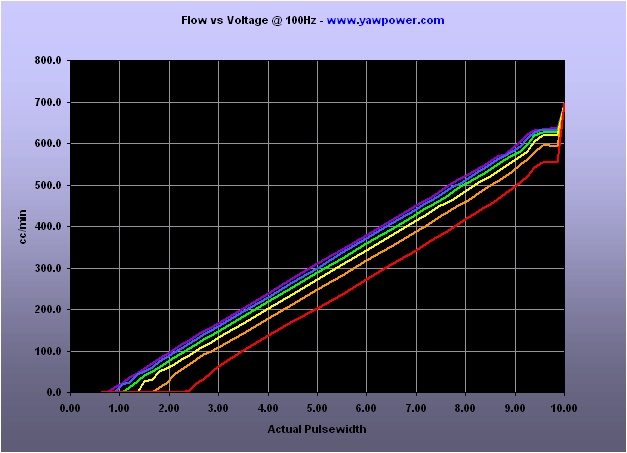
These injectors turn on in 1.14 ms and off in .85 ms. Total is 2.99 ms
or call it 3 milli secs.
or 0.003 of a second. Even at 8000 rpm and 100 degrees of injection
duration (delay start of injection until exhaust port closes), there is
still gobs of time to inject the require amount of fuel needed while
keeping the duty cycle low. If one injector craps out the remaining
injector duty cycle can be doubled without a sweat.
Doug in Japan
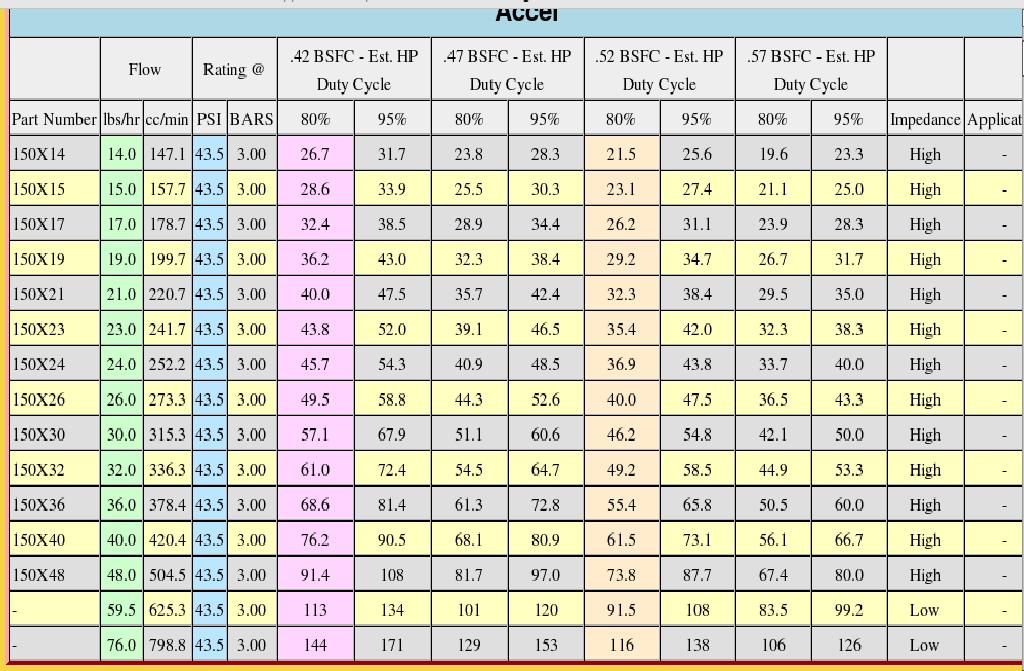
Wow!!! you got that right Doug. 60 pounds an hour is 10 gallons an hour per injector.
40 gallons an hour for four. At a BSFC of .6 that is 400 HP!!!
Great injector. Small too. Ideal for P-ports.
I am sold. I am buying four. No use messing around with marginal RX8 injectors.
--
Paul Lamar ...No rotor no motor.
Paul,
Great choice. You will enjoy them. Some people I know run them at
higher PSIs and claim as much as 90 lbs/hour per injector which is way
over our needs.
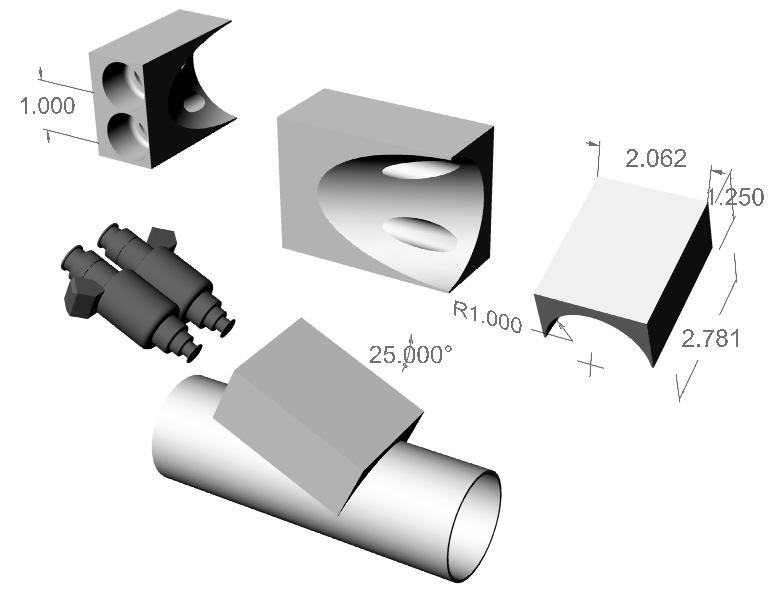
For direct placement in the housing this is what I plan to try:
Bore two angled holes in the rotor housing on each side and parallel to,
the oil injector boss. Next lightly press and ring weld two alumunum
25mm dia. 15mm long plugs in the holes with the low melt point new alloy
brazing. After that, end mill bore a 19mm dia hole through the center
of the plugs and bottom it out against the back side of the metal rotor
housing line. Next take a 19mm OD dia/ 15mm ID pipe and ream the
inside out a hair as well as turn the outside down for clearance. An
upper and lower (inside- outside) O-ring groove needs to be cut on the
pipe. The injection hole will be about 5mm dia and slightly tapered from
the inside. This will put the injector close to the inner housing to
take advantage of the wide spray cone, but far enough back not to
contact the Apex seal. The 19mm pipe complete with O-rings is hand
pressed into place. Properly done it can`t leak water either into or
out of the housing. If desired, a set screw can be installed in the
outer boss perpendicular to the injector mount pipe to assure it does
not move. Finished with the injector installed into this pipe, bring
the wire and fuel rail connector real close to the housing so I believe
the manifolds can wrap over head. Wires and well and fuel lines can
come from the cool side.
The challenge is adjusting the best moment to begin the injection event,
but the advantage is that we put the small slide throttles ( yes thats
plural) right smack up against the housings.
I having a big steel jig being made now by the local shop so I can can
rotate the rotor housings to one of five fixed positions within it
accurately and repeatly. I need various holes on each side and top of
the test engine. I`ll send pictures when the jig is done
Doug
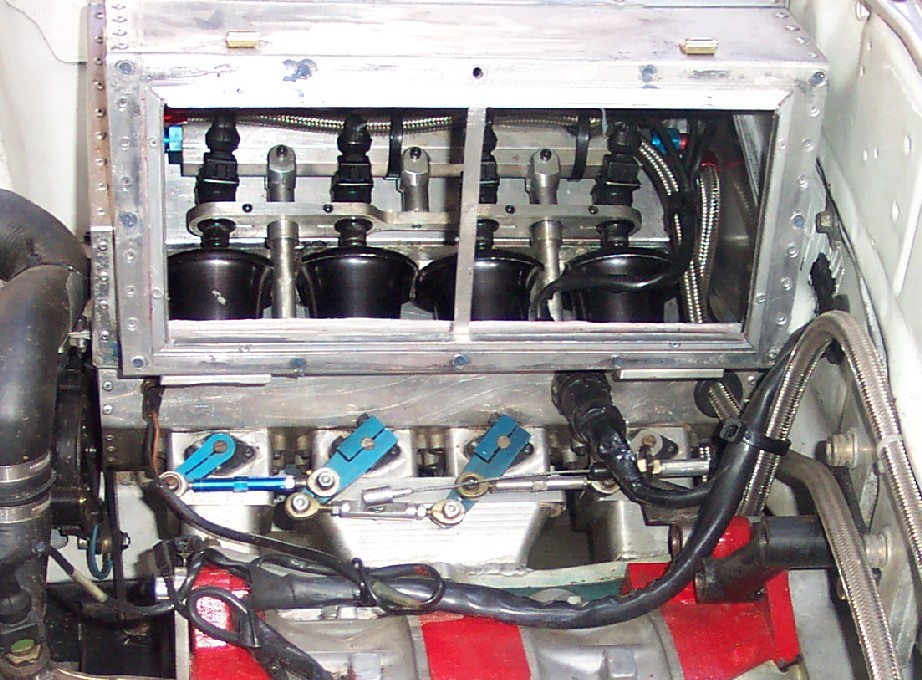
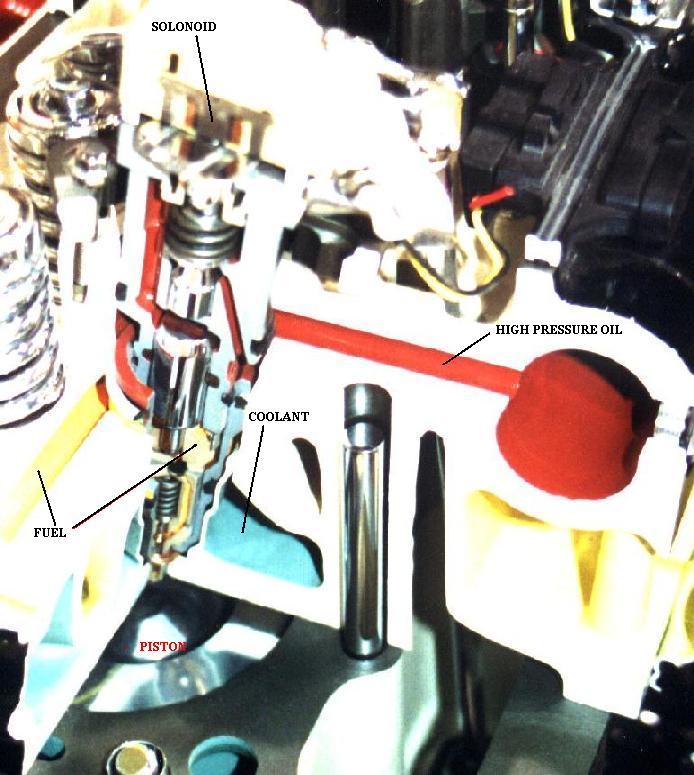
IMHO I think you will be disappointed in relatively low pressure (50 psi) direct injection
Doug. The fuel does not have enough time to evaporate. The new direct injection
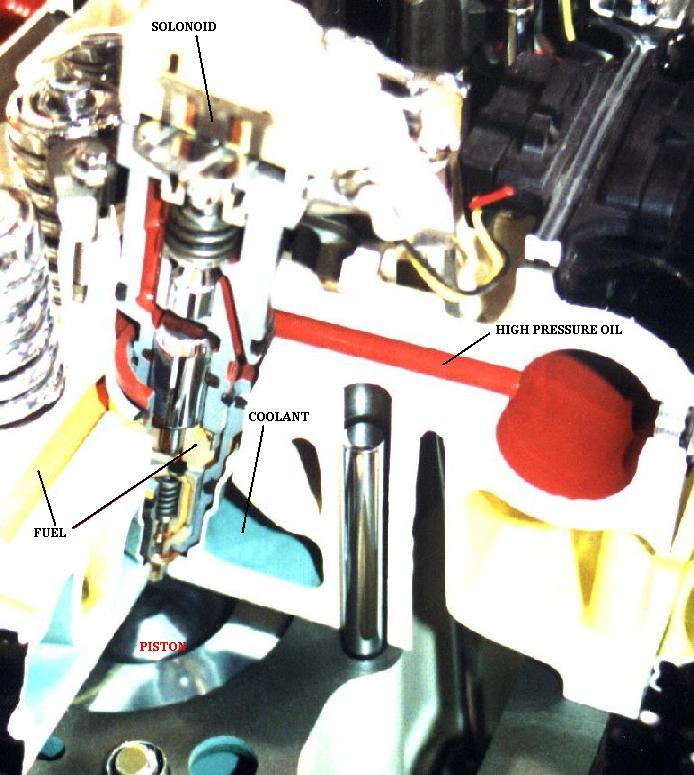
diesel systems are using upward of 20,000 psi. First picture. There is a measurable decrease
in BSFC by injecting at the start of the runner. Second picture. Racing Beat reported
this during dyno runs. Also the fuel cools the air in the runner increasing power.
No harm in trying again however. One can always go back.
--
Paul Lamar ...No rotor no motor.
Paul,
We have been down this road before I think. It seems over the years I
have heard a lot of conflicting opinions on the subject. Case in point
Mistral got their best BSFC injecting near the housing in the inside
ports, after the tried out near the ends as you suggest. Steve Beckham
and Everetts had good results (with other side effects of course) by
injecting against the hot rotor directly thus vaporizing it the spray
but perhaps losing some fuel to the exhaust., Lastly, the Lemans engine
had the injection right after the slide throttle and perhaps three
inches from the inside port. None these situations had injectors that
could deliver fuel so rapidly as the Deka 1V so one half of the time the
Mazda injectors are spraying into a closed chamber before the port
opening causing the fuel to hit the walls and condense.
Their are advantages and disadvantages of course for, Correct me if I am
wrong but the gases in the chamber rotating from the intake port to
about 120 degrees after that is not experiencing positive pressure yet.
In fact when the injection event starts, and there is an hot rotor a few
inches, away, the intake chamber is a minus pressure.
Yep injecting out near the bell mouths would definitely cool the charge,
and may even cause condensation which is of course counter productive.
Works in racing car environments obviously because they have a
tremendous amount of heat contained in a fairly tight cowling. I won't
have that problem with only a few inches of boost, Teflon manifold,
ethanol based fuel E-85, and having an intercooler in between. Sorry I
don't particularly like the idea of creating an explosive mixture in a
thin walled container, that is open to the atmosphere all of the time.
One backfire and the manifold and possibly a lot of cowling is toast.
As I understand it, for direct injection engines, the pressures have to
be enormously high because the injection occurs when and where the
compression is at it's highest.
But in any case you are correct, direct low pressure injection is worth a
try and I can always mount them outside on the manifold if I'm not
satisfied with results. The name of the game is striving for complete
fuel burn whether that comes from speeding up the flame front by adding
a smiggen of H202 gas on the end of the intake stroke or increasing the
vaporization of the fuel.
Doug.
The short pulse idea is interesting. I think the Lemans engine mentioned
injecting the fuel at the start of the runner but they chose
the closer position for throttle response reasons. In a road racing situation
good throttle response is critical. Also it was more difficult to fabricate because
of the changeable runner length. In Formula 1 the runners are only inches long
as the RPM is 19,000. In any event the BSFC differences are minor.
I am not advocating injecting the fuel before the intercooler.
Early diesel engines worked on moderate pressure. Nowhere near 20,000 psi.
20,000 psi is a relatively recently development where engine oil pressure is
used to enhance fuel pressure in special 2 stage fuel injectors.
Lets run through some numbers to put things into perspective.
6000 RPM is 100 revs a second. or .01 seconds or 100 msecs per rev.
The injector fires once per rev. 100 msecs divided by
360 is .27 msecs per degree of e-shaft rotation.
Injectors are rated for HP at 85% to 95% duty cycle.
Lets say each injector is 10 gallons an hour at 85% duty
cycle for gasoline. Alcohol will be much higher.
At cruise and a fuel burn per injector of 3 gallons an hour
the injector will be on 3/10 of 85% or 25% of the time.
It takes 3 msec to turn on and 1 msec to turn off.
At 6000 RPM we have 100 msecs minus 4 msecs or 98 msec to work with.
25% of 98 msecs is 25 msecs.
We need to be on 25 msecs to get the fuel we need with gasoline for cruise.
25 divided by .27 msecs per degree is 93 degrees. The intake port is open
270 degrees. Looks good at this point. Shows the advantage to a high flow injector.
Check my arithmetic and reasoning.
Now as far as the fuel spit back problem of tuned manifolds with injectors
mounted on the runners is concerned the exact time the air flow flows out the
end of the runner should be avoided when injecting fuel.
If direct injection is chosen just after the intake port closes but the
pressure will build up reducing the flow from the injector during the
compression stroke probably cutting off the flow completely after
100 degrees or so with only 50 psi. IMHO it looks like you need to start
injection well before the intake port closes.
Again check my arithmetic and reasoning.
--
Paul Lamar ...No rotor no motor.
The Rotary Engine NewsLetter. Powered by Linux.
ACRE NL web site.
http://www.rotaryeng.net
Youtube key word UTUBPLEASE
Copyright 1998-2008 All world wide rights reserved.