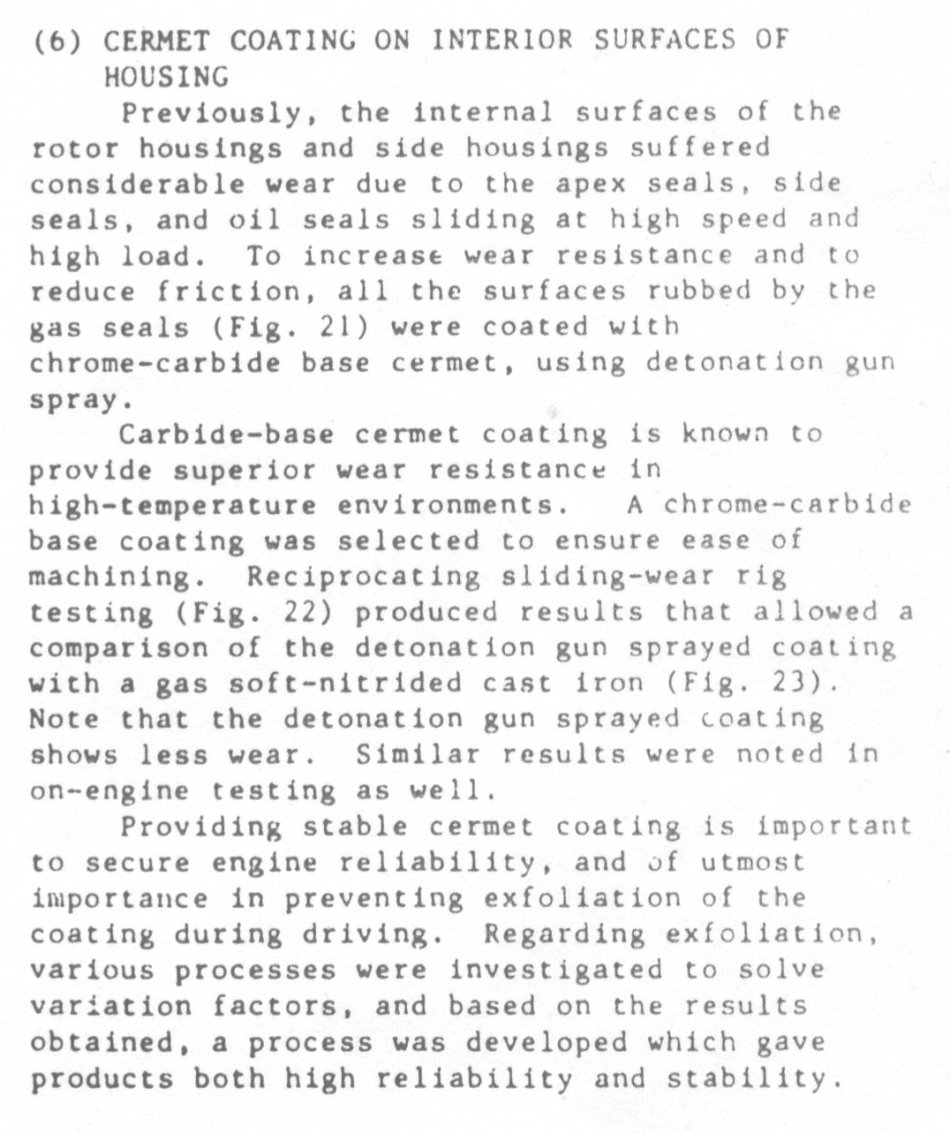
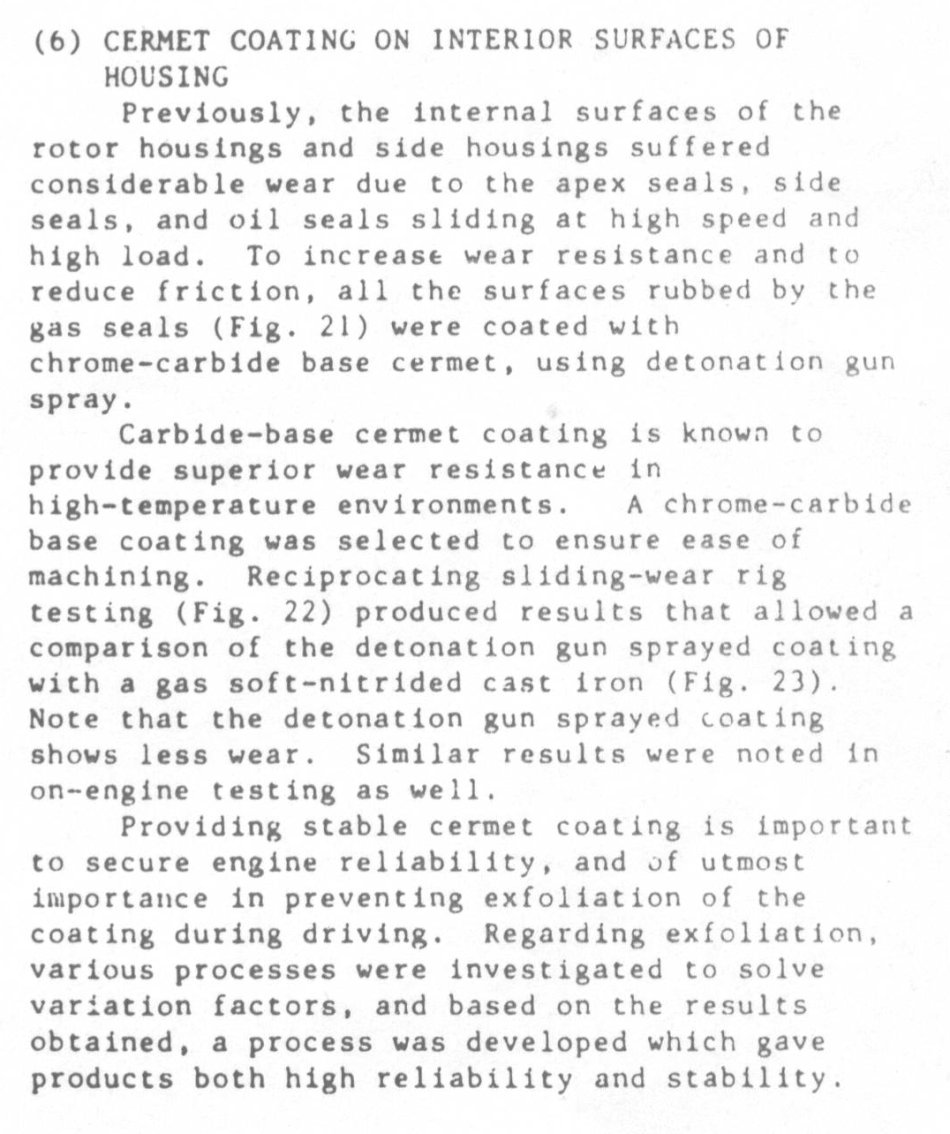
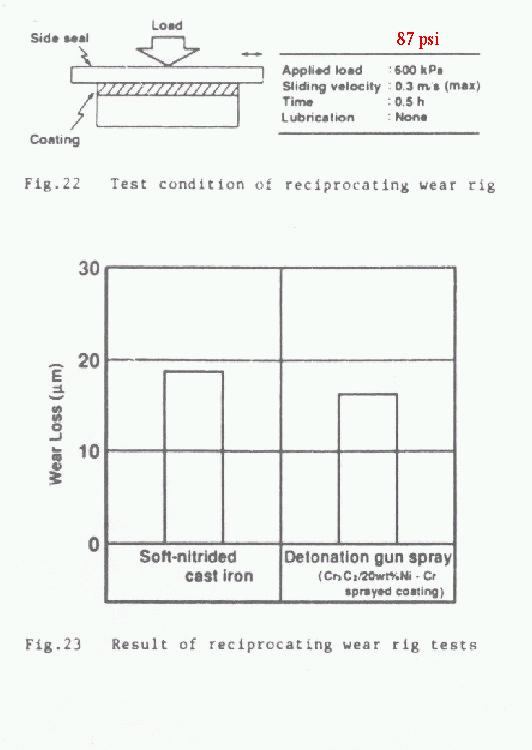
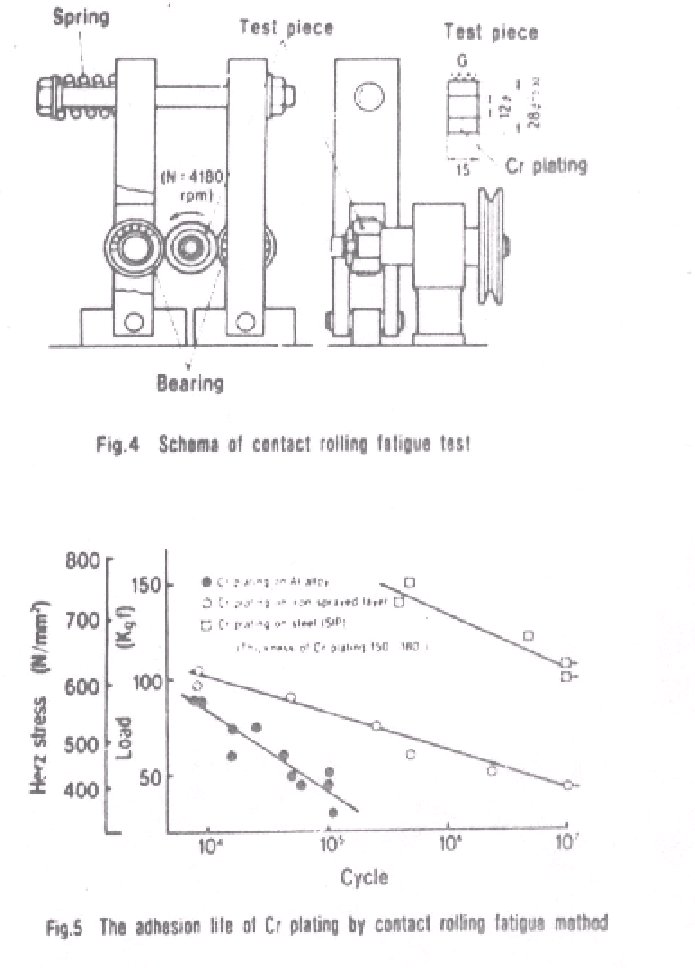
NASA_1994029725
NASA_1994029727
NASA_1996103430
NASA_19920010791
Rob Woods
Thanks Rob. That pdf file is a real good one :)
--
Paul Lamar ...No rotor no motor.
> >
The other two are larger than the 10M my email
supports. If someone has
an ftp site or would be willing for me to send it over IM I
will. Also
another point of interest is this technical paper written by
JHB. I know
Paul doesnt like them for a number of reasons the piece of
info in there
paper that I find a shokcer/revelation that I didnt see
before I read
this months ago was the "clearance" built into the equations.
Do you
care to comment on these dimensional accuracies Paul? Oh and
another
paper I found or maybe I downloaded it from an email.
Rob
How does he know what the clearance or tolerances are? How
many rotor housings
has he measured? I have been in the Mazda engine factory and
the rotor housing
and rotors are made on super high precision tooling.
The guy is blowing smoke. He cut and pasted out of various
Mazda tech
papers to add false credibility to his nonsense. Mazda spent
millions on
R&D.
Mazda rotaries are the way they are
for very good reasons. Mazda makes the
finest rotary engines in the world while many others have
failed and that
includes the likes of GM and Mercedes. When I get back from
OSH I have
a video I'll upload to youtube on real world rotary coating
experience.
Paul Ross
worked on aluminum end housings and coatings for seven years.
Some of his
descriptions on what happened when coatings failed are scary.
--
Paul Lamar ...No rotor no motor.
Paul,
I look forward to that video.I really would like to hear a solid
answer
on this material with this process equals this result. Basically
what
does/did Powersports, Mistral, and Rotomax do to produce their
housing?
Steve Beckham's old post was very infomative and I would like to
see if
he would advise us on some matters other than a history lesson.
I wonder
if it is really as simple as cast/billet chunks of aluminum,
of the
proper type, that just get sprayed and ground. I have been
speaking
with a couple friends who own machine shops and their post
operation
associates and I could do some real interesting stuff up to the
coatings
for very little money at least on the prototypes with very high
quality.
I would really like to see this video lead to the hard answers
about how
we as tinkers, engineers, rednecks can get some of these good
ideas put
to actual use.
Rob Woods
Nobody will tell us. Jim Mederer claims he does not know. He
just sends
it out to a local aero space firm and lets them choose.
I don't know what Power Sport did. I am sure Steve Beckham on
here knows.
Rotomax won't tell me. I suspect it is the same coating
Moller used.
I have a paper done for NASA by Moller on coatings. I would not
trust
Moller as far as I could throw him. BS are his middle initials.
He did
no long term testing.
The only upfront and honest answers I got were from
Paul Ross and Alturdyne. Paul tried a bunch of things for seven
years
and he told me not to bother with any of them except detonation
gun applied
tungsten carbide and that is what Mazda used on the Lemans
engine.
The particles embed themselves in the aluminum as they are shot
from a gun at
the aluminum at supersonic velocities. The whole process is very
costly
and time consuming.
The problems are not always with the coating. One of the
problems is the low
modulus of elasticity of the aluminum. It does not matter how
hard the
coating is if the surface is deflecting underneath it. That
deflection
causes the bond between the aluminum and the coating to fail.
That
is why Mazda inserts steel into the rotor housing and locks it
in place
with the SIP method.
I would use a two piece housing much like Richard Sohn is doing.
It has a a steel or iron wear surface that can be lapped and/or
hardened.
Or replaced if you wish. It could also be chrome plated like the
rotor
housing using the same process. He uses a very clever method
to seal
the wear surface from the water jacket.
You could also cast the steel in if the back side had hooks like
the Mazda liner in the rotor housings. I know of a foundry
that does
that sort of thing all the time.
Paul Lamar ...No rotor no motor.
Rob/Paul-the following in reponse to Rob's questions about our early
Powersport experience with aluminum housing coatings. We worked
hard on
these from 1987-1997. These notes are meant to supplment my
original March
6 email backgrounder in this regard. Paul, you hit the proverbial
nail on
the head with your comment that the problem was not necessarily
with the
wear surface coating.
1. The aluminum housing coatings never failed
We never had a single failure of wear surface coating during this
ten year
period. This includes all of the various different materials
that were
arc/plasma/det gun sprayed materials on our aluminum 356 castings.
We had
the same positive results on the last two generation housings used on
different iterations of the 167/180 lb short-shaft SuperLight tested
in the
RV-3. First tested was the anodized nickel-carbide (.002) by
Tiodine in
Huntington Beach with a proprietary teflon overlay. We later used
another
set of the housings with coatings done by Progress For Industry in
Saegertown, PA. These were electroless nickel with silicon
(Nikasil).
Other--as noted in my earlier email our Reynolds 390 (used by GM in
Vega
and big-block aluminum Can-Am engines) were the only aluminum
housings which
were a royal pain in the ass. We just never could get consistant
results
with the uncoated 390 and it was our fault. We just couldn't ever
figure
out how to do the critical lapping process the same each time to
bring up
the proper ratio of silicon. It was probably our low tech lapping
process
in house. But all our sprayed housing wear surfaces worked very
well.
2. Even when aluminum creep deformation/distortion caused significant
scoring of the a housing on the first SuperLight prototype during
flight
testing of the RV-4--so deep in early flight test to require a
quart of
engine oil be added each refueling stop--the engine ran flawlessly
despite
such bad scoring. And even more importantly, there was no adjacent
exfoliation of the applied wear surface. If I did not provide a
photo
earlier of this housing taken at disassemly, so advise and will send
you a
copy.
3. These problems with creep deformation/distortion in aluminum
housings
never surfaced during all our extenstive dyno testing of engines.
These
problems of long term creep only surfaced over time following long
sustained
high power settings at cruise--average legs of 3-3.5 hours at
mid-to-high
speed cruise power settings. Hopefully the higher temp strength of
the new
NASA-developed aluminum just may be the key here.
4. On the arc/det gun/plasma sprayed engine housings, Francis Romig
in the
shop would first machine the housings flat after they came back
from the
foundry, then machine a recess on which the wear surface was
applied. We
used numerous companies to apply the myriad of materials tested.
Some were
here in the region and others scattered around the nation, but we had
excellent results with all of them. After housings were received
back from
the applicator, Francis would machine the entire housing surface and
Everett
would lap it on an old machine that he and I rebuilt for that
purpose.
Francis would turn out large foam pieces on the lathe and then
machine cross
hatches on it for a lost-foam pattern from which we would have
aluminum
castings done for lapping wheels. After machining/lapping, the
housing
surface was aluminum-only on the outer portion where the fastener
bosses
were cast and only the inner surface coated. I have additional
information
including the names of the specific vendors and materials if that
would be
helpful. Ditto on photos of these housings if I have not provided
to you.
5. Following the above experience, we experimented with the
nickel-carbide
with teflon overlay by Tiodine to slightly fill in the anodizing
porosity.
We also tested Nikasil family coatings on the last SuperLight
engine. We
tried both of these in an effort to reduce required machining steps
for arc
and plasma sprayed wear surfaces. Both worked very well. The goal
was to
lower production costs for planned production engines with aluminum
housings.
6.The problem we anticipated with both of these last two processes
tested
was coating material was so thin that service in the field would be
somewhat
limited. Anything substantative in terms of scoring would be pretty
much
limited to cleaning up the surface, sending back to have
reapplied, then
reassembled. That is why we finally turned to thin-wall steel
furnace
brazed housings (more below) as an option to deal with these issues
as well
as creep distortion.. Nitriding is hard as hell to resist scoring,
relatively cheap and can be done locally, really holds up over
time and
steel has much superior creep properties than aluminum. Had we had
the new
NASA aluminum available back then as an option then, that would have
been
the step to take before either the furnace brazed housings or the
Iron
Eagle.
7. The patterns and core boxes for these aluminum housing castings
were all
made in-house. I made all the sand cores by hand in the shop. All
these
patterns and core boxes and all other pieces, including the prototype
SuperLight engine and reduction gear were included when I sold
Powersport to
Ray Richardson in 1998 after Everett died. This all aluminum
engine and
planetary reduction gear was together and operational when sold and
status
is unknown. Was hoping it would go to the EAA Museum. The photos
sent in
March of it side-by-side with the Iron Eagle were taken when we
removed it
from the RV-3 to install the Iron Eagle with the internal spur
reduction
gear.
8. As noted above, aside from the economics of producing aluminum
housings
for the first intended run of production SuperLights, was the
issue of
creep. Refer Marks Standard Handbook for Mechanical Engineers--page
5-10,
6-94 and other, ninth edition. In this regard, it was exciting when
one of
our group distributed the paper reviewing the specs of the new
NASA-born
aluminum.
9. Don't know if Jim Mederer is using the NASA-developed aluminum
in the
sand-cast aluminium housings he is now selling. I looked at a set
of these
which Phillip Groelz recently purchased. Only long-term flight
experience
will tell the tale in how well they hold up structurally. We know
from all
the years that Everett and I flogged various combinations that
the wear
surfaces are not the problem from an engineering standpoint. The
issues of
creep and the production economics are separate issues. But
producing
aluminum housings is challenging from the economic issues alone.
But these
isues have to be addressed to bring down the unit cost to an
affordable
level for our guys.
10. With the Iron Eagle Mazda prototype, we were simply trying to
refine the
combinations to lower the unit cost of these engines to where we
could
produce them at a cost significantly than our aluminum
housings...all with
an eye on production pieces. At that point we were still using our
planetary reduction gear along with pendulous dampers for torsional
control.
This was before we did the homework to address torsional vibration
with a
torsionally stiff internal spur reduction gear to replace the
planetary
reduction gear and pendulous dampers. This approach significantly
reduced
the parts count and all related costs on the prototype Iron Eagle
at the
expense of the added weight of the standard Mazda iron housings.
Although
they were heavier, they were very inexpensive compared to the
aluminum
housings, long lasting and worked extremely well in service even with
short-term nitrous, and provided us the ability to service them
in-house at
rebuild by minor lapping and retain the nitrided wear surface.
11. Other approaches--we did produce a set of o-ringed aluminum
housings
machined from billet by Francis Romig in the shop. These sections
were then
sandwiched. We never ran them. Instead we opted for the
simplicity and
cost of sand-cast aluminum housings which had fewer failure modes
(sealing
sections, etc.). And at that point we did not have the automated
processes
for such machining in-house as are common now.
12. If the new NASA aluminum doesn't successfully address the creep
issues
with aluminum side housings, it might be worth looking further at
furnace
brazed lightweight steel housings with nitrided wear surfaces. We
produced
a test set of these housings were only slightly heavier than the
aluminum
housings so merit serious consideration in this discussion. If
anybody is
serious about doing a set of these and if the quality of the local
company
who lazer cut these pieces for us (BBC Steel in Canby, Oregon)
deleted all
the files over 10 years old and this evidently included our drawings
when
they pitched all the old stuff. But the photos in the file show a
lot of
design and construction details. They were self fixtured. Also we
weight
the completed housings and have the exact comparative weights vs
aluminum
and factory iron. We assembled the power section of this engine
(without
reduction gear) before we did the Iron Eagle and never got back to
testing
the furnace-brazed engine before Everett died. The furnace-brazed
housing
project was our effort to deal with the issues of creep with aluminum
housings and provide an easily manufactured, durable and inexpensive
wear
surface that was easily serviced over the long term in-house and
locally.
Over the years the nitirided Lycoming cylinders we serviced in the
shop were
impressive so we were familiar with that capability. We got the
idea for
furnace brazing the engine from Jack Rousch. Jack had done a
furnace brazed
turbo engine that produced a prodigious power-to-weight ratio.
Locally, Doug
Johnson at Precision Castparts was a key technical reference here in
Portland, Oregon and still available. That company is the world-wide
leader
in casting of jet engine blades and other other unobtainium
componenents.
Phillip G was an electrical engineer there and retired there only a
month
ago. So we still have some very helpful contacts with the folks
there who
can advise. These furnace brazed thin-wall side housings hold great
potential for a myriad of reasons if the aluminum available now
cannot be
made to work on a cost-effective basis on limited production
numbers. A
thin-wall, lightweight steel housing with nitrided wear surface
would solve
a load of issues.
13. Hope some of this is helpful.
Steve Beckham
All photos sent will be appreciated Steve.
Paul Lamar
Paul,
Please comment on Steve's usage of the term "creep." We need to get the
terms and physical phenomenon straight..
Why do the rotor housings not seem to suffer from the same deformation
(creep?) problems as the side housings? They should be under the same
clamp-up pressure. Is the stackup being completely of Aluminum instead
of fe-al-fe a source of trouble?
Very interesting info about the coatings.
Regards,
Matt-
I am not sure what Steve means by that. Creep usually means a permanent
deflection of material over a long period of time. Very few aluminum
engines are affected by this in aircraft or car engines.
Perhaps there is a part in his end housings that were not adequately
cooled
and creep was occurring at elevated temperatures over 250 F.
Jim Mederer mentioned something about that near the main bearings and
he added material to counter it. I am not sure if it was creep or
just plain
yield or cracking.
What I am talking about in the context of coatings is local
deflection (not permanent)
to the aluminum under the coating as the seal passes over them.
Mazda devised a test rig
to check this mode of coating failure and it was described in the
Lemans SAE paper.
http://www.rotaryeng.net/4-rotor-1-5.pdf/
and
http://www.rotaryeng.net/4-rotor-6-11.pdf/
What may have been interpreted as creep in the past on rotor housing
is when then were permanently deflected due to over heating. That
was not
creep.
What was happening was the rotor housings were over expanding
against the steel
tension bolts and taking a permanent set. When the engine cooled off
you had a coolant leak into the combustion chamber. That pretty much
went
away about the late 80's when Mazda switched to a high silicon, low
thermal
expansion alloy. Also the tension bolts were necked down reducing
the tensile
spring rate.
I have only seen that happen lately when the engine was run
with out coolant at high power. Of course the steel liner was melted
as well.
-
Paul Lamar ...No rotor no motor.
I apologize Paul.. I didn't read Steve's post carefully enough. I
think I've got it now. The "creep" or distortion he's talking about is
strictly on the wear surface, right?
Due to high power operation.
I take that to mean that the wear surface might be getting too hot and
thus becomes weaker, and then the seals chew into it. Does that sound
right?
If it's heat weakening the base metal, I wonder what's primary factor
driving that. Combustion gas exposure or friction? Lack of cooling?
Under oiling? Mismatch between the side seal material and the surface
coating? A combination?
Regards,
Matt-
I have no idea. I am waiting to hear from Steve on what he means
when he says creep.
I suspecting the base metal is merely deflecting and not weakening.
The term weakening is not in the lexicon of the mechanical engineering.
The terms are yield... a permanent deformation of the material.
and deflection.... a non permanent deformation.
The bottom line is to duplicate the Mazda test rigs.
Pay particular attention to the plating tester. Chrome on steel
was far and away superior to anything else Mazda tried.
Paul Lamar ...No rotor no motor.
The Rotary Engine NewsLetter. Powered by Linux.
ACRE NL web site.
http://www.rotaryeng.net
Youtube key word UTUBPLEASE
Copyright 1998-2008 All world wide rights reserved.