>>> You think the DOE cares about rotaries? I'm of the opinion that the
>>> general public doesn't know what to make of them, and I personally
>>> wonder how widespread they could ever be in conventional
>>> transportation. That Mazda has stuck with them all these years is a
>>> benefit to those of us who want high power density for special
>>> applications.
>>>
>>> The step to plug-in hybrid and eventually full electric vehicles
quite
>>> frankly seems much closer to reality than rotaries. What would you
>>> like to see them used in?
>>>
>>> -Chris
>>>
>>> P.S. I think rotaries will never overcome the oil consumption thing
>>> that causes higher HC emissions and certainly limits widespread
>>> adoption compared to "PZEV" reciprocating engines.
>>>
>>>
>>> ----------------------------------------------------------------
>>>
>>> The rotary is the only mass produced four stroke internal combustion
>>> engine
>>> without an exhaust valve. The exhaust valve alone is probably
>>> responsible for 20% of the total energy lost in the exhaust.
>>> That is not the same thing as saying the efficiency of the ICE can
be
>>> improved 20% by the elimination of the exhaust valve. What I am
saying
>>> is eliminating the exhaust valve increases the kinetic energy in the
>>> exhaust and making more available for a turbine.
>>>
>>> Since over half the energy in a gallon of gas is lost in the exhaust
>>> that makes the turbo compound rotary potentially the most efficient
>>> ICE of all with the possible exception of the turbo compound diesel.
>>>
>>> The exhaust valve is the Achilles heel of the turbo compound
gasoline
>>> piston engine as if and when it breaks up it takes out the turbine.
>>> The exhaust of a diesel engine is much cooler. Thousands of CW R3350
>>> turbo compound engines were
>>> built in the 1940's and 1950's so there is no great leap to turbo
>>> compound technology. It could be in use in a year or two. Turbo
>>> compound diesel engines are already available. We have just seen the
>>> tip of the iceberg in turbo compound diesel engines. The current
sales
>>> of Detroit Diesel turbo compound DD15 engines will see to that.
>>>
>>> Hybrids will use ICE's for the foreseeable future so one could use
>>> a turbo compound rotary in a hybrid as well. It would have
advantages
>>> in the power to weight ratio and power to size ratio.
>>>
>>> The Hc emissions have been largely eliminated by the RX8 engine side
>>> exhaust port.
>>>
>>> There is no such thing as a zero emissions vehicle in the U.S. The
>>> electricity must come from somewhere and until there is wide spread
>>> adoption of nuclear power plants we will continue to burn oil,
natural
>>> gas and coal for the vast majority of the electricity generated in
the
>>> U.S.. The emissions are just exported to the source of the
>>> electricity. Sorry but those are the facts.
>>>
>>>
>>> Paul Lamar
>>>
>>>
------------------------------------------------------------------------
>>>
>>
>> --Paul,
>>
>> steve wolpin here.
>> what is the rolling resistance of the traction box in a rotrex
compared
>> to the spur gear box in say a vortec? roughly? any idea?
>> the rotrex is much more compact but does it take more from the crank
to
>> drive it for a similar cfm output?
>>
>> steve wolpin
>>
>> --------------------------------------------------------------
>>
>> No but I think Doug could also measure that.
>> How about it Doug? How much torque does it take to turn
>> the input shaft... both break away and after it starts turning?
>>
>> The thing about gears is they are limited to certain pitch line
velocities.
>> Only traction drives can go up to these kinds of RPM's.
>>
>> I think their claims of 98% efficient are unsubstantiated given the
>> need for the external traction drive cooling system.
>>
www.rotrex.com/pdfs/Rotrex_C-type_supercharger_installation_instructions-V1.
5.pdf
>>
>> I think these Paxton McCulloch curves are more like it with perhaps
30%
>> better thrown in for recent technology improvements to centrifugal
>> compressors. In other words I doubt it exceeds much above 80%.
>> Not the first time this company has made misleading statements
>> in their advertising.
>>
>> http://www.rotrex.com/
>>
>> It take HP to compress air so turbochargers are a better deal as they
utilize
>> otherwise waste HP from the exhaust much like turbo compound engines.
>> That HP burns more fuel. IMHO this companies claims of being "green"
are
>> greatly exaggerated :)
>>
>> Paul Lamar
>
>
> Paul,
>
> I can measure it of course but it will be the weekend before I get
over
> to my workshop. Now I have to take advantage of the Michiwa's
> school's summer break and the unlimited access to their machine shop.
>
> Note the rotrex resistance will be different when warmed up. Cold the
> oil it is real draggy.
>
>
> Doug in Japan
Doug and Paul,
i am less concerned about cold torque requirement. mostly i'm wondering
the
normal operating load put on the crank by the rotrex.
i understand gearboxes cannot achieve the rpm the traction box can. my
comp
question is different than that: i want to know for the output in CFM the
rotrex(es) can achieve and the hp cost(s) of that, what is a comparable
set
of
figures [output and hp cost] for a belt & gear-driven centrifugal with a
similar
cfm capacity that has been optimally sized?
steve wolpin
I assume you are talking about the HP consumed by the supercharger drive
alone.
The Paxton drive is a ball type traction drive so I assume it is
comparable
to a
Rotrex roller type traction drive. I think the question you want answered
is: Is
a traction drive more efficient than a gear drive? My guess is no. It is
probably worse. So too a belt drive is probably worse than a pure gear
drive.
They are probably all in the 95% to 98% ball park.
Now as far as the total HP consumed by the supercharger at a given boost
level
I don't know the answer to that as well. All I have is this data to go on.
Perhaps some one smarter than I can calculate it based on the amount of
boost as
a function of RPM and HP out to the supercharger. These charts are the
best
I
can do right at the moment.
It is very very rare indeed to see charts like this from a supercharger or
turbo
charger manufacturers. These are old charts and it is not in the best
interest
of the companies manufacturing super chargers to publish this data.
A turbo charger manufacturer would have to put the turbine section on a
dyno
in order to produce such a chart. Some of the information one would need
is
the exact amount of kinetic energy in the exhaust. Another way of doing it
is
measure the fuel flow as a function of HP before and after supercharging
and
calculate the corresponding BSFC's. If we had the RPM of the turbo
chargers
we were using we would have another piece of the puzzle.
My wild ass guess is the BSFC will be at least 10% worse with a
supercharger.
The last chart is for a turbo charged rotary and the BSFC is as good or
maybe
slightly better than a non turbo rotary.
BTW in case you are wondering none of this translates to car use as there
is something else far more fundamental with cars and that is the low
percentage
of peak power a car needs to cruise. A turbo charger, by its very nature,
does
not come into use until a fair amount of power is demanded from the
engine.
Supercharged cars like the Mercedes disconnect the super charger while
cruising.
Paul Lamar
Paul,
They don't publish gear step up efficiency, but the F150 I ran with a
Procharger P1SC got the same gas mileage on the freeway with the blower as
it did without. This means the efficiency of the drive was very good.
Procharger builds many friction drive units as well, but their primary
unit
for the street uses gears at a 1 to 4.1 step up ratio internally. You then
use the crank and blower pulleys to get the desired boost level.
If I were going to use a blower on an aircraft engine, a belt driven
procharger, as even if it had a failure, it would toss the belt and the
engine continues to run at lower hp. The gearboxes are self contained, so
you don't loose engine oil as you do with a turbo failure.
Larry
Yes but on the freeway you are not using any boost. You are using less
than
50 HP. Even for a pick up truck. The boost from a centrifugal super
charger
is
proportional to RPM squared or more. So 3000 engine RPM the blower is not
working very hard. As I said the gear train alone is 95% eff. or better.
As I also said what I say is not applicable to car use :)
They don't publish HP consumed as function of boost either.
Paul Lamar
BTW Larry, Get a cheap manifold pressure gage from McMaster Carr and
install
it
on your engine. Engine HP is the product of manifold pressure times RPM.
I had one on my Dodge Caravan. The freeway readings were about 15 inches
of
Hg
and 3000 RPM indicating I was using about 1/4 of the 200 HP the engine was
rated at.
The Procharger is a centrifugal super charger while Mercedes Benz uses a
positive displacement super charger. The boost from a positive
displacement
super charger is directly proportional to RPM. That way you get more
torque
at low RPM. That is also why Mercedes disconnects them when they are
cruising.
When you nail it at low RPM the super charger is connected and you have
instant
boost unlike a turbo charger or a Procharger.
Paul Lamar
> Paul,
> Yes, I know the Mercedes system is the same as my lightning except the
> lightning doesn't have the clutch (lightning blower is much larger and
would
> need a huge clutch). The point of the cruise fuel mileage is the low drag
of
> the gear system. The drag induced by the system is far less than the
torque
> added by the centrifugal blower. Although it was not making positive
> pressure above atmospheric at cruise, the engine cruised at "less vacuum"
> indicated on the vac/boost gage installed in the truck.
> For steady state cruise on an aircraft engine, I will still take a
> centrifugal blower. The rpm's at cruise are high enough to have the
blower
> well into boost and hp is then controlled with the throttle. The low rpm
> torque on the positive displacement doesn't help us on an aircraft....
but
> sure is fun in the truck!
> Larry
You are giving up a little BSFC but of course it works. The vast majority
of WW II aircraft had cent. blowers. Some had both cent. blowers and turbo
chargers like the B17, P38 and the P47. Maybe the B24 but I am not sure. I
just
got a new book of cutaways at the Air Force Dayton Museum. There is a good
one
on the P47 with the aft fuse. turbo. I'll get around to scanning it in soon.
The
P47 could go 428 MPH at 25,000 feet. You ought to put one on the Yak :)
BTW Here are some charts from Mistral that I got at OSH on the BSFC of the 3
rotor turbo and the 2 rotor turbo. Both are as good or slightly better than
the
normally aspirated models.
Paul Lamar
The P47 turbo would be great, but I would have to make the fuselage lots
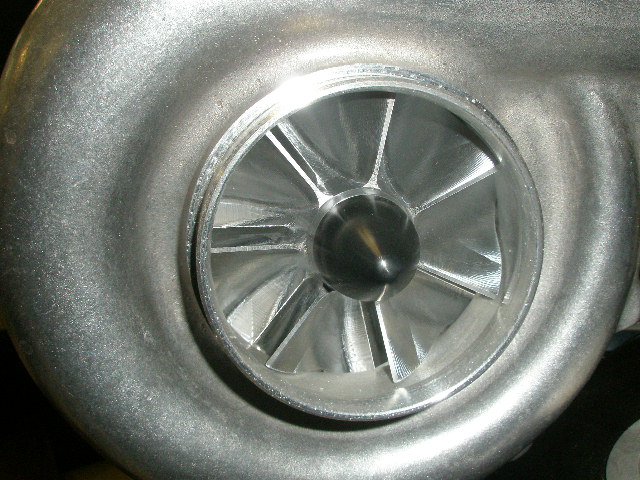
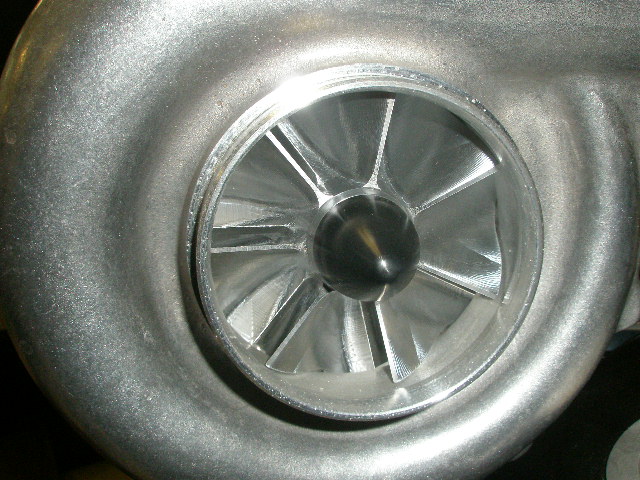
bigger to get all that plumbing in! What I have found is an R2800 blower
that is larger than our R2000 blower that I can fit into an R2000 accessory
case. Aside from that, we have also though of just building our own 7075-T6
billet impeller. The impellers now are so much more efficient than they were
back when this engine was built. You should see the impeller in the
Procharger F1 blower... really cool piece of work. See pic.
Larry
--
The Rotary Engine NewsLetter. Powered by Linux.
ACRE NL web site.
http://www.rotaryeng.net
Youtube key word UTUBPLEASE
Copyright 1998-2008 All world wide rights reserved.