Paul,
An earlier post indicated that both mass air flow and rpm were needed to
determine the timer "on" duration. It also appears that way to me.
Here's my thinking:
The timer "on" time determines the fuel flow per revolution, which needs
to be proportional to the quantity of air per revolution.
But the mass air flow sensor provides the quantity of air per minute.
To determine the quantity of air per revolution, we need to divide the
quantity of air per minute by the revolutions per minute.
Would a PIC chip be a simpler way to achieve this calculation than an op
amp circuit?
Philip
Not quite that way. The injector fires once per rev. With a fixed pulse width
(say 2 ms) that makes the amount fuel injected directly proportional to RPM.
Now it depends on how much air is entering the engine at any RPM. That depends
on throttle opening. The engine can rev to 9000 RPM in the RX8 car if the engine
is not in gear (no load) with very little throttle opening. However the aircraft
prop load is increasing with RPM so the engine is going to need more and more
fuel per revolution as RPM increases. It may need more than 2 ms worth of fuel.
The mass airflow sensor now comes into play. At a fixed RPM the mass air flow
sensor measures the amount of air entering the engine and adjust the pulse width
and hence the mixture up or down by controlling the 555 through pin 5 which is
what pin 5 is designed for. Probably up. This is called "trim" in EFI and OBD
II parlance.
It might work on the mass airflow sensor signal alone pulsing the injector at
a constant rate but that would not be "timed" injection.
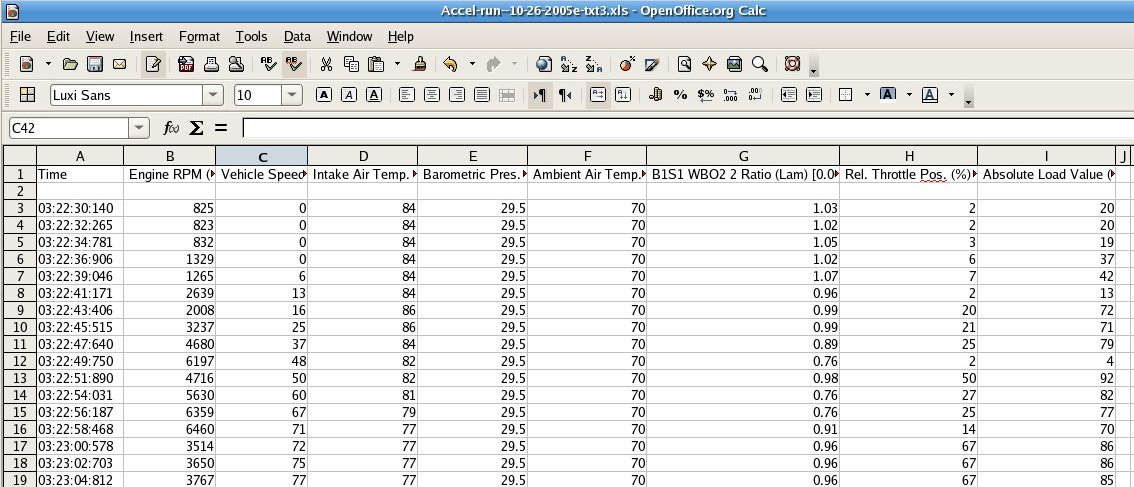
Here is an OBD II mixture chart for an actual acceleration run on an RX8.
"Lamda" is shown in percentages of 14.7:1 air fuel ratio. In other words Lambda
1 (one) is 14.7:1. At 67 MPH and 6359 RPM Lambda is .76. So .76 is full rich
for acceleration. .76 times 14.7 is 11.71:1 air fuel. This is why you want to
keep your foot out of the throttle in an RX8 :) The throttle position and load
value are also shown but this must be taken with a grain of salt as the PC OBD
II monitoring computer is not really fast enough to handle rapidly changing
engine conditions.
We would set up the 555 pulse width in an aircraft engine to be rich all the
time for engine acceleration purposes. No need for an accelerator pump. Many
aircraft engine carbs don't have them. Once you reach cruise you lean the
mixture to as little as 18:1 for best BSFC.
No need for a $1 pic chip with arcane and complex software however it will
surely work.
Paul Lamar
--
The Rotary Engine NewsLetter. Powered by Linux.
ACRE NL web site.
http://www.rotaryeng.net
Youtube key word UTUBPLEASE
Copyright 1998-2008 All world wide rights reserved.