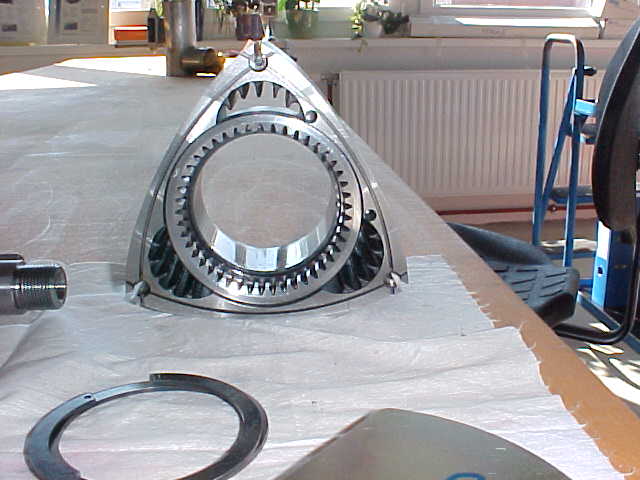
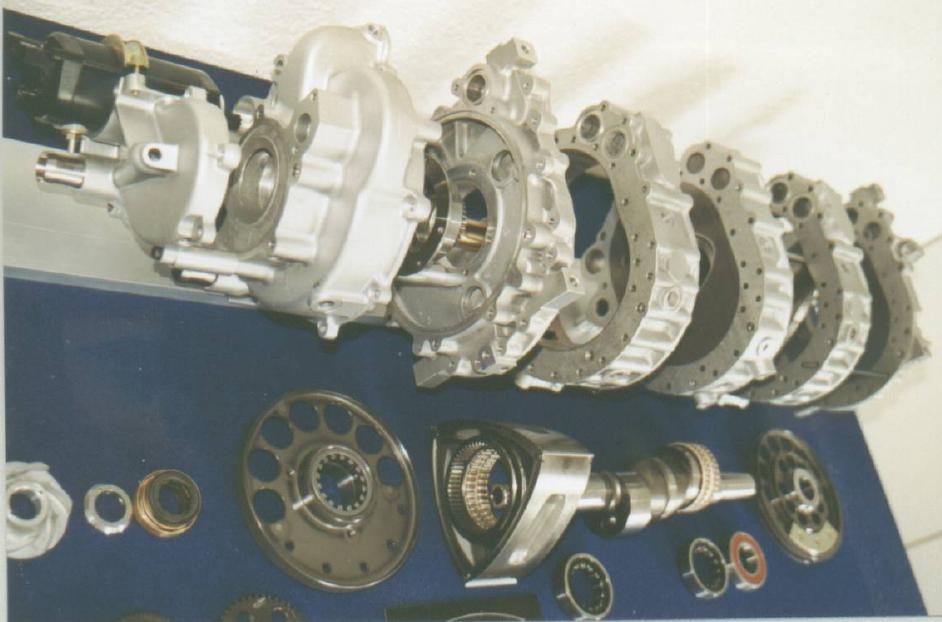
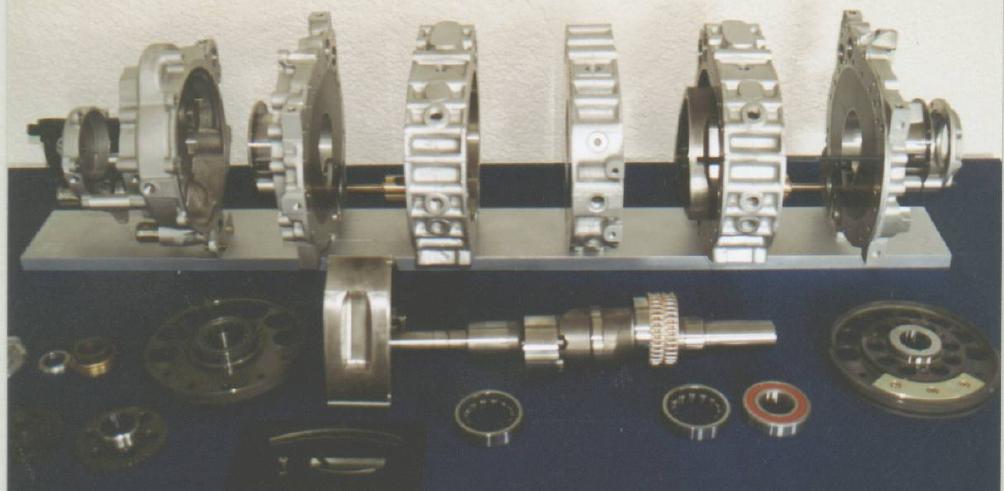
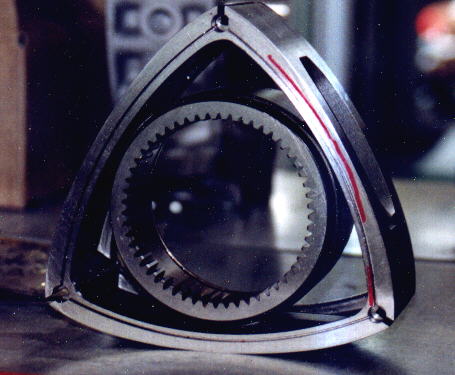
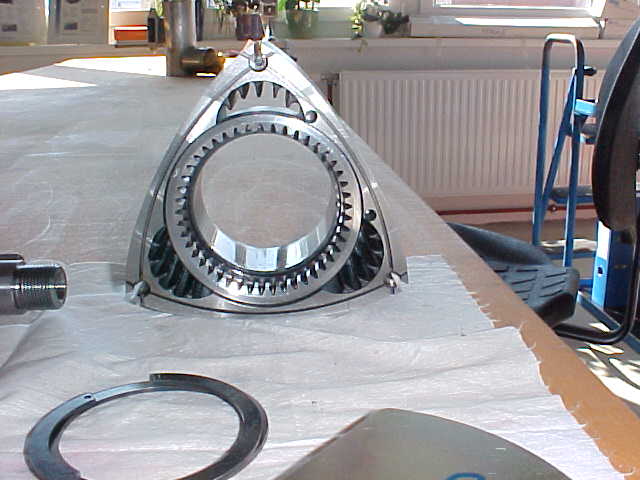
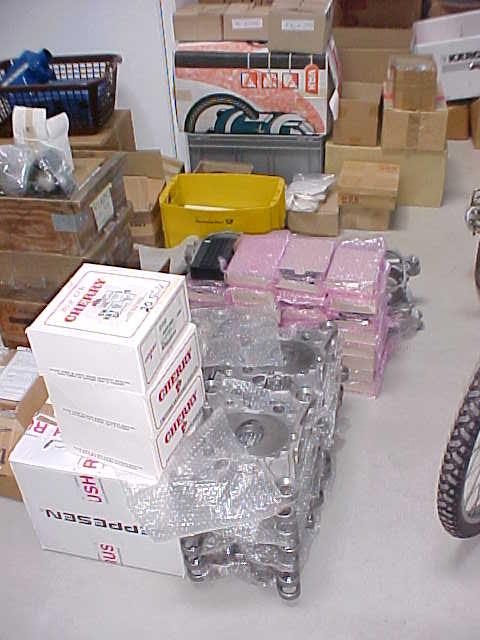
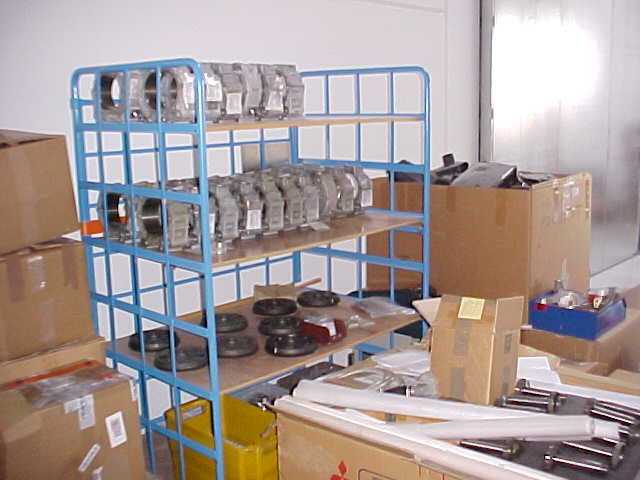
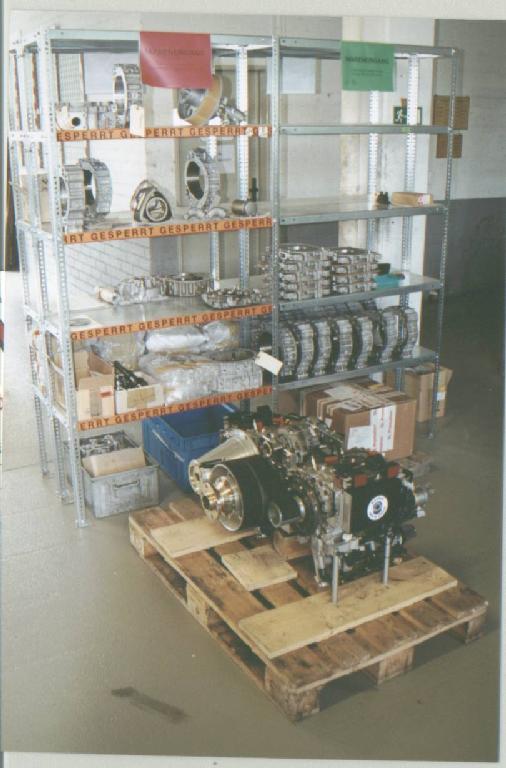
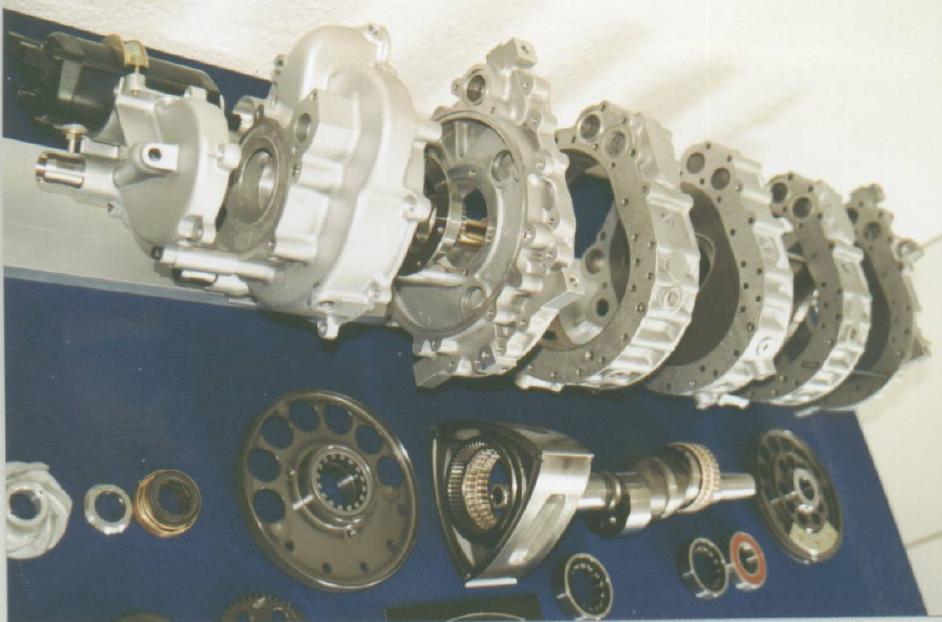
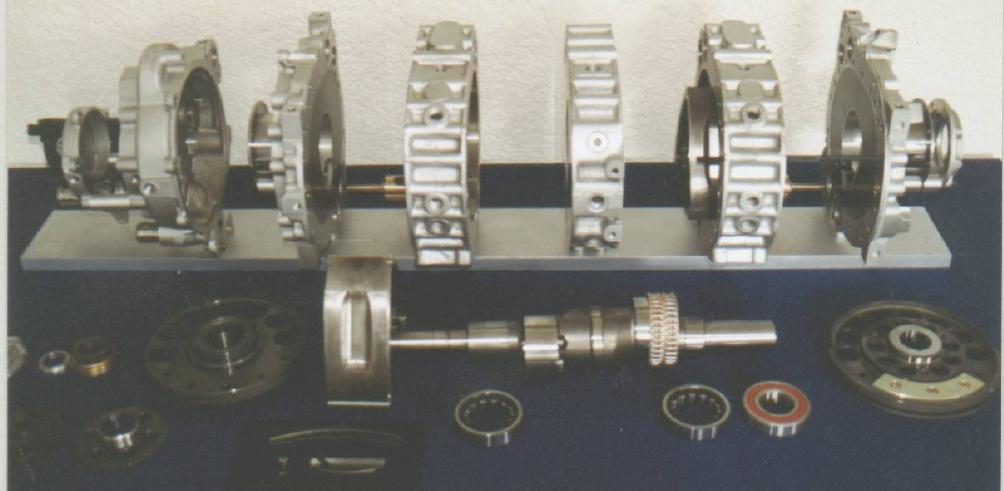
AIXRO had a customer CAD step file on their web site so I downloaded
it into Rhino. Here are a few 3D's. Still need a rotor
and a rotor housing.
Paul Lamar
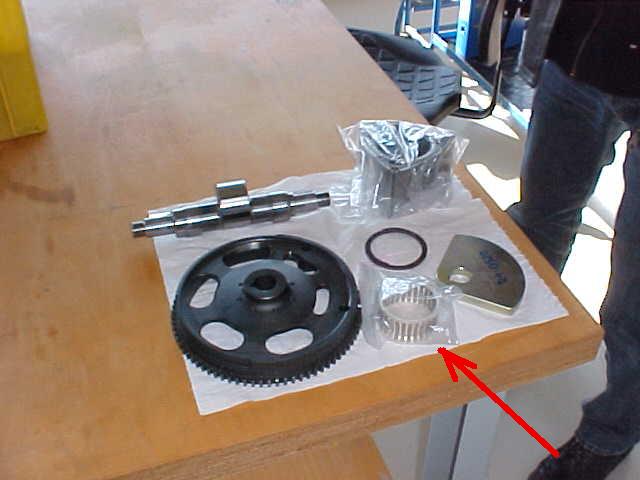
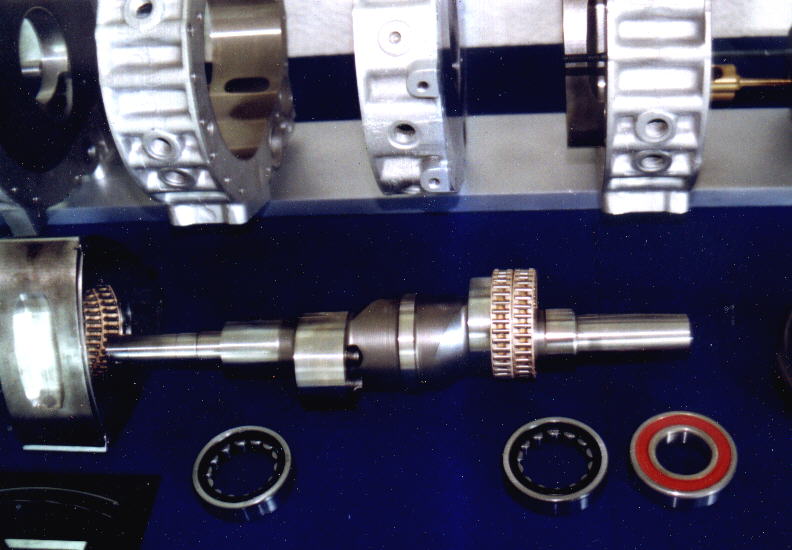
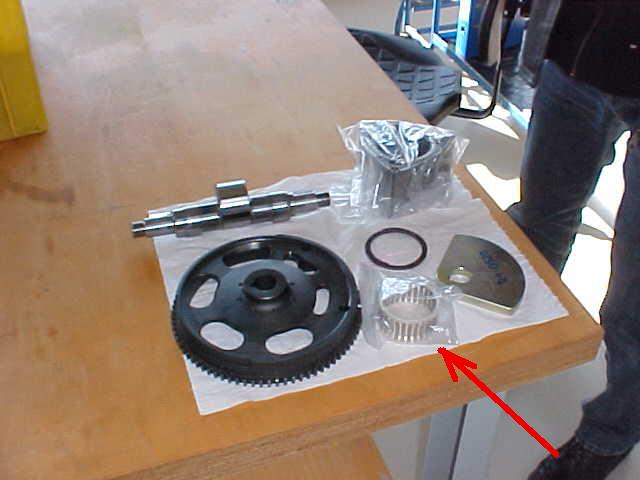
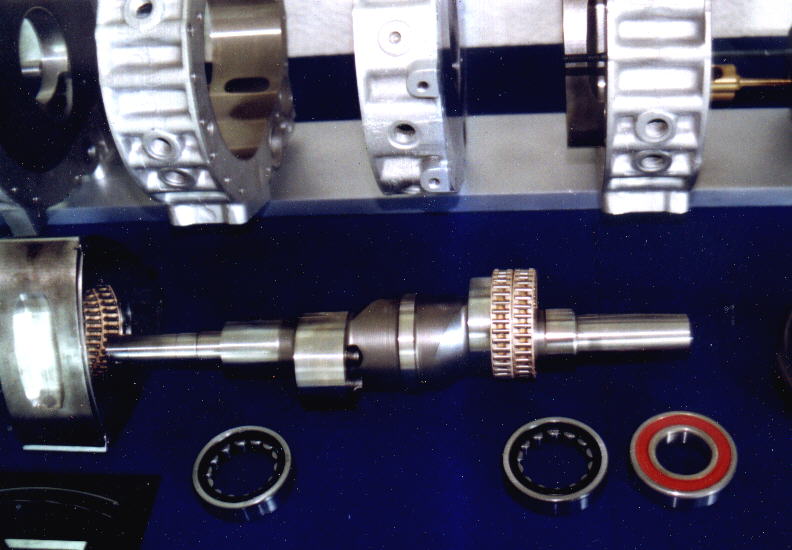
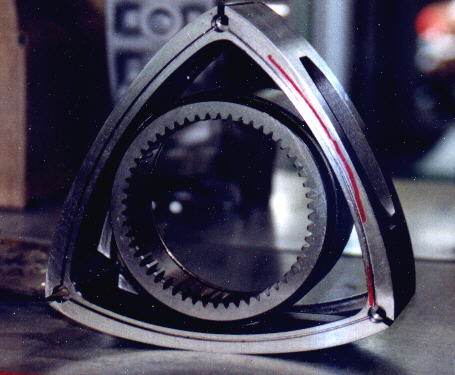
I noticed that that engine uses a caged needle roller bearing for the
rotor bearing. I understand that they have to since it is a charge
cooled engine but if it works for them running up to 10k rpm then maybe
a similar setup could be used for a mazda type engine. There shouldnt be
any "weirdness" in the bearing such as you described earlier posts
since
the cage holds it together. For that matter they are used on every 2
stroke connecting rod out there and nave no problems even with high
rpms. It would seem to me that there are benefits to having a
antifriction bearing vs. a journal bearing in terms of assembled
stiffness, oil supply issues and reduced friction. The only downsides I
could see would be cost and surface hardness requirements on the needle
to rotor since it is cast iron.
Rob Woods
That would be a big mistake. Those bearings are the Achilles heel of the
charged cooled rotary engine. The charged cooled rotor and the e-shaft run way
too hot for those bearings. They are right at the life limit at 10,000
engine RPM. Remember, they have to really zing RPM wise. If it were not
for the fact that the rotor was also turning on the e-shaft they would
not work. As it is they are turning only 6000 RPM while the e-shaft is
turning 10,000 RPM. 6000 RPM is the absolute upper limit for that size
roller bearings.
Paul Lamar
Something to remember is that needle bearing small ends in two cycle
engines never see high ROTATIONAL speeds.
In fact they tend to occillate through a portion of a rotation. The
reason they are used is the means of lubrication, (oil suspended in fuel),
rather than the being a better bearing. A [oil pressure fed] thin-film bearing
is better in holding up to high pressures, and very close on rolling friction
too.
Bill Jepson
In addition to what Bill is saying I might also point out that the pressure fed
oil flowing through the thin-film (AKA plain) bearings is carrying away a lot
of
heat in the process. Also the bottom ends of small 2 cycle engines do rotate
but
the diameter is generally lower than the rotor bearings hence the limit RPM is
higher. Roller bearings are not used in large 2 cycle engines like diesels.
Here are some interesting charts for the friction HP of the rotary compared to
the gas piston engine and the diesel. The e-shaft friction is a significant
part
of the total friction. The friction HP is converted into heat in the e-shaft
and rotor and thence to the oil. That is why it is important to keep the oil
temperature down or the plain bearings will melt. They are usually coated with
soft silver or aluminum.
Paul Lamar
Paul,
A email to the engineering division of Timkien would be the answer to
how approprate they would be for that purpose. The bearing load diagram
you sent indicated that the bearings would have to support 5000 psi at
10K which is waaaaayyyyyy under what the bearing will support. Timken
has proven through testing that a roller bearing has far less
drag/friction than a pressurized oil journal bearing. They pretty much
ended the theory vs. practice discussion on that. I'll look for the
video and report I read. You have no furthur to look than modern cnc
machines for journal vs. anit-friction bearing setups. All cncs use
stacked up taper roller bearings with pressurized lubrication in order
to get the rigidity and strength necessary for their function. Journal
bearings wouldnt surive at the spindle speeds they run today. You will
transfer less heat into the oil if you are using it to lubricate metal
on metal contact versus shear forces from hydrodynamics.
Rob Woods
It is way under what the bearing will support if the RPM is less than 6500 RPM
for one minute :) That number is not the final answer. You must go through the
life calculation spelled out in the catalog. See pages C64 though C68.
That is the gist of the problem with any kind of so called anti-friction ball or
roller bearing. The minute deflections cause the rollers or balls to fatigue
over time not to mention the e-shaft or rotor deflections if they are running
directly in the rotor. You have a very high pressure line contact between roller
and running surface.
Plain oil pressure fed bearings on the other hand have indefinite life if
one can avoid metal to metal contact. Many Mazda engines have proven that with
well over 300,000 miles in car use.
Norton/Midwest/Diamond have plenty of history with needle or roller rotor
bearings. I was told at the Diamond factory this is the big problem with charged
cooled rotary engines. I have also visited the Wankel Gmbh factory in Korf
Germany and they say the same thing. In fact they advocate water cooling the
e-centric shaft to mitigate the problem.
As far as stiffness is concerned the hotter rotor will expand more than the
cooler e-shaft. You will get slop like it or not :) The only way around
that is oven heat the rotor before installing the rotor roller bearings and let
everything deflect when cool. Plain bearings tolerate the differences.
Paul Lamar
--
The Rotary Engine NewsLetter. Powered by Linux.
ACRE NL web site.
http://www.rotaryeng.net
Youtube key word UTUBPLEASE
Copyright 1998-2008 All world wide rights reserved.