Roteryians,
Since I have been lurking on this list, I have been confused about the
term Turbo-compounding.
It seems that the way that it is used it is synonymous with turbo
charging. Am I mistaken?
It is my understanding that turbo charging uses the energy in the
exhaust stream to turn a turbine which intern turns another turbine
which compresses the air going to the intake manifold.
Turbo compounding is a different animal. This technique was used around
WWII in large, primarily radial engines, in which the exhaust gasses,
like turbo charging, turned a turbine. Here's where the similarity
ends. This rotational energy of the spinning turbine, through a system
of gears, was then connected to the crankshaft which increased the power
with roughly the same fuel burn. This was a compounding effect, not a
supercharging effect. There was no increase in MP with the
turbo-compounding.
Now turbo-compounding would be possible by re-inserting the rotating
power at the PSRU.
Has anybody done work on this for the rotary??
Rich
It is related to turbo charging but I would not say it was synonymous with turbo
charging. This is almost a correct statement: "It is my understanding that turbo
charging uses the energy in the exhaust stream to turn a turbine which in turn
turns another xx turbine xx [No. It turns a centrifugal compressor] which
compresses the air going to the intake manifold." My corrections are in []
Last statement is correct.
There are several ways of using a turbine to recover the waste energy in the
exhaust. The simplest is to use one turbine on a normally aspirated engine
fed by the exhaust. First attached jpg.
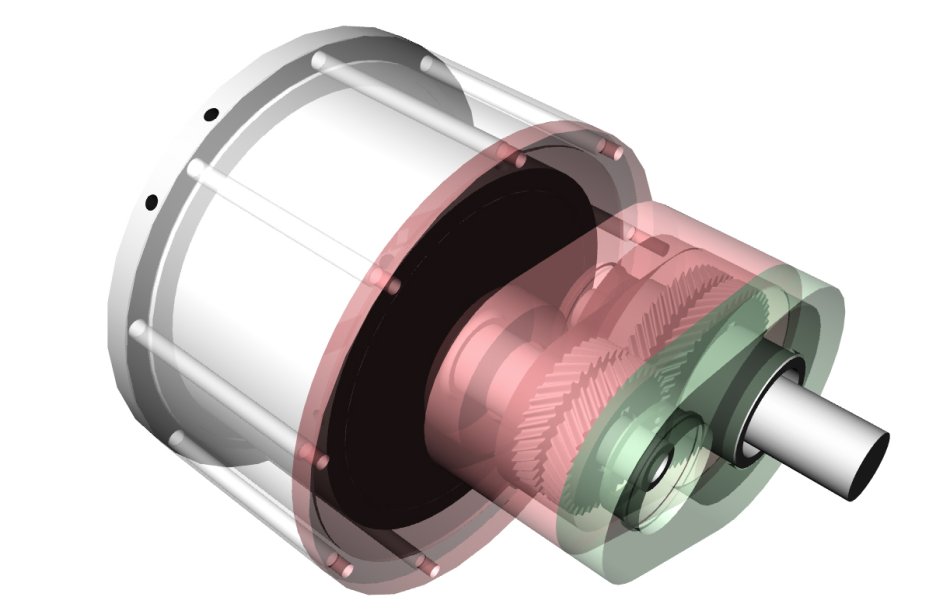
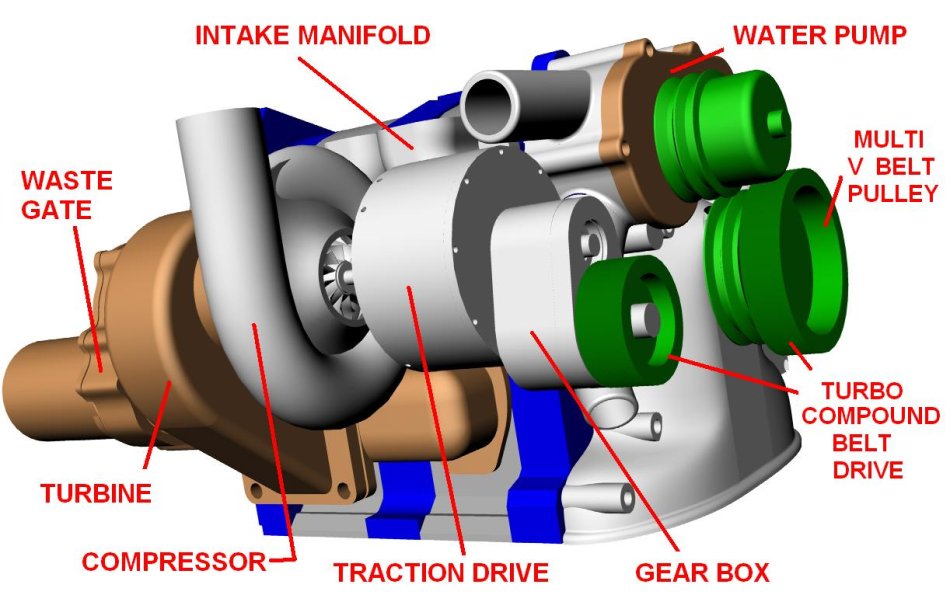
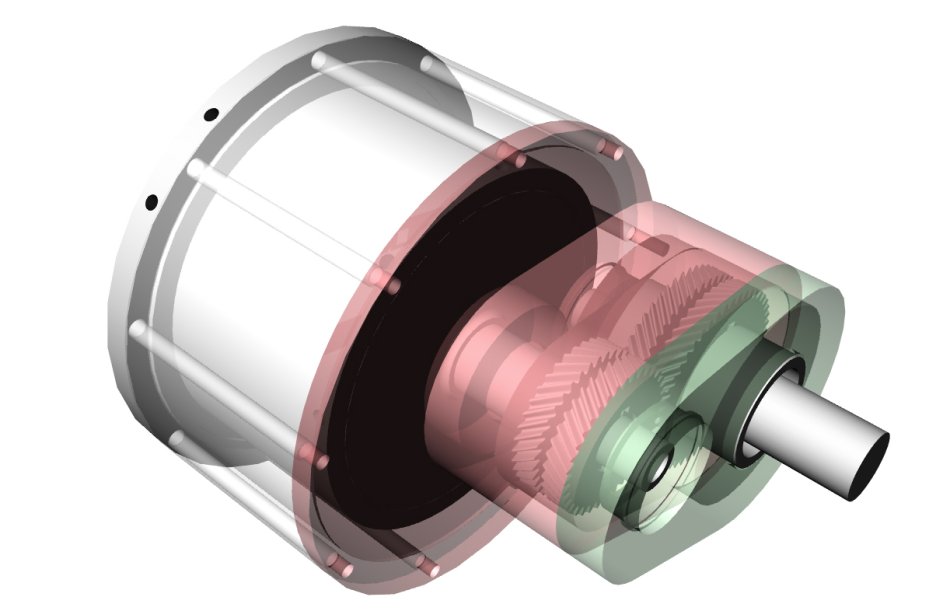
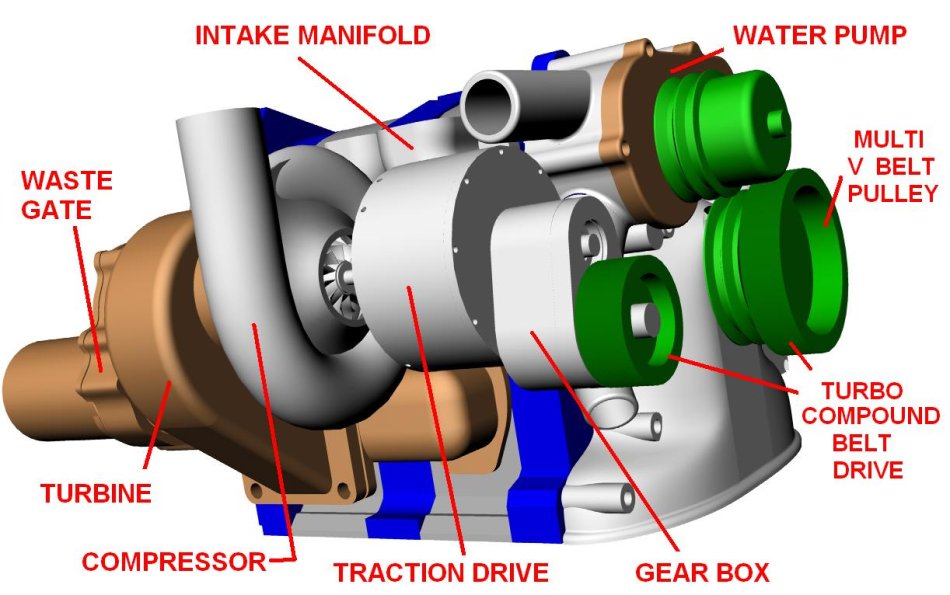
A second way is to extract additional HP out of a turbo charger by connecting an
output shaft to the turbo charger shaft. Second jpg. Probably this is the most
efficient way using a turbo charged engine to start with as there is minimal
heat lost in the plumbing. Any reduction in temperature of the exhaust before
the turbine results in a reduction of the kinetic energy available to turn the
turbine.
However there is too much temperature in a rotary exhaust for comfortable use by
a turbine so a thermoelectric device would cool off the exhaust and generate
electricity in the bargain.
There are many other ways. One of the most popular is to add a second turbine
after the turbo charger. Third jpg.
Read this web site http://www.rotaryeng.net/turbo-compound.html
View these videos.
http://www.youtube.com/watch?v=iy_Jd5kewbM
http://www.youtube.com/watch?v=emLKhfm6MWE
http://www.youtube.com/watch?v=luoUHrX6DeQ
Paul Lamar
Paul
Have you given any thought on to how you are going to support the side
loads of pulley?
I am asking because I ran into this problem when designing to feed into
the other end.
Inputting 50 to 80hp requires another steel bracket and bearing I believe.
Doug in Japan
No I had not gotten that far. I figure it would run on the dyno for
10 or 15 hours no problem. That is >>> MY <<<< main goal.
If the bearing went out I could fix it. It is possible on the
e-shaft to somewhat balance the side loads by arranging the various belt
drives in a logical manner. I was just happy to be able to adjust the belt
tension by rotating the gear box about the turbocharger shaft axis :)
Right now I am focused on getting my RX8 engine running on the prop dyno.
It is too much money to run it on the Mazdatrix dyno day in and day out.
Along the way I will test the 555 EFI system. Mainly because I don't want to
spend $1000 on an aircraft carb.
BTW I also no longer believe in an EFI system that is based on taking only one
10 microsecond sample of the intake manifold pressure knowing what I know about
the chaotic operation of tuned intake manifolds. I suspect that is one reason
you need an EFI computer in the first place. The manifold pressure readings are
all over the map (pardon the pun) because not only is manifold pressure a
function of RPM and load it is also a function of WHEN you sample it for each
different combination of RPM and load. That leads to mixture tables entries in
the thousands. This is also why carbs don't work well with tunned intake
manifolds. They respond to air flowing both in an out. Good thing we are dealing
with fixed pitch props which have a somewhat predictable load. IMHO mass air
flow sensors do a better job because of the inherent averaging and damping of
the hot wire system. It takes time to change the temp on that hot wire. IMHO It
is also one of the main reasons hot wire sensors are now almost universally used
in cars.
I also have a couple of turbo chargers lying around and the next goal is getting
a turbo charged version to run on the prop dyno.
Getting back to the subject at hand you are right of course. The belt side load
could cause problems. I am amazed that more of these PSRU cantilevered belt
drives are not failing the crankshafts on VW's and Soobs.
Paul Lamar
--
The Rotary Engine NewsLetter. Powered by Linux.
ACRE NL web site.
http://www.rotaryeng.net
Youtube key word UTUBPLEASE
Copyright 1998-2008 All world wide rights reserved.