Paul:
This is a comment on the recent thread on Foldaplane techniques,
especially as described by Steve Rahm and as applied to the Vision
aircraft.
You may not know that the subject of "folded joints" is discussed at
some length in my book "Advanced Composite Techniques" (which has
picture of a Vision on the cover) and makes particular reference to the
Vision fuselage as an example. The book contains what amounts to a
self-teaching series of "exercises" which brings the composite builder
from the simplest of open layups to a wing structure assembled from
cored sandwich panels. Among the "exercises" is an example of folded
joints which is essentially the tail cone of a Tailwind aircraft. In one
of the early "exercises", I have the reader assemble a standard US mail
box, where the flat sides and curved top have dimensions and radii
fairly typical of practical aircraft parts and are made at one pass on a
4x8 flat tool, then "folded" in a simple jig.
The family of techniques described in "Advanced" may be summarized as
being various ways of making and assembling flat or single-curved
composite sandwich panels into practical aircraft structures,
particularly where the panels have very thin skins and very thick cores.
Such panels are structurally efficient, as shown by Rutan long ago, and
benefit from the fact that skin material is expensive and heavy and core
material is cheap and light.
Rutan has us apply composite skin directly to shaped foam. After cure,
the rough surface must be filled and brought to final dimension -- a lot
of work as the price of being "moldless." "Advanced" basically shows
how to make skins and cored panels on flat tools using vacuum bagging
techniques, then assemble these panels as needed. The panels have the
accuracy and finish of a smooth tool surface and need very little
filling. Since the panels are very stiff, they are easy to jig for
assembly, whether or not the assembly uses folded joints. This area is
somewhat off-topic, so I'll stop here.
Steve Rahm was a great help in the beginning of my book project. (I hold
Vision planset #34.)
I invite off-list communication from interested builders. If this brief
piece stirs any new interest, please note that my website,
Aeronautpress.com, was blocked by Google because of "unauthorized
access" by hackers. I am transferring my entire Internet stuff to my
local ISP, where I can talk to a human as needed and have them clean my
site. I hope that this whole mess will be cleared up in the next week
and the website restored.
Zeke Smith, Aeronaut Press
Hi Zeke,
I am in the process of decommissioning my swimming pool, filling it in and
erecting a steel Barn/ Workshop, so I will be back to building very soon.
As much as I feel the fold-a-plane technique is good, I won't be using it as
I feel it may add (unnecessary) weight to the panels - even if peel-plied
both sides, as the peel ply itself adds resin to the finished piece. Sanding
back may remove most of this excess resin.
However people are looking for smooth finished panels and the additions of a
gel coat and the smoothness adds even more weight. The smoothness, of
course, is a result of the filling in of the weave and gaps in fiberglass
overlap joints.
The Jig method may have some of the same problems but if the foam is
surfaced filled and the glass fiber is placed on the foam before the resin
tacks up, the glass will absorb up to 15% of the excess resin from the foam
sealing resin and glass beads.
I think this should be explained in full to those who are seeking to achieve
the lightest possible panels, so that they might make an informed choice
about which method to select. If weight is not so important the choice is
easier.
In my particular project I'm aiming for the Light Sport category the target
weight is right on the cusp - so any additional weight must be avoided at
all costs.
George Lendich
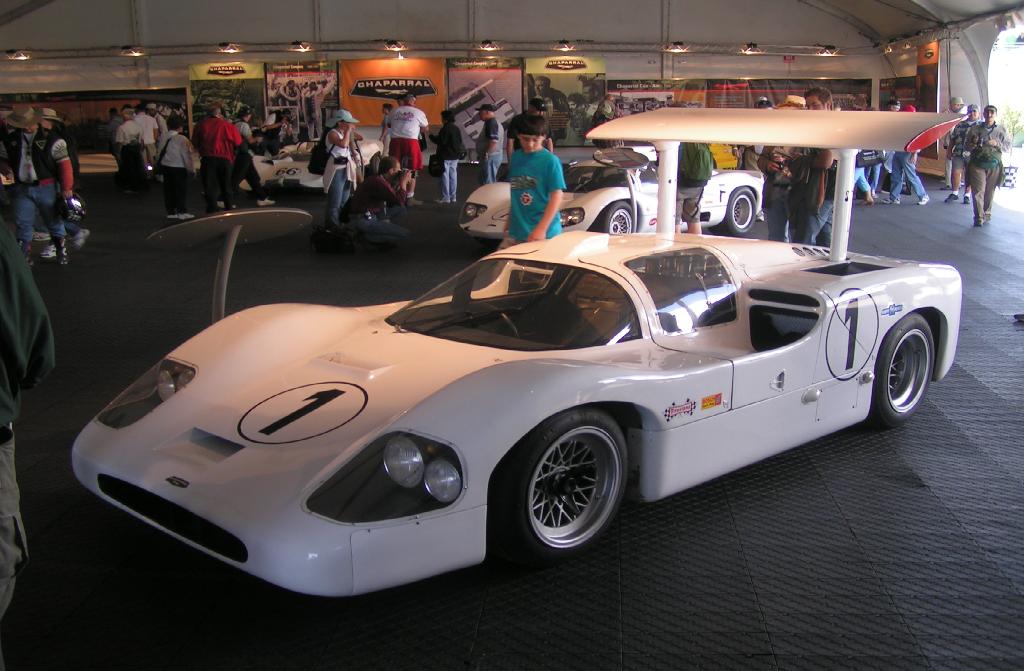
George, Find some lighter weight cloth for the low stress panels.
On this car the body was made from two layers of four ounce glass cloth
with 1/4 inch thick PVC foam core. You don't have to use 10 oz. When it came
back from the paint shop it was twice as heavy :) It went 230 MPH at Lemans.
Paul Lamar
--
The Rotary Engine NewsLetter. Powered by Linux.
ACRE NL web site.
http://www.rotaryeng.net
Youtube key word UTUBPLEASE
Copyright 1998-2008 All world wide rights reserved.