> >>>> When one is trying to recover the energy of a moving vehicle or
> >>>> object slowing down one has a problem. The energy is proportional
> >>>> to the square of the axle RPM so at first there is a lot of energy
> >>>> recovery and
> >>>> braking effect. As the vehicle slows down the braking energy rapidly
> >>>> falls off.
> >>>> If a generator is directly connected to the wheel the braking
effect of
> >>>> the
> >>>> generator and energy recovery will fall off directly
proportional to the
> >>>> RPM.
> >>>> This is not what is required to stop as quick as possible. The
> >>>> conventional
> >>>> brakes must be applied I suspect unless some way is found to rapidly
> >>>> increase
> >>>> the load on the generator such as changing gear ratios and/or by
> >>>> electronic
> >>>> means. The same thing can be said about spinning up a flywheel
to store
> >>>> the
> >>>> braking energy. This device, invented in the early seventeen
hundreds,
> >>>> might be
> >>>> used to speed up the flywheel or generator as the vehicle comes to a
> >>>> stop
> >>>> then is reset to wait for the next stop.
> >>>>
> >>>>
http://www.sailtexas.com/long.html
> >>>>
http://www.antique-pocket-watch.com/sinclair-harding.html
> >>>>
> >>>> It will be very interesting next year when KERS is implemented in
> >>>> Formula
> >>>> 1
> >>>> to see how the various teams achieve storing braking energy in a
> >>>> flywheel.
> >>>>
> >>> Paul Lamar
> >>>
> >>>
> >>> Paul,
> >>>
> >>> If the drive train is influenced by the motor cum generator, the duty
> >>> cycle can be increased as the car slows down. Accelerometers are
solid
> >>> state and cheap to provide the necessary signal to maintain the
desire
> >>> rate. The control circuit fits on a quarter. Same challenge
encountered
> >>> in slowing a low mass wind turbine rotor that has been hit with a
micro
> >>> gust. I do agree that flywheels are a more logical way to store
energy
> >>> however. More efficient than say, electro chemical batteries.
They can
> >>> be electro-magnetically or mechanically coupled through the use of
> >>> ferro fluids that change viscosity depending on the small amount of
> >>> current applied to them. Back in the late 1970s flywheel energy
storage
> >>> systems were all the rage and then suddenly the technology
dropped from
> >>> sight. Perhaps the researchers got side tracked by the PacMan
computer
> >>> game craze:) Since then stable homogenous ferro magnetic fluids
and air
> >>> bearings have been perfected along with certain ceramics that
will turn
> >>> to (super heated?) dust if the outer Kevlar protective casing is
> >>> breached.
> >>>
> >>> The amount of energy a flywheel can store is both amazing and
> >>> frightening. This percieved danger may be the reason the
technology was
> >>> not accepted readily. Witness the damage a truck wheel and tire can
> >>> cause when it comes off and hits a house. I wonder if the gyroscopic
> >>> effects influence the handling of the vehicle?
> >>>
> >>>
> >>> Doug in Japan
> >>
> >> Wait a minute... Isn't the amount of energy available related to the
> >> speed. But, the acceleration is related to the braking force
> >> available (traction on tires)? If so, as a vehicle slows, the
> >> energy available at a constant deceleration should diminish. The
> >> coefficient of friction on the tires won't noticeably change with
> >> speed (ignoring aerodynamics).
> >>
> >> I think this makes sense as slowing from 70-60 mph in 2 sec should
> >> require transferring much more energy than slowing from 15-5 mph in
> >> the same amount of time...
> >>
> >> Ke = 1/2 * m * v^2
> >>
> >> deltaKe = 1/2 * m * (v2^2 - v1^2) which is not equal to 1/2 * m *
(v2 -
> >> v1)^2
> >>
> >> My point is that if you make the motor system large enough to put a
> >> constant energy load on the tires, they will lock up. In order to
> >> maintain maximum braking force you may need gear up the motor for
> >> adequate braking at very low speeds - due to motor inefficiency, but
> >> not much.
> >>
> >>
> >>
> >> Matt-
> >>
> >> That was what I was trying to say but I think you mean generator
> >> and not motor. Yes I know... same o same o but the motor is in
generator
> >> mode.
> >>
> >> Paul Lamar
> >
> >
> > Still not sure we're on the same page. I think having a single ratio
> > drive to the regen generator/motor is perfectly adequate - a cvt or
> > other variable ratio drive is not necessary. The bulk of the energy
> > available is going to come from slowing from a high speed. The regen
> > energy available from a slow speed is negligible.
> >
> > Storing energy to a flywheel certainly requires a different approach -
> > accelerating the flywheel while decelerating the car.
> >
> >
> > Regards,
> >
> > Matt-
> >
> >
> > Well You could be right. Maybe we don't have to change the ratio.
> > How do you propose speeding up the flywheel as the car slows?
> >
> > Paul Lamar
>
>
> Like I said.. The all mechanical storage system (flywheel) requires
> something different. If weight weren't a concern, I'll bet an
> electric-electric system would be as efficient as anything else - the
> wheel motors become generators while braking, driving a motor which
> mechanically turns the flywheel - probably gear the flywheel to turn
> faster than the motor. It might be difficult to design a motor which
> would survive at the RPM required to make the flywheel efficient
> (v-squared term dominates). It could be worth trying though as
> integrating the motor into the flywheel would dramatically simplify
> the system.
>
> The electrical portion of the system is reversed to recover power from
> the flywheel.
>
>
> Matt-
>
> Well we shall see as weight is everything in a Formula 1 car.
>
> Paul Lamar
>
Paul and Group,
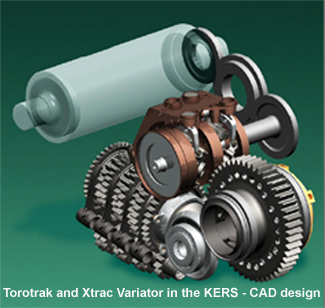
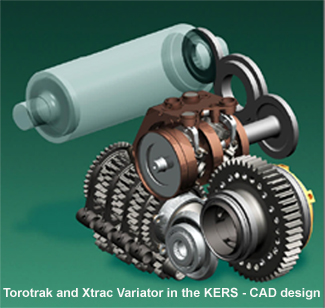
Here is a link to a Kinetic Energy Recovery System by *Torotrak and
Xtrac*. The web site says it weighs about 11 lb.
http://www.torotrak.com/Marketing+information/Press/Torotrak+and+Xtrac+announce+new+Licence+Agreement+for+F1+Variator+development.htm
Norm DeBoer
"Some of the new KERS systems under development will be mechanically based and
will utilise a flywheel to recuperate, store and subsequently discharge a moving
vehicle’s kinetic energy, which is otherwise wasted when the vehicle is
decelerated. The kinetic energy is stored during a braking manoeuvre and is then
released back into the driveline as the vehicle accelerates.
The toroidal traction drive variator, being developed with Torotrak and using
Torotrak’s patented technology, is a central element in these mechanical
flywheel-variator KERS systems as it provides a continuously variable ratio
connection between the flywheel and the vehicle driveline, via the vehicle’s
gearbox. Torotrak has granted a licence to Xtrac to design, manufacture,
assemble and distribute components or complete variator systems, which
incorporate Torotrak’s technology, to its F1 customers.
The innovative combination of a Torotrak variator – providing mechanical
efficiency that should be in excess of 90 per cent - with a flywheel of advanced
construction, results in a highly efficient and compact energy storage system.
Whilst Xtrac will supply variator units to its customers, the flywheels for
these energy recovery systems are being developed separately by the Formula 1
teams themselves and their specialist suppliers. Torotrak will provide the
control system expertise.
Torotrak and Xtrac believe that the variator-flywheel solution provides a
significantly more compact, efficient, lighter and environmentally-friendly
solution than the traditional alternative of electrical-battery systems.
“The variator weighs less than 5kg [11 pounds] in these applications and
provides a high level of mechanical efficiency, enabling the overall mass of the
mechanical KERS systems to be minimised,” says Chris Greenwood, technology
director at Torotrak. “This mechanical efficiency, combined with the variator’s
ability to change ratio very rapidly, helps to optimise flywheel performance.”
Beats the heck out of the silly 300 or 400 pound electricity system in the
Toyota Prius and GM Volt.
Paul Lamar
The Rotary Engine NewsLetter. Powered by Linux.
ACRE NL web site.
http://www.rotaryeng.net
Youtube key word UTUBPLEASE
Copyright 1998-2008 All world wide rights reserved.