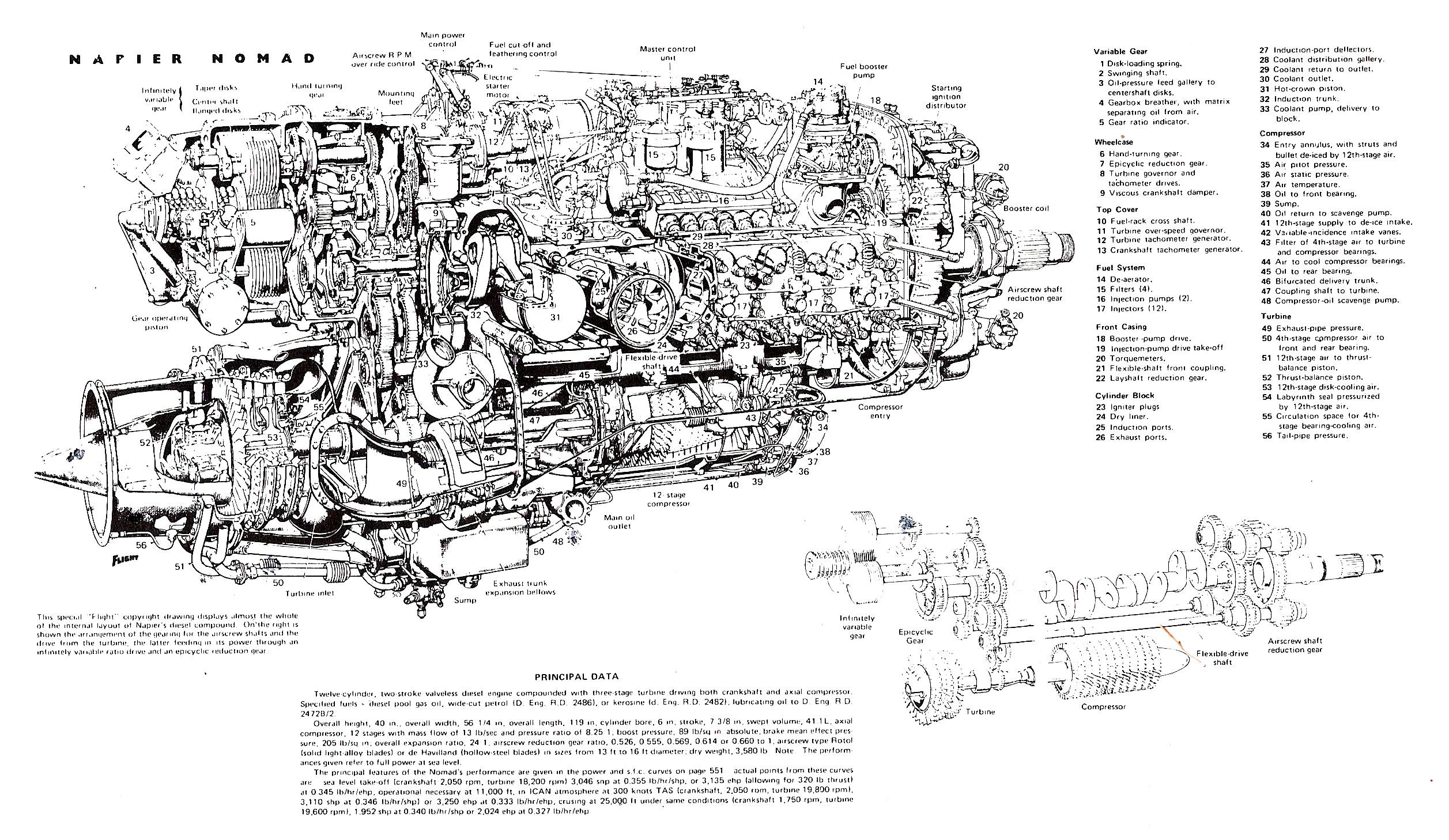
I just found the reference to the lowest recorded SFC in an aviation
engine. The 1950 Napier Nomad with a 0.36 SFC turbo-compound,
supercharged 12 cylider diesel 3,000 hp.
http://en.wikipedia.org/wiki/Napier_Nomad Now, that's a
worthy challenge to beat with a 16X rotary engine. (not the hp, the SFC)
Greg
They have one in the Ottawa museum as well as the Smithsonian.
Here are some pictures I took at the Smithsonian.
Paul Lamar
--
I looked at the drawing again and see that the axial compressor feeds the
diesel and that the diesel's exhaust drives the compressor and feeds power
to the output shaft as well.
This looks more like a gas turbine in parallel with a diesel. Where is the
turbo compounding? Is it the small percentage of exhaust passing through
the turbine's power turbine stage?
George Lazik
Yes but not a small percentage. About 40% of the total energy in the fuel goes
out the exhaust of the 2 cycle sleeve valve diesel engine in the form of waste
heat and kinetic energy.
The diesel engine does some of the compression and all of the combustion as
well as sending most of the power to the output shaft. The exhaust kinetic
energy from the two cycle diesel is fed to the turbine to recover some of the
other wise 40% waste energy in the exhaust and feed it into the output shaft.
Note; the big advantage of this engine, over the Wright R3350 turbo compound
engine and like the Wankel rotary, there are no exhaust valves to dissipate
kinetic energy.
Paul Lamar
The Rotary Engine NewsLetter. Powered by Linux.
ACRE NL web site.
http://www.rotaryeng.net
Youtube key word UTUBPLEASE
Copyright 1998-2008 All world wide rights reserved.