Thanks. =)
What would be the point of fitting a larger compressor to slow down
the turbo? Larger compressors have a higher "comfortable" flow rate
and function very poorly if this rate isn't carefully matched to the
engine it is supplying. A bigger compressor would allow the turbine to
extract more work from the exhaust gas, but the extra airflow this
generated would have to be wasted or it would literally back up and
flow out the compressor inlet several times per second. This "surge"
really beats up the turbo and just means you're asking the compressor
to operate in a pressure-flow regime it is incapable of.
One thing they did in the F1 turbo era was to use very large
compressors to circumvent the poppet-valve release used to control
boost pressures. The story as I remember it is that at some maximum
permitted pressure, a valve on the intake would open and vent charge
air to the atmosphere until pressure dropped below the max allowed
value. Teams selected turbos that would outflow the poppet valve,
which would have looked rather something like you described: a big
compressor wheel fitted to a smaller exhaust wheel, possibly lacking a
wastegate altogether. Naturally this uses ALL of the exhaust energy
the turbine is able to reclaim, but the extra work is still being
wasted.
If you wanted to use an air motor to drive the crank, you could use an
exhaust-driven turbo to supply it for some Rube Goldberg-style turbo
compounding. The frictional losses would likely be obscene. =D
I have a PDF version of the 2nd edition of that book. I have not
exactly read it cover-to-cover though.
-Chris.
Our biggest problem is the turbine blows up after a few hours.
The built in waste gate is too small. Even when wide open.
True the heat is high but the excessive RPM is the main culprit as
the load on the blades is m*V^2/r. A pop off valve on the intake
manifold
would be no problem. So far a bigger compressor seems to be working
almost fine
on Dave Leonard's turbo 13B in his RV6. My guess is the turbine is three
or four
times more powerful than needed for continuous operation. The excess
power is
there to accelerate the compressor as quickly as possible.
Dang now you tell me :) Can you email me the pdf?
Paul Lamar
Paul,
I believe Dave Parks uses a pop-off valve in his TE-06 turbo set up. It
makes sense to control surge. I will install one for safety purposes
even though I have a bypass valve to unload the supercharger or
completely bypass it.
Chris,
Thanks for the input and link to the Nye company. They may be just the
people we are looking for. A turbo gen set has always been a passion
for me but I don't see it in turbo compounding a aircraft engine
because of the downstream component weights. Power generation at a
fixed base or large truck, running on biofuels, yes definitely.
Where are you located by the way? I am in the midst of trying to identify
a candidate for some turbocompounding proof of concept testing and I'll
be in the states for the next week on the West Coast of USA. Have plane
can travel.... well a little ways a least:).
I would appreciate your observations on trying to ball park a turbine.
Reeves Callaway gave us some good advice about picking a turbine that
can swallow the whole gas flow of our engine as a starting point.
Probably in a T4 size shell. Problem is we don't really know how to
measure the exhaust gas flow yet, and that is something I would be
interested to know. I know how to measure air flow on the intake side
with a variety of techniques including ultrasonics.
It has been suggested before that we roll our own axial turbine but that
step is down the road a bit and has its merits and demerits. In the
end, perhaps a hybrid enhanced guided flow radial turbine would be most
compact, and easy to install unit at the expense of some loss in
efficiency.
From Garrett's website I picked up three possible candidates to try and
JUST DO IT, though I admit these choices could be laughable unsuitable
and a waste of time and money. I am only interested in the turbine side
and fitting a traction drive where the compressor normally resides.
First tests the turbo/traction drive is connected to a small dyno.
Design goal is 80 hp output and turbine operating at some point between
75K and 90K rpm. Your comments would be appreciated.
The turbines are from smallest to biggest:
Model Wheel dia. Trim A/R
GT3571 68 84 1.18
GT3582R 68 84 1.06
GT4508R 87 86 1.01 to 1.44
Doug in Japan
Paul,
It is worth contacting this company. Check this out.
http://www.nyethermodynamics.com/nt-rt30/index.html
Doug in Japan
I did. It is vapor wear so far. I sent the following questions
on Tue, 23 Sep 2008 05:31:31 and I did not receive an answer yet.
What is the operating temperature of the magnet?
What is the tensile strength of the magnet material?
Is the bearing assemble water cooled?
How much electrical power can one extract from a 200 HP
2.6 liter engine?
Paul Lamar
Doug,
I'm in the Boston area, but I would be pleased to help in any way I
can. I'll be in Sacramento from Oct 2-10 if you happen to be nearby
and want to discuss any of this over coffee or lunch.
To get in the ballpark you could measure intake volume flow and EGT
and estimate exhaust volume flow from that. This is inexact, but it
should have some relevance for rough turbine sizing. You'll want to
know turbine inlet temperature and pressure anyhow, and they're easy
to measure. Too bad Garrett charts aren't what they could be.
A bypass valve and pop-off valve serve different purposes. Limiting
boost in a race class is pretty much the only use for a "pop off"
valve I've ever seen. Compressor bypass or blow-off valves in contrast
are used in any turbocharged Otto-cycle engine. Diesels don't need
them because they are not air-throttled. Aircraft shouldn't really
need them because the throttle isn't constantly being slammed shut,
but for what little effort is involved it wouldn't hurt to have one.
It's hard for me to weigh in on turbine selection because there isn't
too much information available. The 68mm exhaust wheel with a smaller
A/R housing is my rough guess best choice, and it might even be a
touch large. The 3582R comes with a non-divided turbine housing and
has a relatively wide range of exhaust housings available for fine
tuning. Worth noting, Garrett GT-series turbos are often ball-bearing
which makes them expensive (the "R" models will be), and as I
speculated in the previous email, the turbine efficiency may actually
be LOWER than an older design. I freely admit that this is
speculative, so take it for what you will. An actual "T4" turbo would
be much cheaper, and you can get Chinese knock-offs on eBay for about
$200. I wouldn't put one on a plane, but it could be used for size
testing on-the-cheap.
A radial-inflow turbine with your own guide vanes would be a nice
thing to reach for eventually. Homebuilt gas turbine hobbyists could
donate lots of ideas and know-how if you can get in contact with them.
This guy made a beautiful inconel NGV for a commercial turbocharger
turbine from scratch:
http://www.technologie-entwicklung.de/Gasturbines/Monocopter/Turbine_Details/body_turbine_details.html
His site is filled with a bunch of heroic garage gas-turbine projects,
and most of the skills used would relate pretty well to
turbo-compounding.
Paul,
The trouble with Nye Thermodynamics is that the "company" is a hobby.
Nye Manufacturing is this guy's full-time job, and in the off hours he
screws around in his shop with turbomachinery. I'm sure the fantasy
(for most of us, too) is to build this hobby up to the point where it
is net-profitable on its own. Meantime it seems to get only what time
he can devote to it.
Vapor-ware is a funny thing. I'm not inclined to think of his doings
as vapor-ware in the same way other never-updated projects are
presented. The large portfolio of stuff he actually HAS built leads me
to believe that design is much closer to reality than most of the
other stuff I see floating around the web.
They're no stranger to power-take-off turbines and would be an
excellent source in a turbo-compounding project if they were
interested.
-Chris
P.S. I'll try sending you that PDF in another email. It's 10MB, so I
hope gmail and earthlink can handle it.
Thanks Chris. You are up early or late :)
Paul Lamar
I work nights and have learned not to slap the circadian rhythm around. =)
-Chris
I have searched for years for this pitch line velocity data.
55,000 FPM! I am impressed.
Thanks again Chris.
Paul Lamar
--
Chris,
Yes on the meeting. Thanks. I'll buy you lunch or dinner and make it
brief. Good website and I notice lots of improvement in the model
engine jet world since I checked in with them three years ago.
As fate would have it I need my bi-annual medical and my doctor Leroy
Brown, lives in Sacramento. 2, 3rd or 4th is OK at this time but I will
have to get back to you on the exact date. Please send me your cell
phone or contact method to
fir@gol.com
Paul,
I just went to the workshop today and recalculated line speeds and loads
on the improved Bell 3:1 drive. Last year we got the decimal point wrong
one place to the right in the calculations. As measured, for every
engine and sun gear rpm, the individual planet gears revolve 1.3333
around their needle bearings with a maximum speed of just under 10,664
rpm. The planets also roll .813 feet along the ring gear. At 8000 T.O.
rpm this works out to 6,504 ft/min gear line velocity. In addition
all these particular gears profiles always have at least two teeth in
full contact at any moment. The prop limit of 2800 still allows a few
hundred more engine rpms to capture the hp peak if it appears there.
Localized hot spots in the cooling system then remain the biggest
obstacle for high power longevity.
Doug
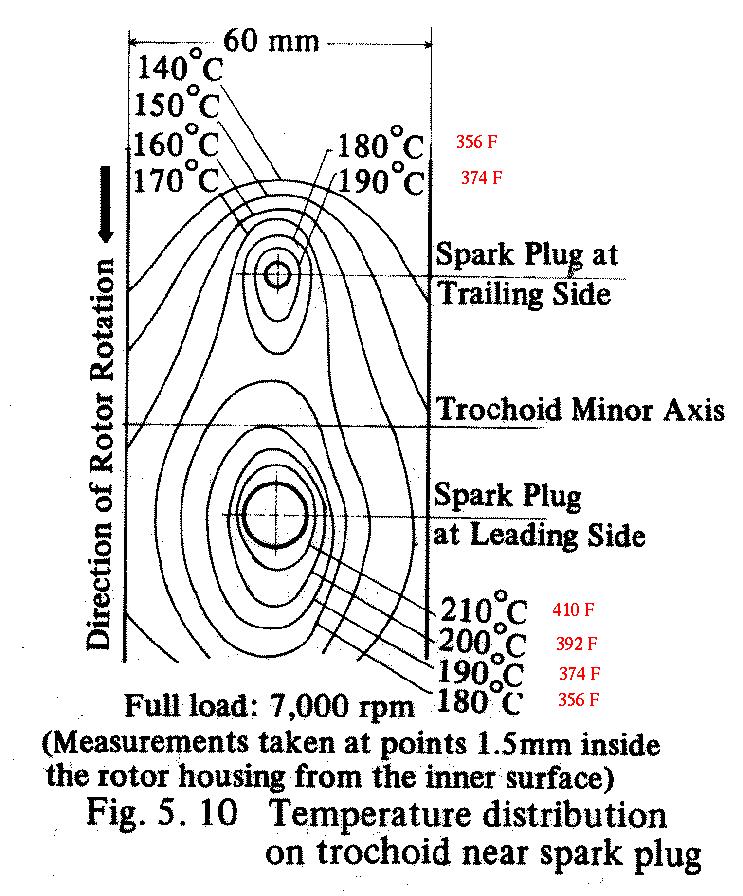
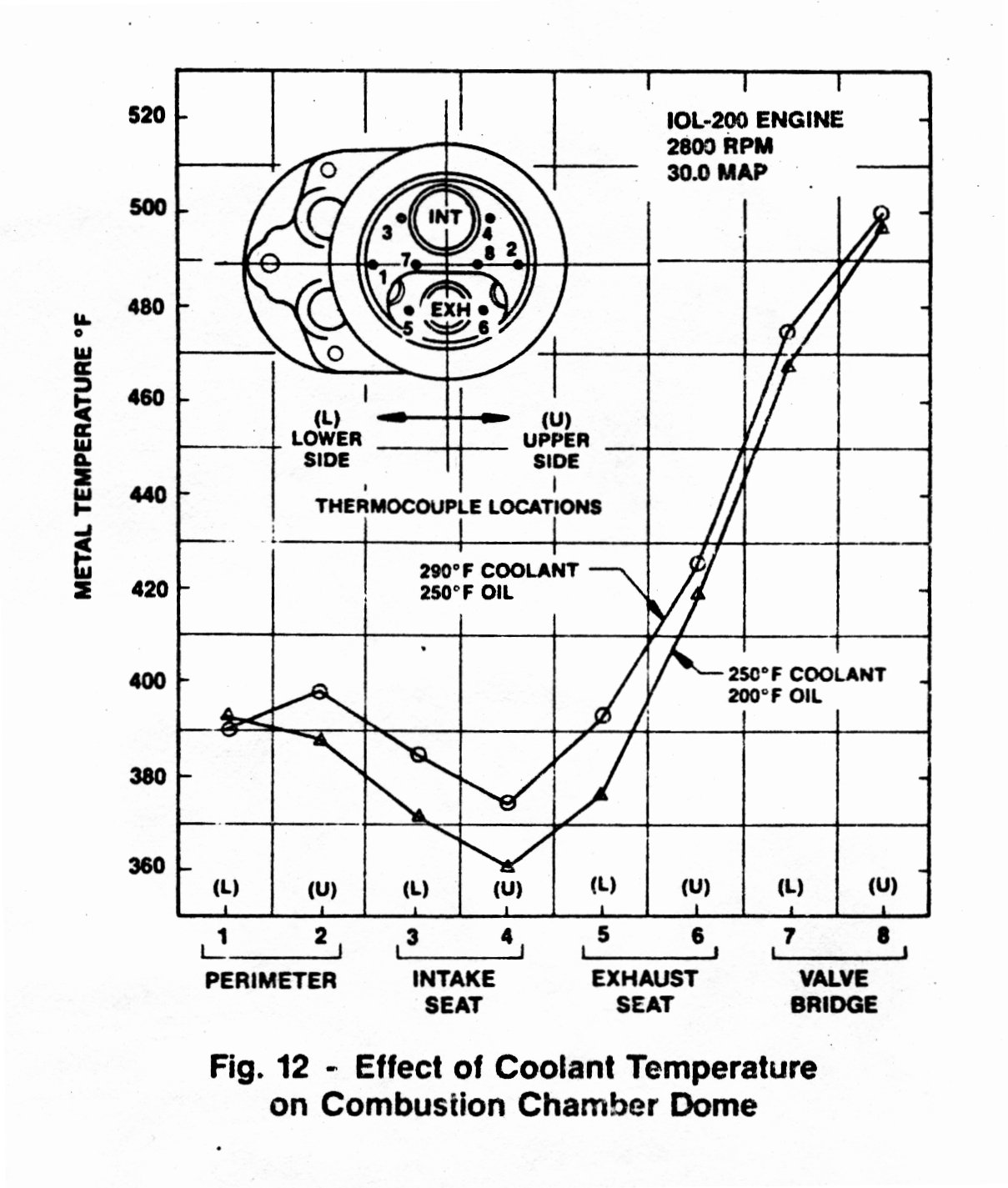
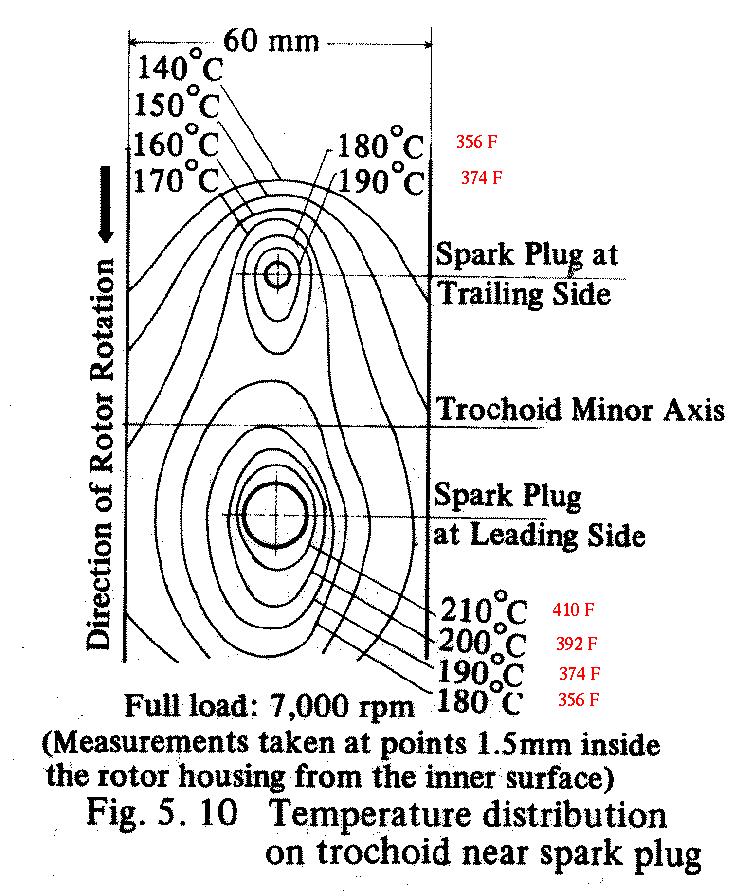
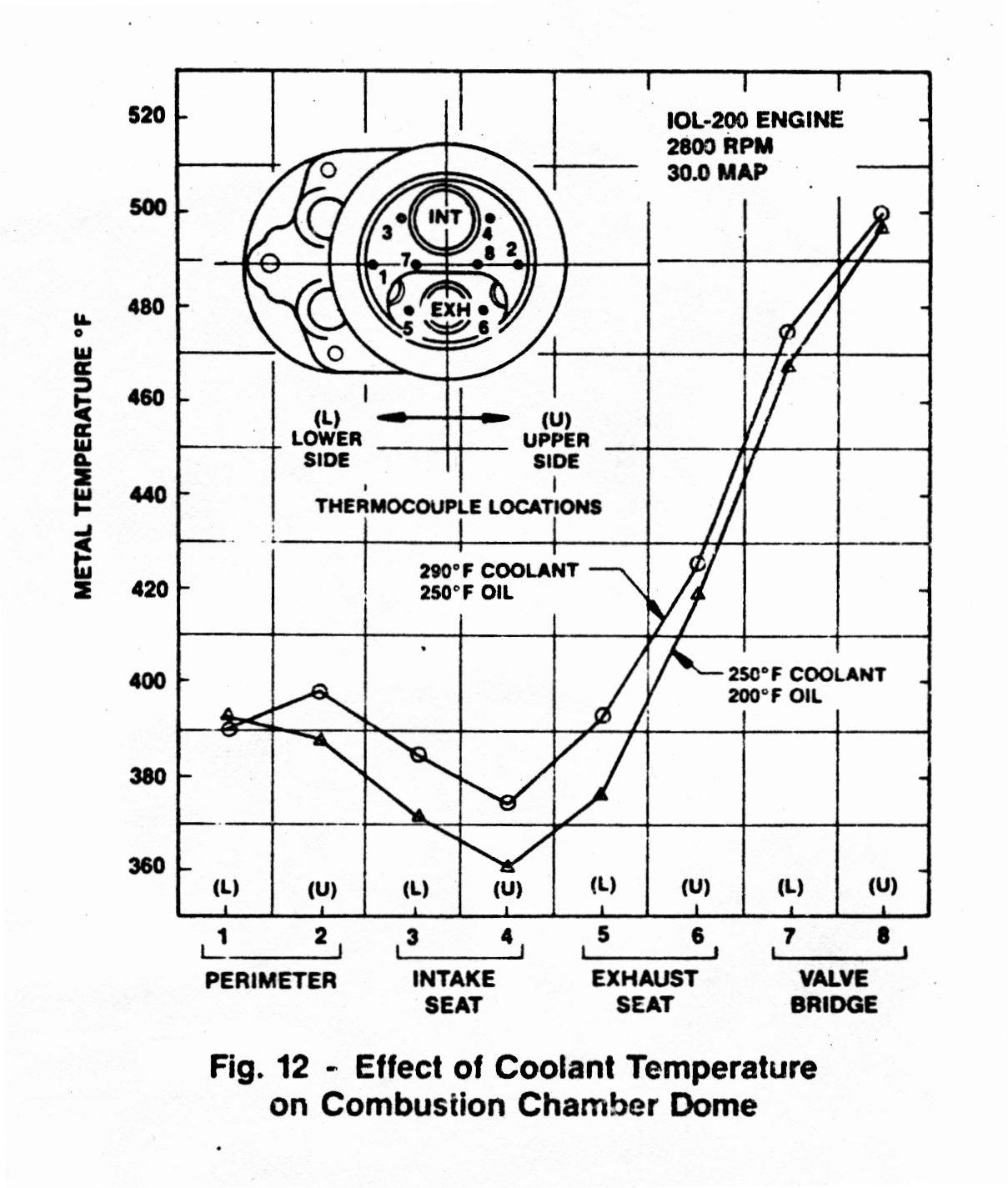
Nah. Local hot spots are over rated.
Compare this chart with a Continental liquid cooled aircraft engine.
The rotary is 100 F cooler let alone an air cooled piston
engine which is even hotter.
Paul Lamar
--
The Rotary Engine NewsLetter. Powered by Linux.
ACRE NL web site.
http://www.rotaryeng.net
Youtube key word UTUBPLEASE
Copyright 1998-2008 All world wide rights reserved.