> Hello all,
> > This is in regard to the spark plug cool that is being
discussed. I
came
> across this on the RX7club.com site. I pleasantly surprised
to see the
> amount of technical experimentation that some on this board
try. I send
> the good nuggets I come across.
> >
http://www.rx7club.com/showthread.php?t=751977
> > > Rob Woods
Interesting thread. So far it has been unnecessary to modify the
rotor
housings
for rotaries used as aircraft engines. These guys may be at the
150 to
200 HP per rotor level. Here is a trick all should do if they
get a chance.
It relives any steam pockets that may be generated around the
spark plug
area.
Also the 3rd gen water pump and RX8 water pump are less than ideal.
The Rx8 in particular as it is much smaller than the 2nd gen
water pumps.
Somebody is already making a better impeller for the RX8 engine
but I
have not
tracked it down yet.
The bottom line is you need to know what is happening and the
only way
to know that is measure the "cylinder head" temperature with thermal
couples
embedded in the roto housings.
Paul Lamar
Paul,
Do you know if anyone has tried a better water pump? By that I
mean a separate engine driven after market pump. I have found at
least 2
examples Mazarre (sic) makes a engine driven pump intended to
replace a
standard pump on a V-8 chevy. They have a performance chart for
the pump
on their site explaining that the pump requires about 4.8 HP to
move 60gpm "with normal engine back pressure." They do sell the
electric water pumps, but only claim they are good for drag
racing, NOT
for road use. As we have told people forever it seems. 5 HP
sounds about
right on their engine driven pump if they are moving that much water
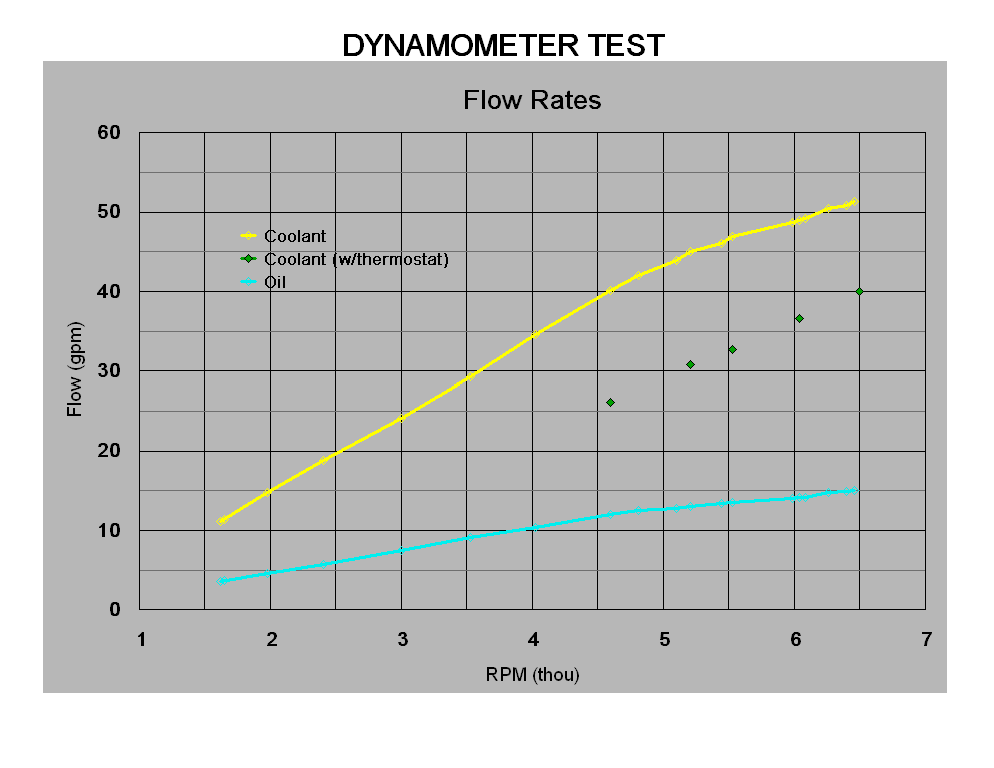
without cavitation. The Wisconsin powersport guys said they had
tested
the standard second gen pump and it was topped out at 53 gpm at the
verge of cavitation. I wonder if we could move more water and
solve that
problem? I also like the original PowerSport efforts into center
feed
cooling. That seems like a better idea over all if you are going
to run
at those power levels. Perhaps Steve might tell us if that was ever
followed up on?
Bill Jepson
Cooling with a 2nd gen pump is just not a problem for aircraft use.
Mark Steitle with the installed thermo couples is not reporting
any problems so far. Mazda data at 7000 RPM has the "cylinder
head" temperature
100 F lower than a water cooled Continental aircraft engine like
the one
that went around the world in the Voyager.
There is an after market pump that Jim Mederer used on one of his
1200 HP turbo 3 rotors. It is used on 800 HP sprint cars and it
is made by KSE
as I recall.
Changing the cooling system from series to parallel As P.S.
attempted and NSU
used would be a worth while thing to do but it is near
impossible without a
complete redesign of the engine. The fact of the matter is
nobody, unless they
are building a Reno racer, are going to demand much over 300 HP
as they don't
want to burn the fuel.
Paul Lamar
Paul,
I found the KSE site and the pumps aren't that expensive but yes they
are still overkill, unless a bypass valve can be milled into them and as
such will allow us to adjust the flow we want.
Could you explain the advantages of the way Jim routed the second outlet
into the front housing?
I believe both inlets go into a common cavity in the front housing.
Could the pump inlet be connected to the outlet of the radiators?
Bill I had no luck on finding any company website close to the name you
mentioned. Could you send the URL to us?
Doug in Japan
I can't read Jim Medere's mind but perhaps this drawing will give us
some clues.
Also this is an excerpt from Max Bentele's SAE 1991 book Engine
Revolutions.
Max was working for Curtiss Wright in 1958 during the early days of
the rotary.
"Chapter 8 - The Rotary Engine Era"
"Cooling of the trochoid housing presented the greatest challenge.
In a reciprocating engine, cylinder head and piston dome are exposed
to all phases of the working cycle. In contrast, the individual
portions of the engine outer housing are exposed only to their
respective phase. Temperature and flow velocity of the working
medium, and thus the heat flux to the housing wall, vary along the
trochoid circumference. Two extremes exist: In the combustion zone,
the very high heat flux will induce nucleate boiling of the cooling
water; in the intake area, the inflowing fuel/air mixture is, due to
fuel evaporation, colder than the ambient atmosphere and much colder
than the cooling water. The design task was therefore twofold: (1)
to prevent overheating and resulting thermal cracking of the housing
in the combustion zone and (2) to minimize thermal distortion of the
housing and to assure effective gas seal operation."
"We soon realized that NSU's circumferential cooling flow was
incapable of fulfilling all requirements of high-performance
engines. We selected axial flow, back and forth between the side
housings, with the flow velocities in the various rotor housing
sections adjusted to their respective heat input. In the combustion
zone, the high-velocity cooling flow removes the steam bubbles
generated by nucleate boiling, and thus permits extremely high heat
fluxes to the housing without detrimental effects. This cooling
scheme was also beneficial to the structural integrity of the rotor
housing. Engine test runs confirmed its effectiveness in all
respects. It was patented and became the standard for all
high-performance Wankel engines."
What Mazda did not do is adjust the flow velocity between front and rear
rotor housings let alone the 3 rotor. Rotor housings are
interchangeable.
BTW nucleate boiling is good boiling.
Paul Lamar
Paul,
If the 2-rotor guys are needing more flow, it may be possible to install
a 20B water pump, or possibly just the impeller, onto the 13B front
housing as the diameter of the 20B impeller is larger by about .025".
If this could be made to fit it would supply a little more gpm than the
stock pump.
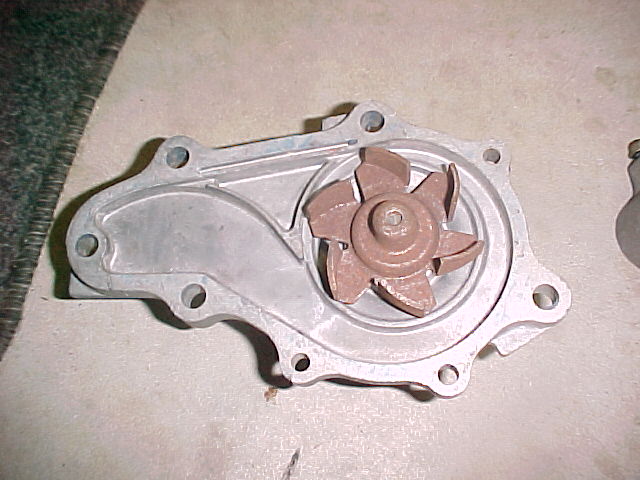
Bob Darrah built a direct drive water pump using a MoPar water pump
kit. He machined a new wp housing from a chunk of aluminum. At this
point we only know that it works on the ground as he hasn't flown it yet.
And there was the builder that used a Toyota water pump. Any word on
how that worked out?
Mark S.
The Toyota pump never flew.
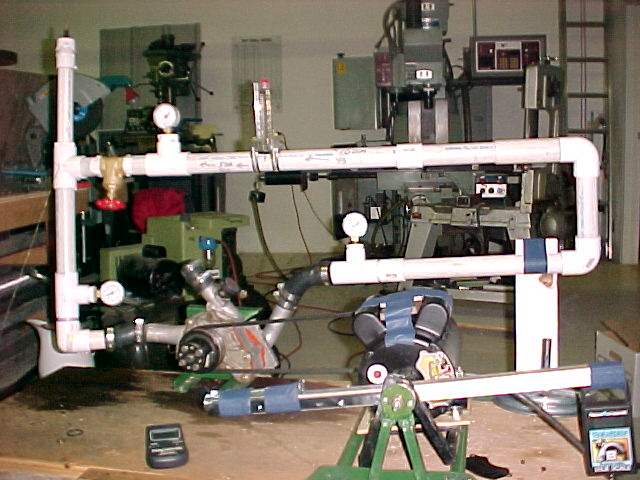
It is tricky to measure the flow as a much depends on the restriction
of the block and rad. Vance an I used a partially opened valve to measure
the flow at different pressure drops.
Paul Lamar
--
The Rotary Engine NewsLetter. Powered by Linux.
ACRE NL web site.
http://www.rotaryeng.net
Youtube key word UTUBPLEASE
Copyright 1998-2008 All world wide rights reserved.