> I just found this paragraph in my new turbine book I bought in London.
> "Gas Turbine Engineering Handbook" Boyce. Third edition. 2006
>
> Here is the quote.
>
> "The new gas turbines being designed for the new millennium are
> investigating
> the use of steam as a cooling agent for the first and second
> stages of the
> turbines. Steam cooling is possible in the new combined cycle
> power plants,
> which is the base of most of the new high performance gas
> turbines. Steam, as
> part of the cooling as well as part of the cycle power, will be
> used in the new
> gas turbines in the combined cycle mode. The extra power
> obtained by the use of
> steam is the cheapest MW/$ available. The injection of about 5%
> of steam by
> weight of air amounts to about 12% more power. The pressure of
> the injected
> steam must be at least 40 Bar above the compressor discharge.
> The way steam is
> injected must be done very carefully so as to avoid compressor surge.
> These are not new concepts and have been used and demonstrated
> in the past.
> Steam cooling for example was the basis of the cooling schemes
> proposed by the
> team of United Technology and Stal-Laval in their conceptual
> study for the U.S.
> Department Of Energy study on the High Turbine Temperature
> Technology Program,
> which was investigating Firing Temperatures of 3000 degrees F
> 1649 °q, in the
> early 1980s."
>
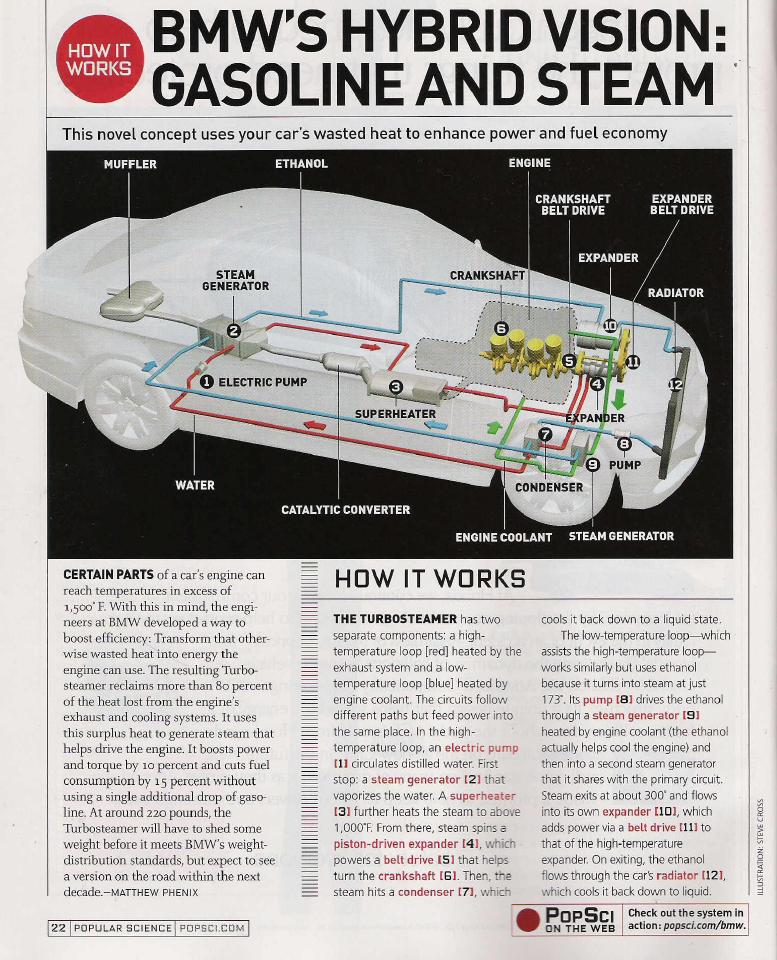
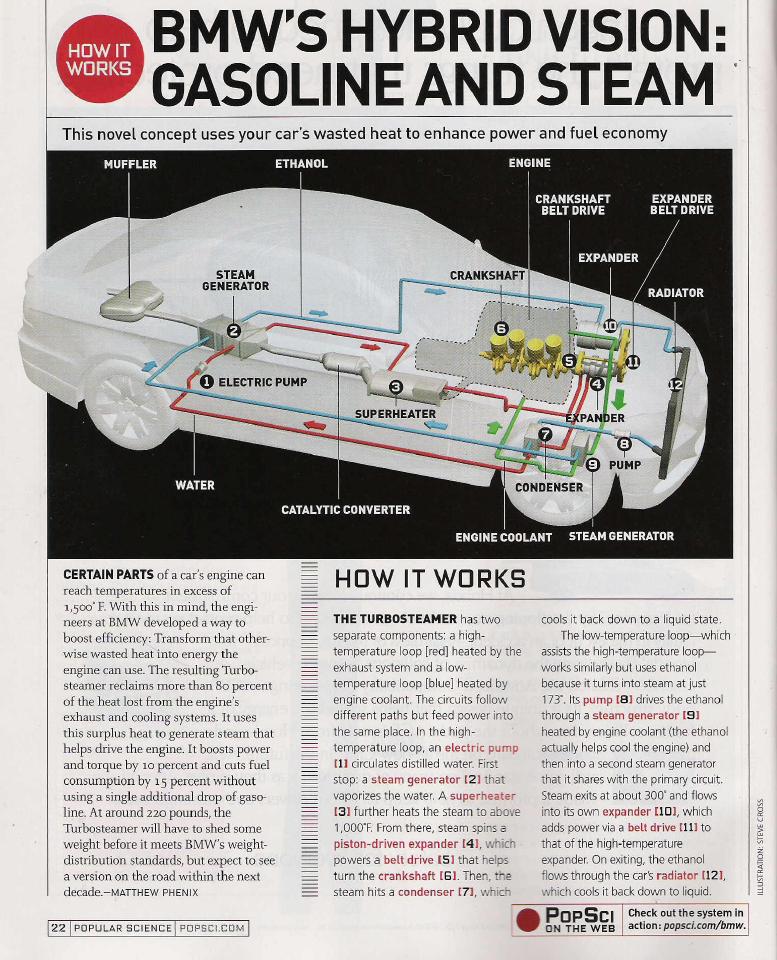
> I had already considered this in 2005 for the turbo compound rotary
> when I found out it is being done in bottoming cycle power
> plant gas turbines. I did the attached 3D to show how it could work.
>
> This is a further increase in the efficiency of the turbo
> compound Wankel
> engine. Might as well put all that exhaust heat to work.
>
> Development of the R3350 Turbo Compound Engine 1954 SAE
> Transactions. I had no
> idea, prior to 2005, when I first read this paper, that so much
> kinetic energy
> was wasted by the exhaust valves in a piston engine turbo
> compound. Need I
> mention yet again... the Wankel rotary has no exhaust valves ?
>
> Paul Lamar
I would like to see/read more on this subject.
Marc Joseph
Engines of this type are known as bottoming or combined
cycle engines and are widely used in stationary gas turbine
electric power plants. Waste heat from the turbine is used
to generate steam which drives a steam turbine. They are
also highly efficient getting as much as 50% of the energy
in a pound of fuel.
We convert the un recovered heat to steam and inject it
into the turbine. We then condense the steam in the exhaust
back into water down stream. We might need to carry a bit
of make up water. Gas turbines according to Marks approach
60% over all efficiency. The steam can be injected back into
the same turbine. No second turbine required.
No additional weight except for a steam pipe in the exhaust
pipe and a condenser. The condenser's job is to convert what
is left of the steam in the exhaust back into water. The
left over heat in the exhaust (900 F) after some of it has
been extracted by the turbine will convert the water in the
pipe into steam.
Is this what you had in mind Marc?
Paul Lamar
The Rotary Engine NewsLetter. Powered by Linux.
ACRE NL web site.
http://www.rotaryeng.net
Youtube key word UTUBPLEASE
Copyright 1998-2008 All world wide rights reserved.