I had no idea Curtis Wright investigated aluminum
rotors. I was going over some old 1963 booklets and
tech papers Don Sherman sent me awhile back (his complete
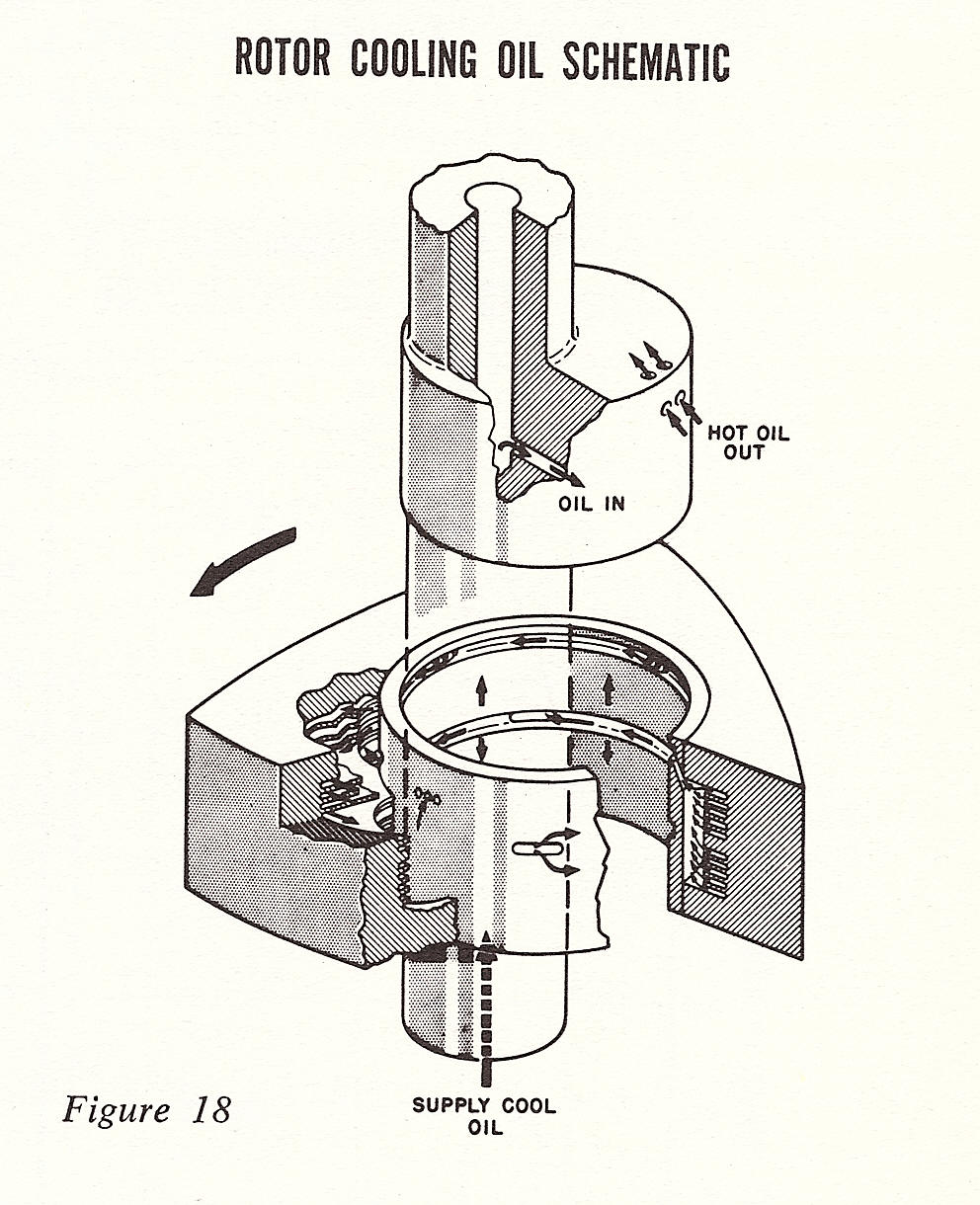
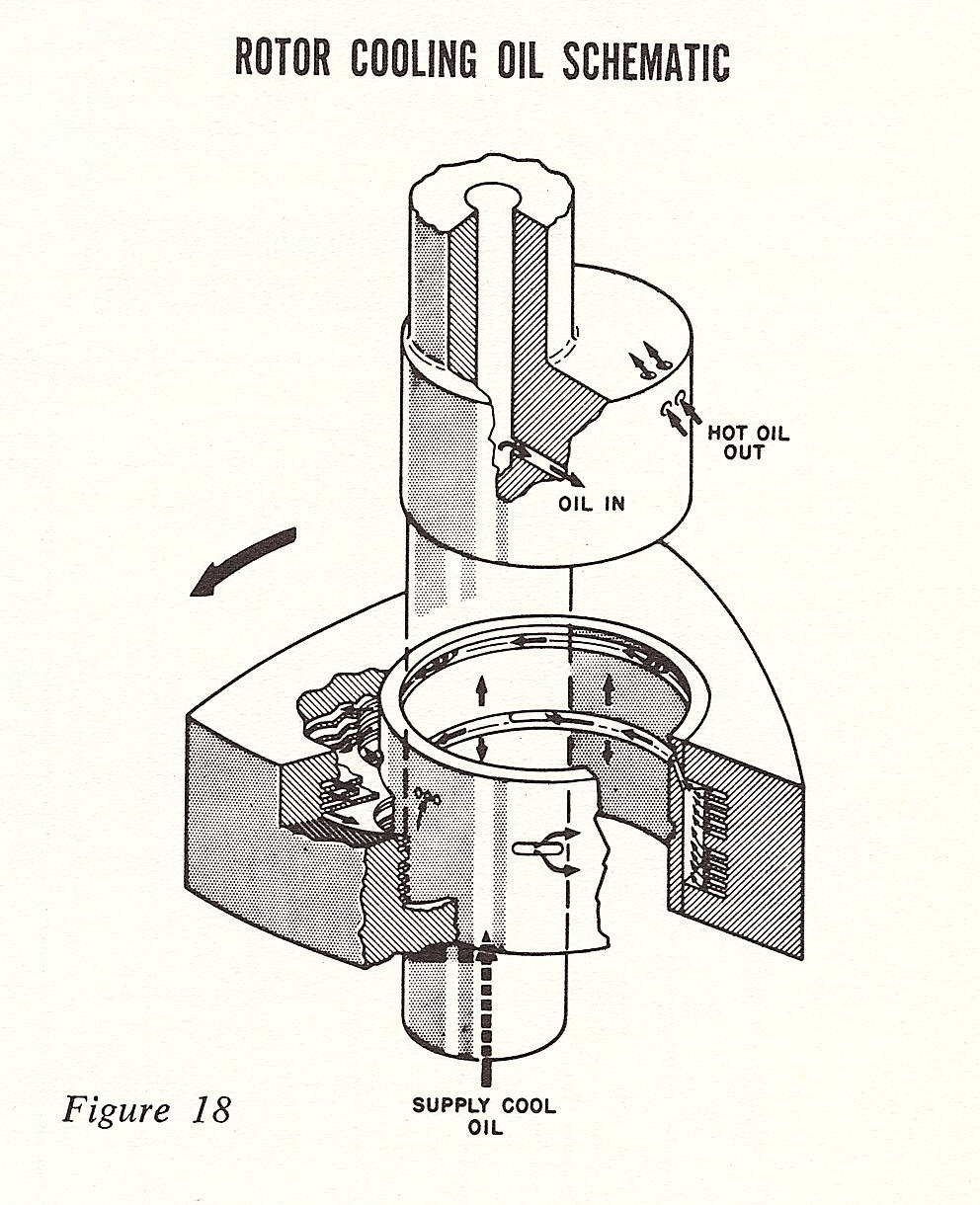
collection. Thanks again Don.) and ran across this illustration.
The booklet was written by Max Bentele and was called "Curtis-Wright's
Experimental Rotating Combustion Engines". Here is an excerpt.
"A rotor made from an aluminum forging offers the benefits of lightweight
and
high thermal conductivity, but requires adequate cooling.
One of the most successful aluminum rotor designs is cooled by forced
circulation of oil from the engine lubrication system. The cooling circuit
is
schematically illustrated in Figure 18. Oil is supplied from the hollow
shaft,
through radial feed holes in the eccentric, and then to the rotor bearing
central annulus. The oil then divides, one part to lubricate the bearing
and the
other to cool the rotor.
Integral fins in each rotor lobe provide adequate cooling surface and a
small
hydraulic diameter. A recess at each end of these finned passes acts as a
manifold for distribution of the oil. The oil from the rotor exit, after
passing the bearing end annulus, is discharged from timed shaft eccentric
passages directly into the housing drain annulus.
The oil entering temperature, temperature rise, and period of contact with
the
metal are controlled to avoid coking or other lubricant deterioration. To
date,
we have had no evidence of adverse effects in this regard. While the oil
flow of
this design is continuous, the velocity varies as a function of the system
dynamics: shaft and rotor inertia pumping superpose a roughly sinusoidal
pressure increment onto the oil supply pressure. The cooling oil is
metered at
the exit; in this way, the rotor cavities are maintained full. Cast iron
rotors
can be made very much simpler than aluminum rotors but at present, not
quite as
light. Their cooling system is, however, different; it is adjusted to the
lower
thermal conductivity of cast iron and the thinner rotor walls. It is
expected
that by further design and casting improvements, the weight of iron rotors
will
approach that of aluminum rotors."
Curtis Wright failed to take advantage of this weight reduction not
realizing
that someday the RPM of the rotary would be limited to 11,000 RPM by the
weight
of the rotor. Modern material, like Beryllium aluminum alloy, would make
aluminum rotors even better. Be/Al alloy is three quarters the weight of
just
aluminum. My guess is the RPM of a two Be/Al rotor rotary (weighing 180
pounds)
would double to around 22,000 RPM and the HP would also double to about
1600 HP
for an all out p-port turbo charged racing version. That would be a power
to
weight ratio much better than a pure turbine with about 1/3rd the fuel
burn and
1/10th the cost in a turbo compound rotary configuration.
http://www.berylliumproducts.com/Attributes.aspx?id=AlBeMet162
When this happens it is going to be an earth shaking event.
A 300 HP car engine could shrink to below the size of a soccer (foot)
ball.
The empty weight of the car would also decrease as it is largely a
function of
the engine weight. The light aircraft industry would never be the same if
these
super power to weight ratio rotary engines were used in VTOL designs.
Paul Lamar
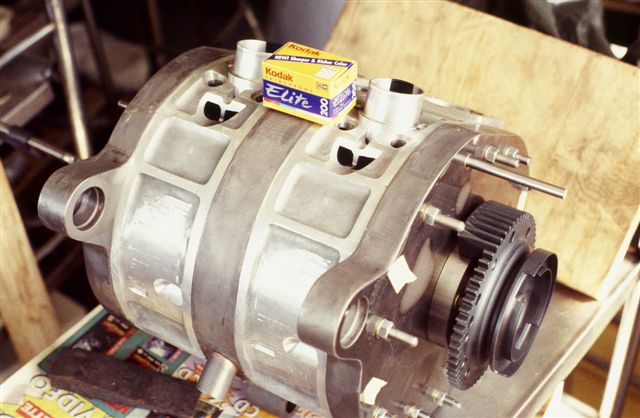
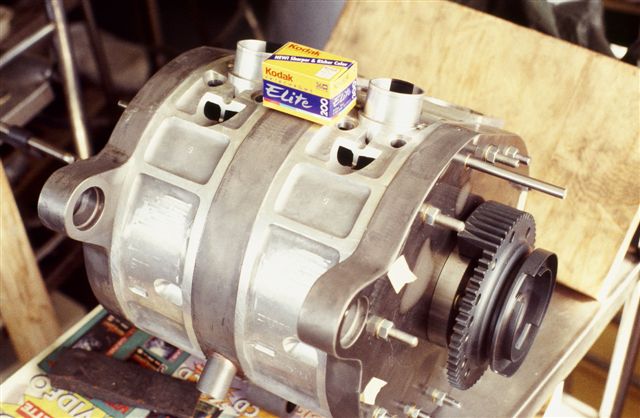
Paul, you mention the sizing possible of the rotary aircraft engine to the
size of a football, and couldn't remember if I sent you a copy of this photo
showing the assembled power section of our little 180-200 hp engine with a
35mm film box on top of it for scale. Where did Max B go after the Curtis
Wright project?
Steve Beckham
I was thinking of car engines with the complicated intake system
and all accessories. Max Bentele probably retired after CW. He was born in
1909.
Paul Lamar
--
The Rotary Engine NewsLetter. Powered by Linux.
ACRE NL web site.
http://www.rotaryeng.net
Youtube key word UTUBPLEASE
Copyright 1998-2008 All world wide rights reserved.