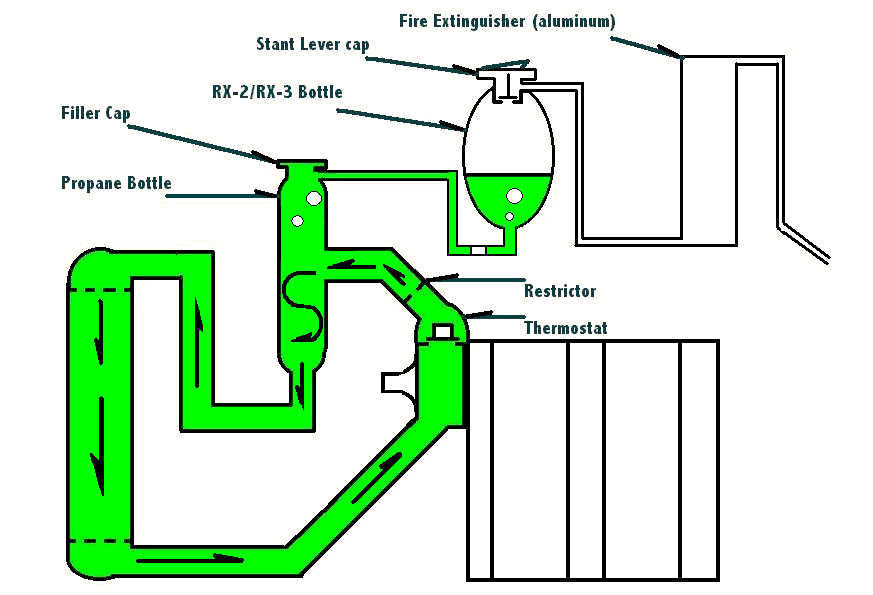
The restrictor is on the water outlet, and the top hose is the same size
as a street Mazda. The radiator is a Griffin double pass aluminum. 3" by
19" by 31" Two rows of 1 1/4" tubes. Both inlet and outlet on the
passenger side.
Here is a picture of a cooling system that has worked for me since 1980.
I added the Rol-air-trol. A home made version of a air/water separator.
I used to manufacture heat transfer packages that used a giant version.
I thought Bell and Gosset made those but now I don't see one in their
catalogue. When pumping hot water around a building, you must remove all
of the air from the loop. When air goes through a pump, it expands
violently (cavitates) at the pump inlet and may damage the pump, and it
makes an awful noise at the pump, and going through fin tube cabinets in
each room. Nothing is as funny to school kids as a fin tube cabinet that
sounds like it is having a diarrhea attack. So air in the loop is just
not allowed. The air removing device helped me get the air out quickly
without hurting the engine, as my system may be drained often. It is
difficult to remove air from the rotary when it is level. More so if it
is not level. The rest of the system is what you would have found on
every RX-2 and RX-3. The pressure bottle is kept 1/3 full of coolant.
When air is delivered to the pressure bottle, it pops to the top and
only airless coolant can be forced back into the system when a
temperature/volume change occurs. In two or three heat cycles the system
will be solid coolant. The bottle must be refilled after each heat
cycle, but not over 1/3 full. I have a Shrader valve on my bottle, so I
can be at relief pressure before the engine starts. Probably not
required for airplanes. You could also add the pressure gage on or close
to the bottle for easy reading, and or, a gage on the dash to view
coolant pressure. The racing organizations require that catch tank, but
there is never anything in it.
I used a stock RX-2 pressure bottle, but a better choice would be an
aluminum aftermarket bottle to get a good selection of cap pressures.
The pressure cap is on the bottle. Not on the swirl pot. That cap is
solid and used to fill the system.
Lynn E. Hanover
Hi Lynn,
I have a couple of questions about this cooling system. I bought an
aluminum filler neck then found out the propane bottle is steel. Do
you use a brass filler neck and solder it? Would it make any great
amount of difference if outlet came out the side at the bottom? If the
top of the air/water separator is only 1 or 2 inches above the
radiator, is that enough?
I think I will get an all aluminum one made up. I've found a place
here that does great work welding aluminum. Since I don't have any
"track rules" I will forget about the overflow can. I tried to buy a
simple cap for the separator and the clerks at a speed shop and an
Autozone thought I was nuts. I'm pretty sure I used to have a car that
had a setup like that though with a separate pressure cap elsewhere in
the system. I finally bought a regular pressure cap and stripped the
lower seal, spring, etc. out of it.
Thanks,
Bob W.
--
N93BD - Rotary Powered BD-4 -
http://www.bob-white.com
3.8 Hours Total Time and holding
Cables for your rotary installation -
http://roblinstores.com/
The troubles with this diagram are several.
Re-stricters are a bad idea as they reduce water flow and increase the HP load
on the pump. If you want higher pressure in the block use a 30 psi pressure cap
instead.
Also the RX2/RX3 pressure bottle should be full all of the time
and some fluid should always be in the so called "fire extinguisher" which is
really an atmospheric pressure over flow bottle. When the engine heats up and
the coolant expands, tiny bubbles are formed. These bubbles will be vented by
the pressure cap to the overflow can. When the engine cools off pure fluid will
be drawn back into the pressure bottle and the engine.
The last three diagrams are the proper way to do this type of system.
http://www.stant.com/brochure.cfm?brochure=204&location_id=179
The radiator pressure cap has a fivefold job:
1. Filler cap to access the cooling sytem,
2. Closure cap to keep coolant in the radiator,
3. Pressure cap to prevent overheating by pressurizing the system to raise
the boiling temperature of coolant and allow the automobile's engine to operate
at more efficient higher temperatures,
4. Pressure relief valve to safely and harmlessly vent excess pressure into
the overflow jug, and
5. Vacuum relief/siphon valve to draw coolant from the overflow jug back
into the radiator to prevent air from entering the system and allowing the
coolant to perform its function more efficiently.
Paul Lamar
--
The Rotary Engine NewsLetter. Powered by Linux.
ACRE NL web site.
http://www.rotaryeng.net
Youtube key word UTUBPLEASE
Copyright 1998-2008 All world wide rights reserved.