Paul,
Just an interesting note on props.
On the Yak this year, we changed our nose case to speed the prop tips up to
mach .92. This required us to use a different prop with much thinner tips
and less cord. The rule of thumb that works is use very thin tips if the
blades will be near the speed of sound, and a thicker prop with more cord
and pitch if it turns slower.
The two combinations, thin blades on fast nose case, and big paddle blades
on the slow nose case were nearly identical in speed. The big difference is
the smoothness of the thin blades turning fast. The fat paddle blades were
hard on the airframe. Rare Bear had the same problem when they ran the big
blades on a slow nose case.
Larry
--
I think you should try the slow nose cone (PSRU) with more cord and
pitch and also with thin tips if the engine will run faster :)
What red line are you using?
You need some titanium rods and Be/Al pistons in that beast :)
You would be on the bleeding edge. How fast do you want to go?
Of course you will need to instrument the prop with strain gages to make
sure it will not come apart with thinner tips and higher RPM's.
You don't want it to throw a blade and jerk the engine out of the airframe
needless to say.
Here is a company in Germany that is making this kind of strain gage stuff.
http://www.sensortelemetrie.de/English_Page/body_english_page.htm
Widely used on Formula 1 chassis and engines.
It won't be cheap.
BTW this will also work for measuring the temperature of our new
aluminum or titanium rotors while the engine is running at 20,000 RPM.
Paul Lamar
--
Paul,
We currently run to 2850 rpm at 51 inches of manifold pressure. That is 100
rpm above the rated redline. Our current plan is to use one of the engines I
just picked up in Florida to build the race engine. Engine will have lighter
pistons, lighter valves and heavier valve springs allowing us to turn the
rpm's up higher without hitting the piston on the head. Rod stretch and
valve float are the 2 common failures when the engines are over rev'd, so
making the parts lighter and stronger will help. We are also installing a
larger blower impeller from a R2800 in the rear case to increase manifold
pressure.
Turning the engine faster will require changing back to the slow nose case,
and we just received 3 blades from a P51 that will be cut down to our 10' 3"
diameter. They are near identical to the albatross blades we ran this year,
except they have 10 deg more twist.
Wonder if Klaus wants to build me a 14 cylinder ignition.....
Larry
A capacitor discharge ignition system would certainly help. Should be no problem
with only 9 cylinders at 3000 RPM. Think about dual valve springs wound in
opposite directions so they rub on each other. www.racingsprings.com Either that
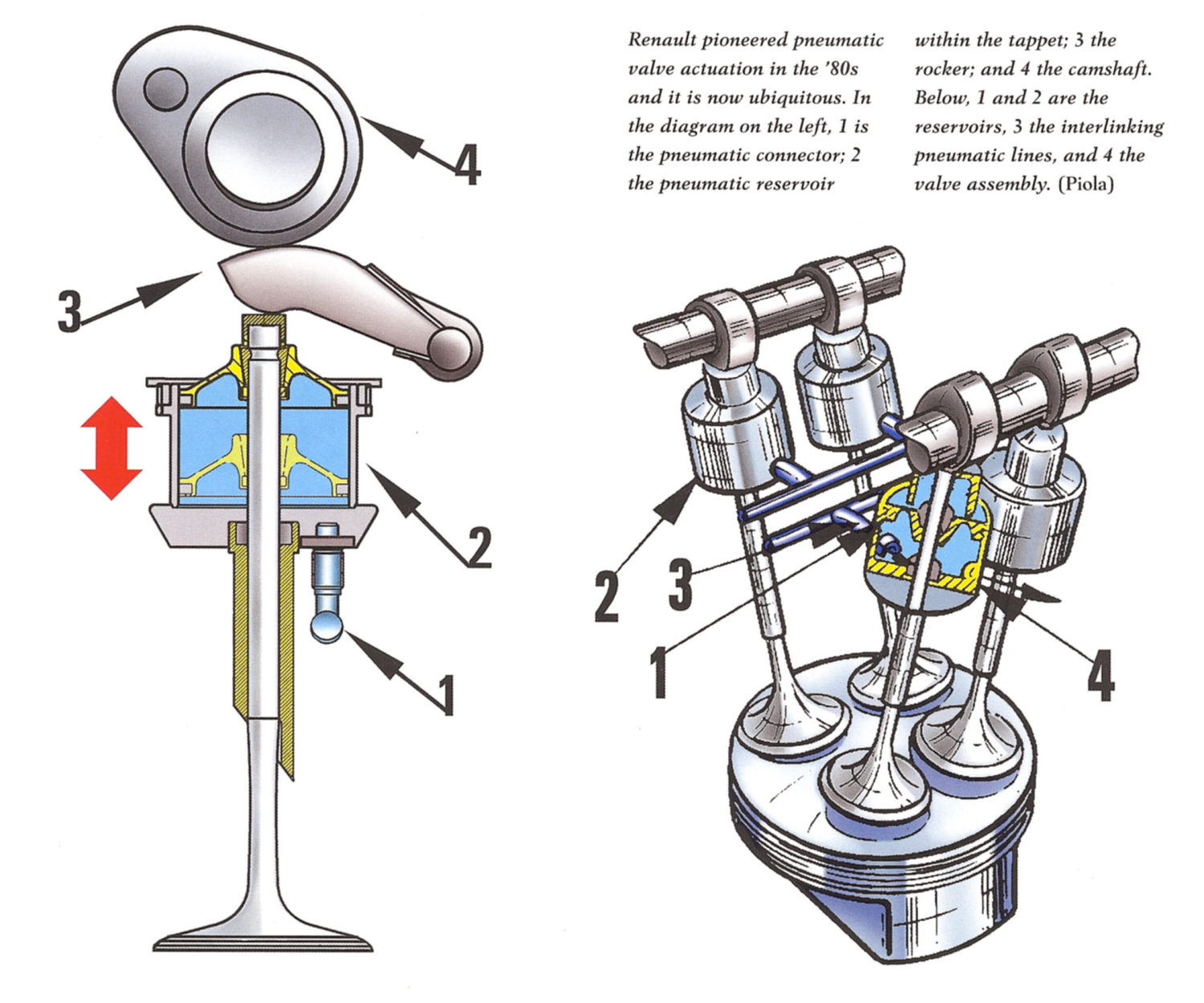
or go with the Formula one full pneumatic valve return system. Use aluminum push
rods for the valves. Titanium if you don't have room for the aluminum.
If the followers are rollers think about titanium followers with steel rollers.
Titanium everything except the exhaust valves.
Paul Lamar
Paul,
Nice pics. Would you scan and post upright images, please. Piola had some
beautiful upright drawings. I just love to see them.
Thank You
Ted
The pic was a bit large. Here is a smaller version.
You should get your rotor I mailed any day now.
Paul Lamar
--
The Rotary Engine NewsLetter. Powered by Linux.
ACRE NL web site.
http://www.rotaryeng.net
Youtube key word UTUBPLEASE
Copyright 1998-2008 All world wide rights reserved.