-----------------------------------
Paul,
I thought we talked about a larger diameter, slower turning turbine some
time ago. This looks very good! I need one for around 5500 continuous
engine rpm.
Steve Brazil
------------------------------------------------
I think we finally have a handle good enough to recommend a direct drive
turbine
diameter and blade configuration as a starting point.
I'll run through the numbers for you. Such a low engine RPM may not be
practical
for a direct drive turbine. So don't get your hopes up too high.
-------------------------------------------------------------------------
To get closer in I need the exhaust pipe diameter and a measurement of
the
dynamic pressure in the pipe using a SS pito tube.
The dynamic pressure will be in the range of 500 to 1000 pounds per
square
foot or 3 to 7 pounds per square inch.
Paul Lamar
--
Paul
In measuring the dynamic pressure via a stainless pito tube does the pito
tube itself introduce an error in the reading? I was under the
impression Mazda used some type of high temp. piezo electric sensor
inserted into a bung welded on the manifold before the turbine.
Doug in Japan
Not significantly. I think Mazda was measuring static pressure in the
exhaust.
It is the combination of exhaust gas density and exhaust gas velocity you
are
after. That is what generates dynamic pressure. Dynamic pressure is what
generates lift on a wing or a turbine blade. As you climb and the air
density is
reduced you have to fly faster to get the same lift on the wing. If you
heat the
air the density also goes down. That is were the term density altitude
comes
into play.
-------------------------------------------------------------------------
I am just thinking out loud here. Given the dynamic pressure (we can
measure
that) and exhaust gas temperature (we can measure that too) what is the
gas
velocity? Anybody have any ideas on how to calculate this?
I suspect. It has something to do with the ratio of the temperature
expressed
in Kelivin. 100 F is 311 K. 1700 F is 1200 K or four times higher.
Does that mean air density at 1700 F is one quarter of what it is at 100
F?
Dynamic pressure in pounds per square foot at sea level density
and standard temperature is .0026 (AD) time velocity squared.
D.P. = A.D. X V^2
-----------------------------------------------
Here is something else to think about. The rotor face is 3 inches wide
and 7.5 inches long. The face moves from top dead center to bottom dead
center
in 1/2 revolution. The rotor face moves in and out 2.5 inches. 11,000 RPM
is 183
revolutions per second. One revolution in .005 seconds. Half a revolution
in
.0025 seconds. So the rotor face speed is 2.5/.0025 or 1000 inches per
second
in and out. If there were no rotor housing that would be the speed of the
column
of exhaust gas moving in an out with the face of the rotor.
What happens is all of this column of exhaust gas goes through the exhaust
port
which has an area of only 2 square inches. The speed of the exhaust gas
going
out the port is increased. So the speed of the exhaust gas going out the
port
is proportional to the ratio of the areas or (7.5 X 3)/2 or 11 times the
speed
air moving in and out with the rotor. Namely 11000 inches per second or
917 feet
per second. I guessed 1000 feet per second which is pretty close. The
question
remains. What is density of the exhaust gas?
Paul Lamar
------------------------------------------------------------------
Paul,
Wouldn't it depend on the molecular weight of the constituents? Perhaps
some of these formulas will be helpful?
http://www.air-dispersion.com/formulas.html#gas
Doug in Japan.
------------------------------------------------------------
Thanks Doug. That site looks helpful.
**** pounds per cubic foot = ( 1 / Z )( MW / 10.73 )( psia / °R ) ****
Z= gas compressibility factor at the given temperature and pressure
(dimensionless)
MW= molecular weight of the gas
°R= absolute temperature of the gas in degrees Rankine = 459.67 + °F
Also, in many cases, it may be assumed that the ideal gas law applies and
thus Z
may be taken to be 1.00.
That answers the Kelvin and Rankin question. Rankin for English and
Kelvin for French :).
All we have to do now is plug in known psia and Rankin for sea level
as a check and we should get air density which we know.
It is twice as hard being and old engineer because all the old stuff
(which turbo compounds are) is in English and the new stuff is in French.
As my late good friend Vance the rocket scientist would say; "We got to
the moon
on inches". If Vance were still here he would have the answer.
I guess that is why all those European engineers at the symposium where so
surprised when confronted with turbo compounding. They never heard of it
before
as they were educated in French and turbo compound was invented in English
:)
Still sorting this out.
------------------------------------------------------
Wait a minute it is coming to me. We know the mass air flow rate
going in the engine and the mass airflow coming must be the same.
Mater can neither be created nor destroyed. The air density must be in the
ratio of the temps in Rankin or some such.
Paul Lamar
Paul, you are getting there. The Mass outflow = the air mass inflow + the
mass of the fuel, (which is ~ 1/14 the mass of the air). Then the gas law,
covered in some of your earlier messages applies
PV = nRT
Pressure*Volume = (number of moles)
*Gas Constant* Temperature
Gas constant must be chosen for the unit of temperature used, which can be
either Rankine (where zero is -460F) or Kelvin (where zero is -273 C). For a
given mass flow through the engine, the higher the temperature, the higher
the PV product.
Bill Schertz
KIS Cruiser #4045
N343BS
----------------------------------------------------------
Thanks Bill.
Here is the bottom line problem. Lets say we measure a dynamic pressure
of 750 pounds per square foot (5 psi) and the exhaust gas temperature is 1700 F
and the static pressure in the pipe near the end is sea level. (30" Hg or 15 psi).
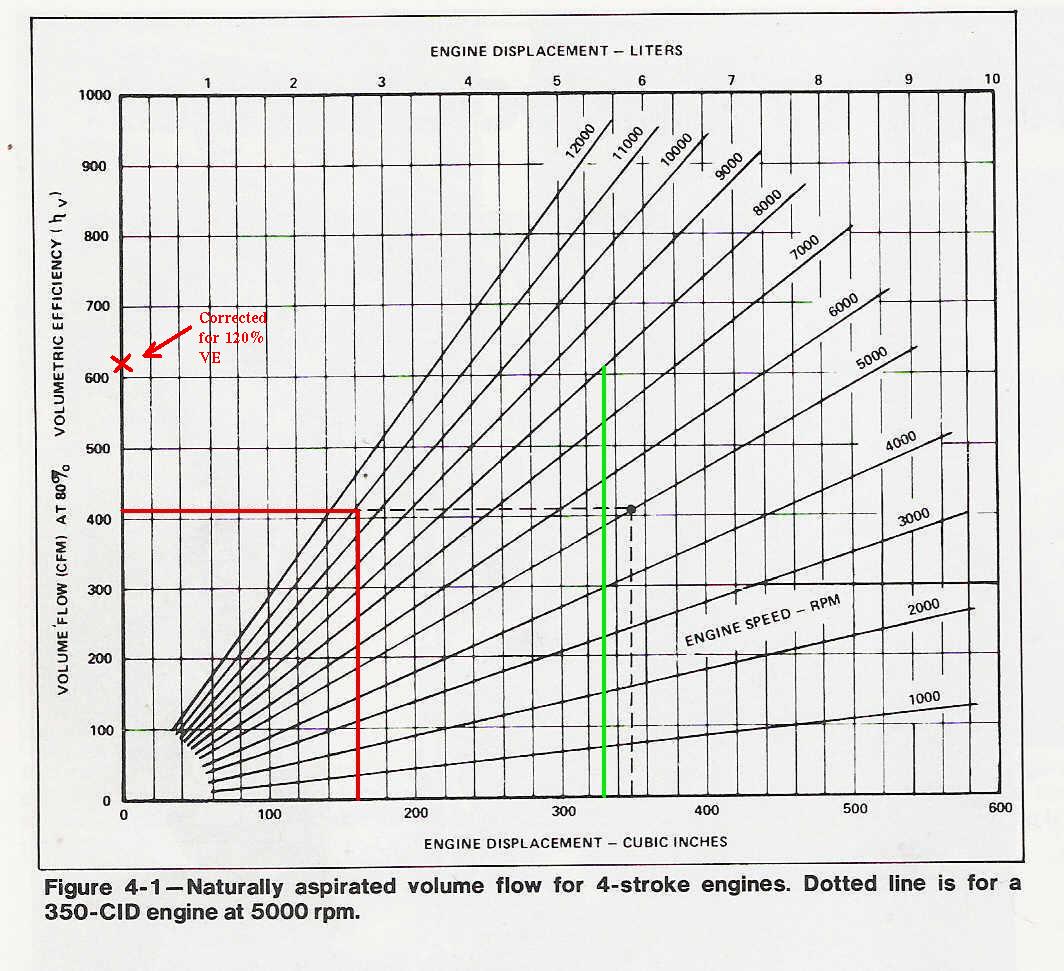
We also know what the mass flow into the NA engine is. This chart
gives us that for a 80% VE and a 2.6 liter engine (13B) running at 410 cubic
feet of air per minute at 11,000 RPM, 80% Volumetric Eff. Red line.
Corrected for 120% VE it looks like 410 * (120/80) = 615 cubic feet a minute.
What is the exhaust gas velocity if you don't mind running the numbers?
I need the exhaust gas velocity to determine the max RPM of the turbine.
Thanks.
Paul Lamar
--
The Rotary Engine NewsLetter. Powered by Linux.
ACRE NL web site.
http://www.rotaryeng.net
Youtube key word UTUBPLEASE
Copyright 1998-2008 All world wide rights reserved.