Turbocharging Performance Handbook. Motorbooks 2007
Jeff Hartman.
IMHO it is one step up from Hugh MacInnes book Turbochargers.
All the math and heat transfer theory is there needed to size
turbines and compressors.
I finally have a handle on the HP obtained from a radial
inflow turbine as opposed to an axial flow turbine used in the direct
connected turbo compound rotary. The radial inflow type is the one you
can buy off the shelf in the form of a turbo charger.
In theory you can now build a turbo charger from parts that will not
only work as a turbo charger but the turbine will also have enough
excess power to feed back into the e-shaft.
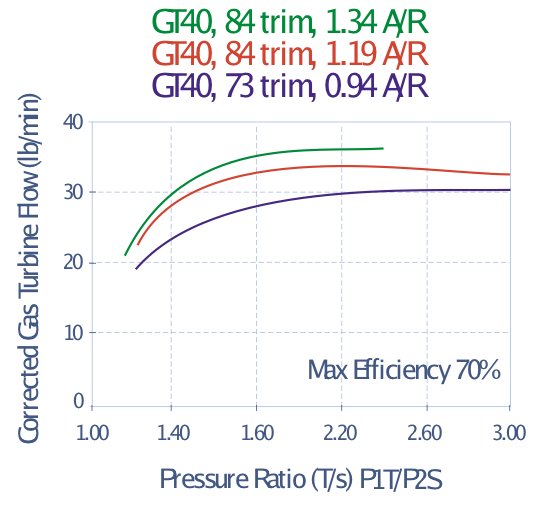
Garret publishes this chart for most of their turbo chargers
and it was a mystery to me why they were doing that. It did not
tell me much. There was a piece missing in my mind. What is the
HP for the silly thing? The missing part was this equation
that converts this information into turbine HP.
HP = Mass Flow X Specific Heat X Turbine efficiency X turbine Inlet
Temperature X (1 - (Expansion ratio raised to the -0.254 power))
The specific heat was a bit of a surprise but on the other hand
my thermo knowledge leaves a lot to be learned.
I am not real sure what minus 0.254 means. I have heard of fractional
exponents but not negative fractional exponents. The 0.5 exponent
means the square root of the number. Here is an explanation
of fractional exponents for those that don't already know about them.
http://www.purplemath.com/modules/exponent5.htm
--------------------------------------------------
But there is another relationship (which, by the way, can make computations like
those above much simpler). For the square (or "second") root, we can write it as
a power, like this:
sqrt(2) = 2^(1/2)
...or:
sqrt(4) = 4^(1/2) = 2
The cube (or "third") root is also the one-third power:
cbrt(8) = 8^(1/3) = 2
The fourth root is also the one-fourth power:
4th-rt(81) = 81^(1/4) = 3
The fifth root is also the one-fifth power; and so on.
-------------------------------------------------------
Not all calculators can do this but QB can and that is what I use.
Some of you spread sheet gurus may already know how to do this.
We now know all the variables from what Garret publishes and what
the rotary is capable of so we now know the HP of any Garret turbo
charger turbine!!
Finally!
Now we can choose one for our geared turbo compound
set up. The top RPM principle still applies. Max rPM is when the
speed of the blade equals the speed of the exhaust gas. A max torque is is when
the turbine is not moving. So max HP still happens around half max RPM.
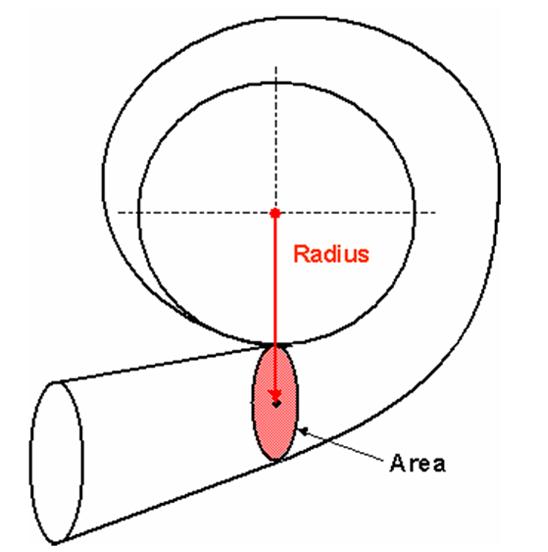
The other thing that is important is the "A" area as in A/R is the key
number. The "A" area should equal the exhaust pipe area or your calculations
will be off. Unfortunately Garret does not give this number directly.
One must calculate it from the flange drawings.
Not to worry if you don't get all this right off the bat. I'll be talking
about it for some time to come.
Paul Lamar
--
The Rotary Engine NewsLetter. Powered by Linux.
ACRE NL web site.
http://www.rotaryeng.net
Youtube key word UTUBPLEASE
Copyright 1998-2008 All world wide rights reserved.