>
>Also on the subject of R&D. I still haven't heard back from Howmet
>Ti-Cast yet. I will give them till next week then I will call them
to
>see if they have a response. On an engineering side of things Ti is the
>obvious material to use for everything on the engine short of gears and
>e-shafts depending how you look at it but I think the cost will be too
>much. I hope that I am wrong but we shall see. Figure I would throw that
>update in there as well.
>
>Rob Woods
Rob,
I am interested in Ti for the rotors and we have Ted in Moscow that is
willing and able to help make it happen. Have you estimated the weight
savings or cooling requirements.
Doug in Japan
Doug,
Hard to say really. I don't really believe numbers that are thrown
around without an actual design study behind them. Cast Ti has anywhere
from a 1/2 to a 1/3 less thermal conductivity versus cast irons. 40
percent less density, half the expansion rate, double to triple the
tensile strength but anywhere from equal to half the modulus of
elasticity. If i were just looking at it, without changing any
dimension(based on modulus vs. tensile) it would be about 40 percent of
the weight of the rotor. So that is my unfounded look at things that
will eventually be looked at.
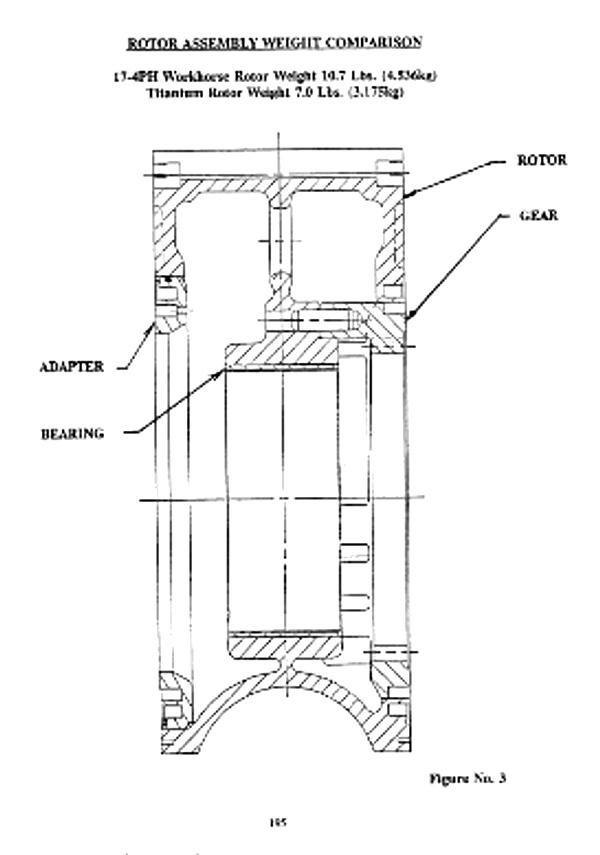
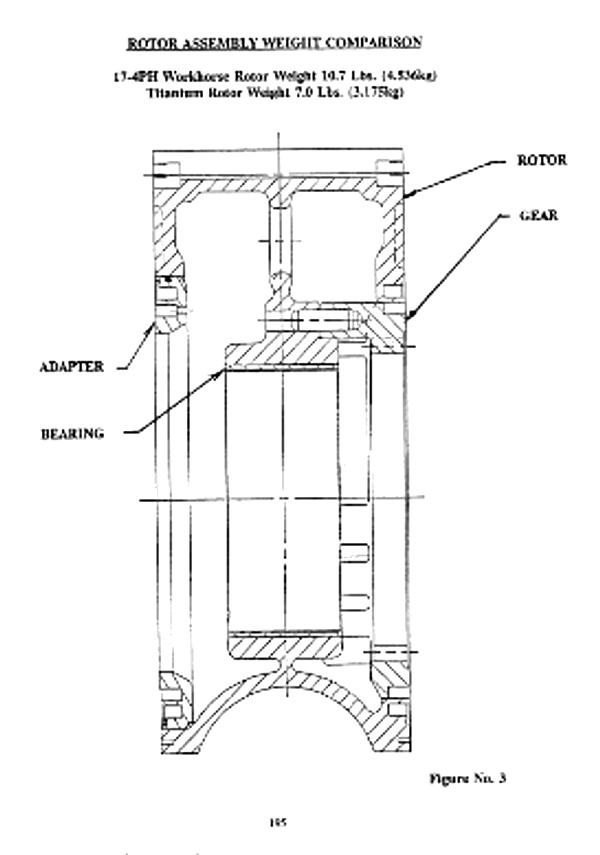
NASA did it but from Stainless to Ti and assuming they did it right,
which is a fair assumption, they went from 10.7 lbs to 7 lbs which is 35
percent reduction.
You put that back in my fake math and that means from cast iron to Ti
which has less difference in densities and the new fake math we will say
is 30 percent. 9lbs at 30 percent reduction gets you to 6.3lbs.
The answer to your question is light as shit comparatively. Better
solution to aluminum, not that I think it is a solution at all in my
opinion. Which leads me to another direction. All of this "we can spin
it to 20k rpm and make 900hp" thing is not the right direction in my
opinion. You actually have to attach the engine to things like clutches,
prsu's etc. which makes for very large problems in taking the speeds.
Can be done in F1 for short periods but if anyone thinks they can spin
the engine that fast and make it last is kidding themselves. In order to
spin that fast the journal bearings in their engines have to be super
high tolerance which means at room temperature then engine is siezed. F1
engines have to have special oils circulated at higher than normal temps
for conventional oils before you can even start them. Yeah it works in
jet engines but they dont have the torque variances an ICE has. Even an
engine as relatively smooth as a rotary. Fantasy arm chair engineering =
usable 20k rpm wankel of any reasonable car engine size.
The right direction I feel is this. If you can make a rotor that light
then you should make the engine bigger and take advantage of greater
torque and power. Lets say you can get away with a 9 lbs Ti rotor in a 1
liter per rotor engine that can rev to 8000rpm. Playing with some
numbers on the side it looks like this could be possible but again until
it is actual gone through a complete design study it is all arm chair.
The only way to get to that design study is learn how the whole thing is
designed from the ground up and that is what I am doing. As soon as I
get past this part I will move on to design studies of size and strength
of rotors in different materials. So while I am doing that and
contacting Howmet we will see.
Rob Woods
I forgot this attachment.
Rob Woods
--
The Rotary Engine NewsLetter. Powered by Linux.
ACRE NL web site.
http://www.rotaryeng.net
Youtube key word UTUBPLEASE
Copyright 1998-2008 All world wide rights reserved.