Hi,
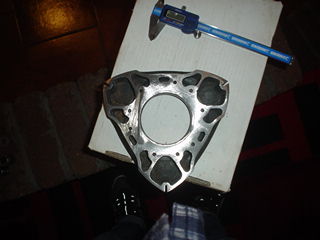
Finally, got the rotor in the mail. Thanks to Paul. (Is it RX8 rotor?
I
remember that You mentioned that pocket and faces are machined. On
this one
pockets a left as cast.)
I agree totally with what Paul and Rob are suggesting.
Next steps:
1) Disassemble it.
2) Cut in two halves.
3) Scan it.
4) Create a valid 3D model of standard Mazda rotor.
Here I will need help from Rob.
Rob, as I understand You've got
all the math to model the rotor faces. If I
remember correctly You're working with Pro/E. Is it possible that You
model
outer geometry (faces) and send me the file (native Pro/E or any
common -
Parasolid, Step or IGES). Modeling the faces out of scan data is not
the best
idea IMHO.
5) As Rob mentioned "Cast Ti has anywhere
from a 1/2 to a 1/3 less thermal conductivity versus cast irons. 40
percent less density, half the expansion rate, double to triple the
tensile strength but anywhere from equal to half the modulus of
elasticity. If i were just looking at it, without changing any
dimension(based on modulus vs. tensile) it would be about 40 percent
of
the weight of the rotor."
If I remember it right Mazda rotor is made out of ductile iron. Its
properties:
Elastic Modulus 120000 N/mm^2
Poissons Ratio 0.31 Shear Modulus 77000 N/mm^2
Thermal Expansion
Coefficient 1.1e-005 Density 0.0071 g/mm^3
Thermal Conductivity 75 W/m K
Specific Heat 450 J/kg K
Tensile Strength 861.695 N/mm^2
Yield Strength 551.485 N/mm^2
Now for the Ti cast rotor I'm planning to use VT20L which was designed
for
extended work at 500C.
Fe C Si Mo V N Al Zr O
H
<0.3 <0.1 <0.15 2 2.5 <0.05 6 2 <0.15
<0.012
Elastic modulus 123000 N/mm^2
Poisson's ratio 0.33 Shear modulus 46000 N/mm^2
Thermal expansion coefficient 9e-006 Mass density 0.00465 g/mm^3
Thermal conductivity 7.8 W/m K
Specific heat 500 J/kg K
Tensile strength 1160 N/mm^2
Compressive strength 1170 N/mm^2
Yield strength 1070 N/mm^2
Hardening factor (0.0-1.0; 0.0=isotropic; 1.0=kinematic) 8.5e-007
N/mm^2
Advantages that we may have:
Strength = 134.6%
E modulus = ~ 100%
Density = 65.5%
Thermal
conductivity = 10.4%
Thermal expansion = 82%
More than that at high temperatures mech. prop. advantages will be
higher.
Anyway as Bob mentioned we can safely assume 30% weight reduction of
rotor
assembly. I agree with Rob that revving the engine 20000RPM may cause
all sorts
of problems. But revving the 3 rotor engine to 12 - 13,000 RPM sounds
realistic
to me.
Now, what's the current thinking about feasible price for a 7 - 6.5lb
Titanium rotor? We're not talking about mass production but high power
applications.
Thank You
Ted
Ted,
I don't like scanning either. What is inherently wrong with it is that
it only lets you copy something without having the ability to modify it.
Point clouds to surfaces is a useless tool unless you are trying to
knock something off. Part of all or our endeavors should be to
understand what we are doing so when we want to make a logical changes
they can be done easily and effectively. I think a particular good
product would be a lower compression ratio rotor for the RX-8 for
instance which has almost nothing to do with copying the current rotor.
I think a very good idea would to send a rotor to a material science
center, maybe the one we had at University at Buffalo, to determine
exactly what type of cast iron that Mazda uses in the RX-8 rotors.
Especially to find out what the hardness levels are at the apex seal
slots. Cast iron is such a variety metal that speculating as to what it
is pointless. Just test it. This should be on the hot list to do. Other
rotors don't really matter so much since the RX-8 rotors are of the
highest apparent quality/engineering. If we don't have real data on what
we are trying to improve then it will make it harder to make the
replacement as good as it could be.
I couldn't tell you what the cost would be for a Ti rotor. I am looking
into it and will let you guys know when I find out. Read up on the post
up to this point.
I don't use pro-e but that is the program it looks like we will need to
use in order to accurately model the rotor and housing. Once done in
pro-e it can be imported into solidworks. That os fine with me for now
since the primary function is to replicate what Mazda has done but in the
long run I want to try different configurations so a better solution
will have to be found. I hope to find a way to make a macro that will
have this functionality.
Example:
http://www.profilesmagazine.com/p33/marsalek.html
Rob Woods
Rob,
I like your thinking. I have compared the RX7 and RX8 rotors. The weight
difference between the lightest RX7 which Ted has and the RX8 isn't all that
much. I believe the walls and internal structures are more uniform in the
RX8 casting and one important point is that the area surrounding the apex
seal is smaller ( read shorter in the length of depth) - as the apex seal is
shorter.
So from a practical point of view coping the RX7 rotor is safer, the
differences in wall thickness ( to the RX8) are negligible.
If I've read my mail correctly recently I believe Paul sent that rotor to
Ted, and sent that particular one probably for these reasons.
I've cut up a rotor and it appeared to me to be cast steel rather than cast
iron - but it certainly wouldn't hurt to know what it is exactly. I had the
e-shaft tested for the same reasons.
George ( down under)
--
The Rotary Engine NewsLetter. Powered by Linux.
ACRE NL web site.
http://www.rotaryeng.net
Youtube key word UTUBPLEASE
Copyright 1998-2008 All world wide rights reserved.