Speaking to a test pilot of the RFB Fantrainer I was able to get this
information to
share with you.I realize that most of you are interested in the puller
configuration instead of the pusher like I am, I just felt is was
interesting
information to share to you.
The rotary engine is certainly the answer to the best power to weight,
turbocharging is vital because of the sensitivity of the engine to
density altitude.Especially for the ducted fan applications as it
is efficient only within a narrow power band.We operated the FANSTAR
between 5,000 and 6,500 RPM, with the cruise setting at 6,000 RPM up
to 8,000 feet.Without turbocharging there just isn't much left above
5,000 feet.
400 to 500 HP is about the right power output, similar to the
Allison C3/600 in the Fantrainer. However, with the turbine output
limited to 450 HP, and the turbine efficiency dropping off at altitude,
your turbocharged engine will deliver sea level power up to approximately
18,000 feet ... and so make your machine faster at altitude, and giving
you greater flexibility in power settings.
The biggest concern at this time would be the reliability of the rotary
engine. I have heard from the people who are building the new rotary
engines for the experimental class, that they would expect at least
1,000 hours TBO. I am not convinced that the engines can reach that
goal, especially in a turbocharged form, but I have not had any recent
experience with them. We have been considering one for installation in
a kit helicopter, and it would work wonders there if all the concerns
can be met.
David Aka D B
The rotary engine is no more sensitive to altitude than the pistonengine.
They all lose power due to lower density air. We have several people
flying
rotaries up to 14,000 feet all the time.
The turbo charged RX7 got a reputation for short life because most people
jacked
up the boost and HP without remapping the computer. The engine would
detonate and fracture
the 2 mm wide cast iron apex seals. As my friend Jim Mederer of Racing
Beat would
say: "Don't let it detonated!" :) A more realistic solution is use 3 mm,
high
quality, steel seals or Inanette 3 mm ceramic seals.Both have a
different
resonate frequency.
My friend Dave Leonard has been flying a turbo rotary
for several years now. You can see it fly on Youtube. (UTUBPLEASE) He has
lost several automotive based turbo chargers (but no apex seals) so don't
try to use the stock turbo or any automotive turbos in an aircraft.
http://n4vy.rotaryroster.net/
450 HP engines suck down a lot of fuel. Any 450 HP engine. That is a
reflection
of the low efficiency of a ducted fan. Any ducted fan! including the one
in the
fan trainer.
Check out
http://www.mickaircraft.com/duckt.htm
Paul Lamar
I had never heard of this plane before this email so I looked it up.
Whata
SHARP looking airplane. (As an ex Commander 114 owner I'm partial to the
tall T-tail.) What's its story? Is it in production at this time? Thanks.
Bill Hobson
Never went into large scale production. IMHO due to the low efficiency
of the ducted fan. Read high fuel burn per MPH. Low MPG.
Paul Lamar
Thanks Paul - that's too bad. One of the frustrating things about looking
things up on the web is that nobody ever seems to DATE their web pages. I
found a lot of information about the Fantrainer that's probably 10 years
old! Very cool looking plane.
Bill
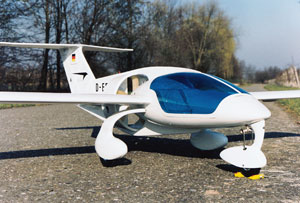
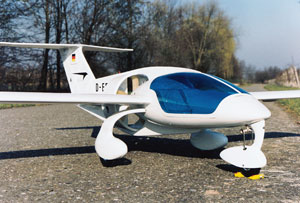
Bill, Your not the onlt one - here's a nice shot!
George ( down under)
--
The Rotary Engine NewsLetter. Powered by Linux.
ACRE NL web site.
http://www.rotaryeng.net
Youtube key word UTUBPLEASE
Copyright 1998-2009 All world wide rights reserved.