<snip
With the discussion on-going about in tank fuel pumps and fuel
return lines, I am asking if I need to make accomodation for
anything special. Presently, my tanks have no provision for a fuel
return or in tank pump. Would it be necessary to design in any of
this stuff?
Thanks, C. Smith
C. Smith -
I have offered to build and test an EFI PWM Pump design utilizing in-
tank, submerged pumps, but I'd be more than happy to test an external-
pump design afterwards, probably using the Walbro pumps that Tracy
sells. (He and many others have proved their reliability.) I assume
that would work for you.
One goal of this project is to design a RETURNLESS EFI pump system.
Other goals are reliability, redundancy, and low cost.
The usual caveats apply for EFI pump placement. You will want to
place them AS LOW and AS CLOSE as possible to the fuel tank output
line. NOTE: EFI pumps DO NOT LIKE TO SUCK - they will simply create
fuel vapors and bubbles, lose prime, and spin to destruction. You
might hear the pump suddenly "spin up" when this happens. Even a rise
of many inches can cause this effect with warm fuel (ask me how I know).
Needless to say, I disagree with Paul about putting the pumps on the
firewall. That can create too much "sucking" during climb out - just
when you need absolutely reliable fuel delivery. (Hence, my in-tank
submerged preference.)
Regarding you "designing in any of this stuff" - that's up to you.
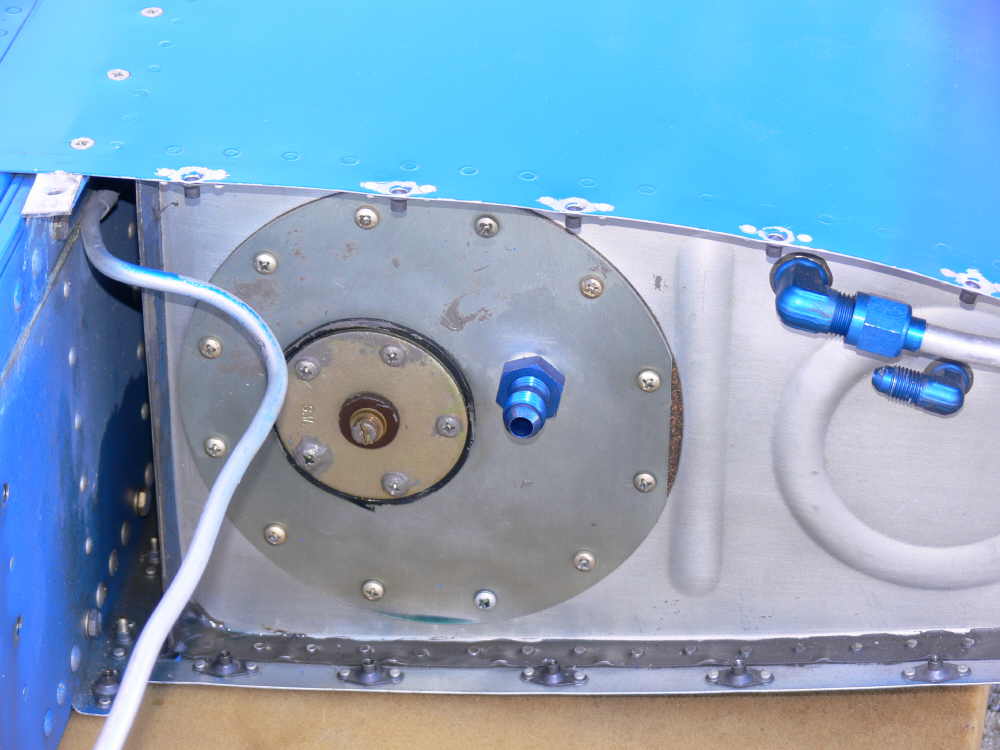
The RV series has a wet wing tank with a round access port on the
inboard side. I plan to mount the EFI pump on the inside of that
removable access panel. We'll see what EFI pump parts are available
as the project progresses ...
-Vince Orton
Some suck better than others. The MSD is positive displacement
while most are centrifugal (Walbro) and don't suck worth a damn.
Paul Lamar
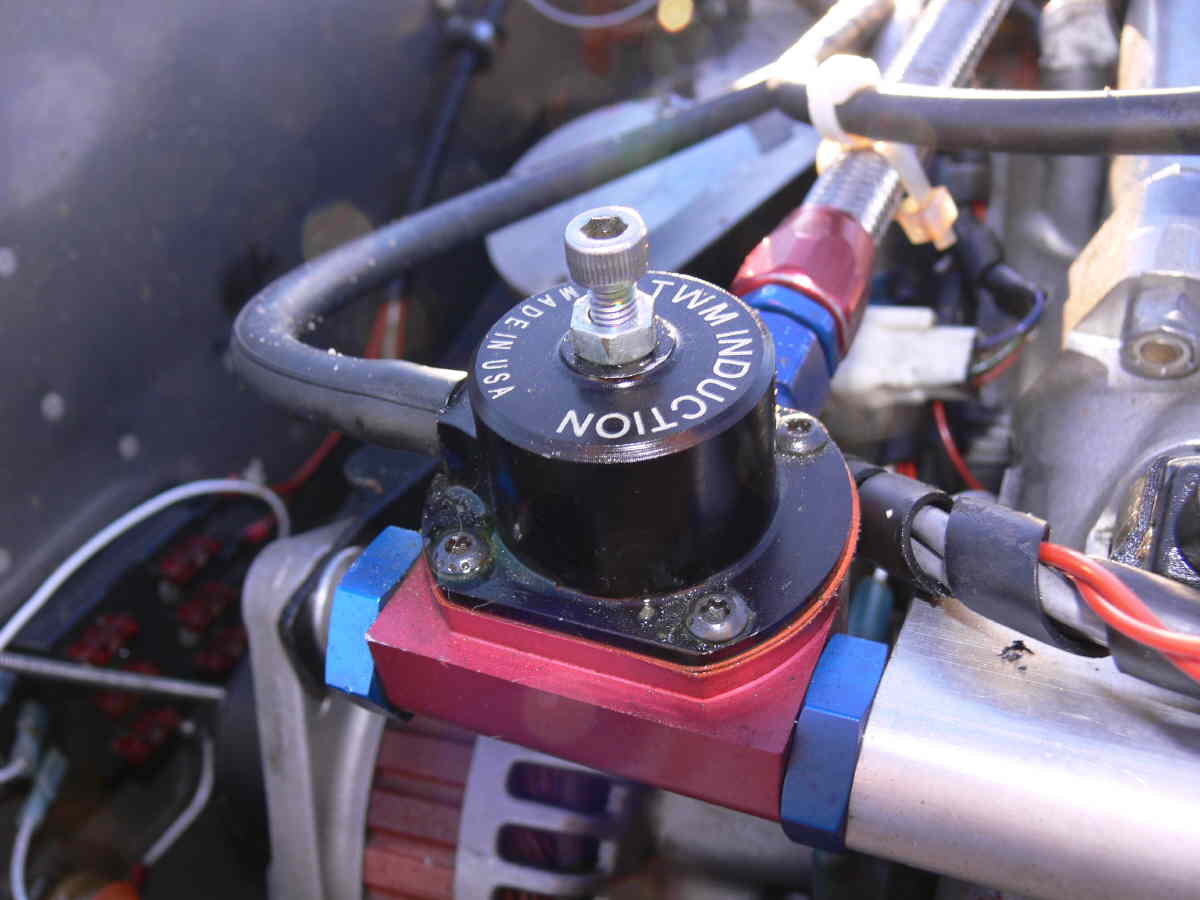
If you are going to run a returnless system with fuel injection you are
going to want to test pressure spikes and drops. It is almost standard
to run a pulsation damper in the rail to make sure the pressure loss in
the rail due to injection stays consistent for consistent pulse width
delivery. I dealt with this on Korean cars we tuned since they like to
use cheap stuff. In really cold environments you can run into weird
issues.
Rob Woods
I have said it before.. I'm still a fan of engine driven (mechanical)
fuel pumps for the pressure part of the system. Hi pressure electric
fuel pumps need an unreasonable amount of power to operate and demand
you either run two alternators (not a terrible hardship), carry large
batteries, or operationally demand that you land soon after the loss
of your electrical power source.
A mechanical pump system with low-pressure (low power) in-tank (or
near-tank) pumps could be designed to be returnless. The pump's
output would be proportional to RPM, which is not ideal. Proportional
to load would be better - a feedback system could either mechanically
or electrically regulate pump pressure by actuating a leakage past the
pump's vanes/rotor. Use mechanical direct-drive for the brute force,
and low-power actuation for regulation.
If you are concerned about the failure of the mechanical pump,
design-in a fixed orifice "dribbler" system which will run on the
low-power in-tank pumps. Use a mechanically actuated valve to control
whether this system is delivering fuel to the manifold directly, or
through the engine driven/regulated pump hi-pressure system.
This is if you are determined to ignore the advice/experience of Steve
Beckham on providing fuel to the rotary.
Back to your regular programming...
Matt-
Why design a return less system? One of the big advantages of using the
rotary is the ability to use a fuel return system! Yes you have to deal
with routing a fuel return line - no big deal though in the overall
scope of the project. The big advantage is that it eliminates virtually
all risk of vapor lock and hot start issues. This is important
especially if you want to run winter blend mogas at high altitudes.
Fuel return also greatly diminishes the possiblility of water
contamination. Once that pump is circulating, even modest amounts of
water in the system are quickly removed from the injectors.
The same goes for contamination from a 2-stroke oil bolus. When I go
somewhere on cross country and fill an empty tank, that is a big gulp of
2-stroke oil that needs to be mixed in. I try to shake it up, but on a
number of occasions it has not completely mixed, causing quite an engine
stumble. If it were not for the return line bringing most of that oil
back to the tank, the engine may have quit and I may never have gotten
the engine started in time.
Take my word on this one (and I cant remember ever having said that
before) - GO WITH THE FUEL RETURN SYSTEM! Put your EFI pumps in the
tank if you want, but they will be easier to service outside the tanks.
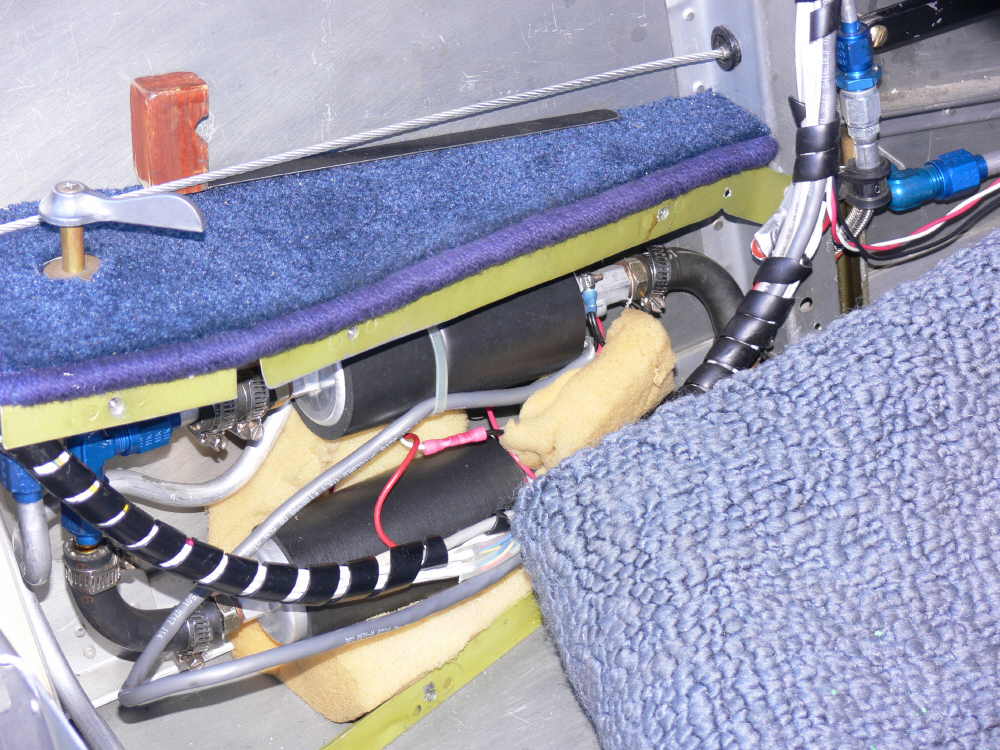
Put them low, just outside the tank or inside the fuse. You won't be
sorry. I used scrap aluminum to build a nice little cubby that houses
the valve and both pumps, just forward of the spar on the pilot's side.
makes for a nice cup holder too. will try to get a picture on of these
days.