Vince here is a project for you.
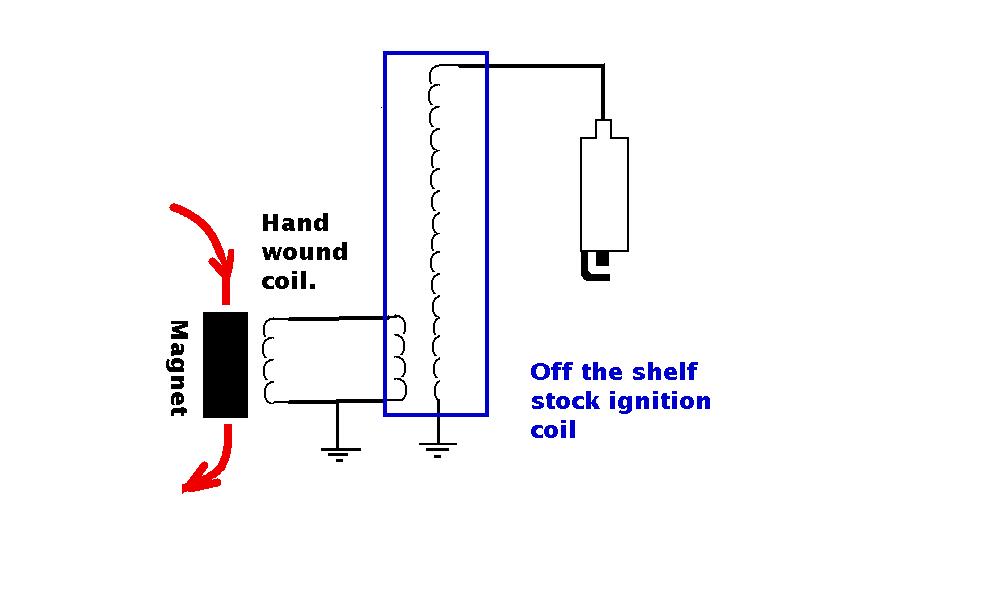
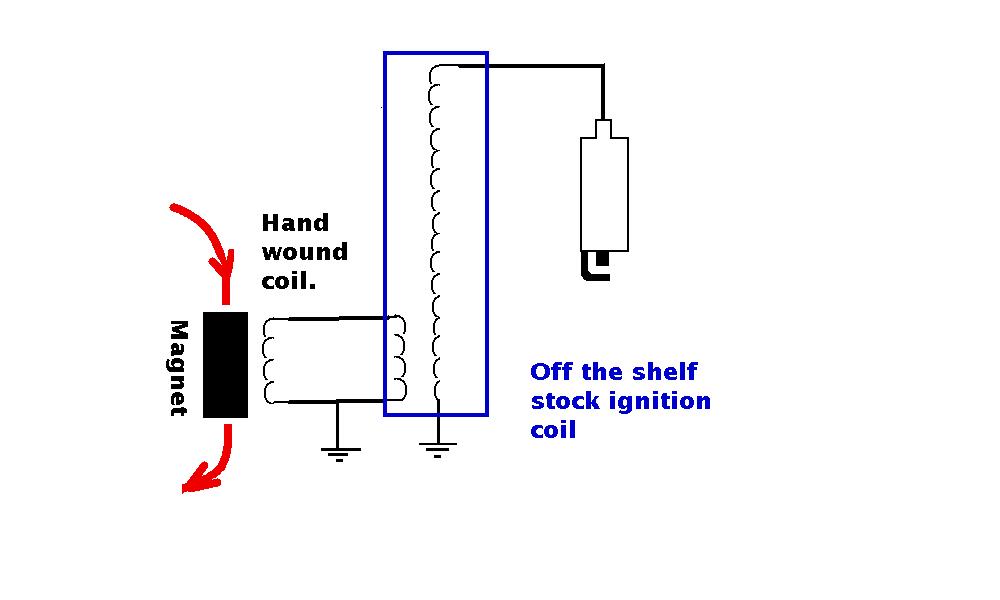
Two hand wound coils and two magnets.
Rotate the magnets in a device mounted 180 out on the e-shaft
nose and feed the hand wound coil voltage into any standard
Ignition coil and see if it will spark when the magnet goes by.
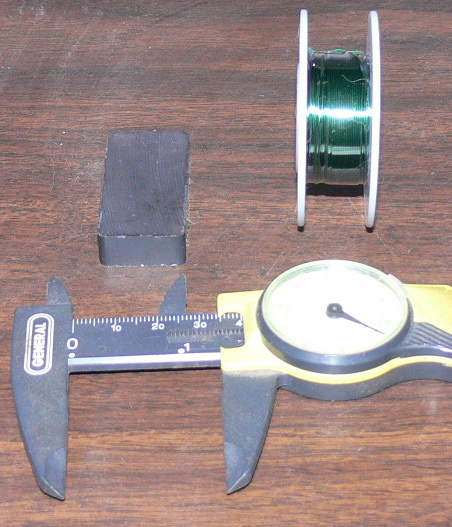
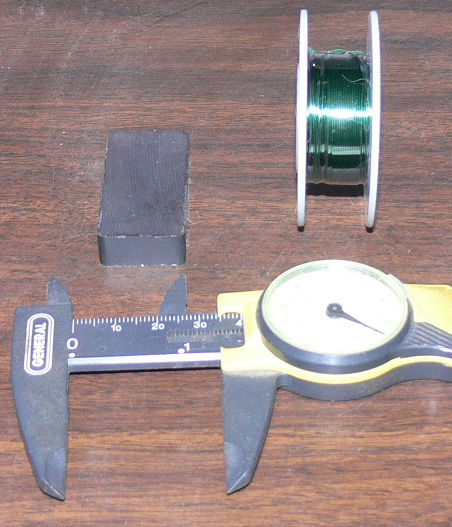
I found a couple of large 1 by 2 by 1/4 thick bar magnets and some
coil wire in radio shack.
This idea does away with the need for an ignition timing trigger,
alternator, battery and electronics as long as you use
gravity flow carbs. You might have to try several hand wound
coils until you get something that works. My guess is they
should develop 300 volts peak.
I have my plate full building this 555 EFI.
Paul Lamar
Paul -
Hand-wound? Me? I dunno ... I thought I made my predisposition for
Off-The-Shelf (OTS) parts clear. :) I think I'll stick with the PWM
EFI Fuel Pump project for now.
But just for discussion's sake:
I always thought the old distributor hole should be filled with a
custom alternator setup. I suppose an alternator+magneto would work
too. Kind of like using the distributor hole as an accessory pad.
(Could it take the torque?)
I'd like to know if any of those Harley or RevMaster setups could be
made with ONE magnet - that would be a perfect magneto-type setup.
As for using the electromagnet coil to power an ignition coil, that's
just a simple step up transformer with OTS parts. It would work so
long as the electromagnet coil generates enough current - that's the
rub. It
*IS* simple though. No moving parts other than the flywheel
& magnet.
Hmmm ... Can these coils (4 total, 1 per plug) be put on the flywheel
end of the engine? I think so, using a flywheel-mounted magnet and
counterbalance.
Advantages:
- No moving parts and dirt simple
- It would advance timing automatically with rising RPM
- Can be used to complement Electronic Ignition for power-out
redundancy.
One last thought: Using high-voltage diodes, the Ignition coil can be
powered by two sources, the fixed electromagnet AND a digital power
source, solving start problems during slow cranking.
Back to the PWM EFI pump project ...
-Vince Orton
Hi Paul and Vince,
I may be wrong here but I have the impression that a single rotor engine
fires like a one cylinder, 2 cycle engine. If that's true, then a 2
rotor would fire like a 2 cylinder, 2 cycle engine. This is a common
outboard motor configuration. My 2 cylinder 10 hp Merc is quite old so
not representative of state of the art but it has magnets inbedded in
the underside of a hollowed out flywheel and some sort of pick-up coils
180 degrees apart that are in close proximity to the flywheel's inner
surface. Could these parts, purchased as OTS replacement parts, be used
to fire a 13b? I can see where it's possible to fire 2 plugs but there
are 4 that need power. Tracy fires leading and trailing
plugs simultaneously and sees no difference in operation. Then there's
the matter of ignition timing. My old outboard has the pickups mounted
on a moveable plate centered on the crankshaft and a mechanical linkage
from the throttle arm that rotates the entire plate. I'm not exactly
sure why this setup even works because I see no "wound coils" like
Paul's pictures show. The pick-ups appear to be a laminated metal
construction similar to what you'd find in a clock motor. If any of this
is interesting, Vince, at least there are no coils for you to wind. Any
thoughts? Dave M
Sounds exactly what I have in mind.
The 2 rotor rotary fires twice per rev 180 out of phase.
No need for advance as the engine only generates significant
power from 5000 to 7500. Lots of engines are running on 22 degrees
or so fixed advance.
Paul Lamar
The Rotary Engine NewsLetter. Powered by Linux.
ACRE NL web site.
http://www.rotaryeng.net
Youtube key word UTUBPLEASE
Copyright 1998-2008 All world wide rights reserved.