Hello Paul-
Sent this to Tracy earlier today; thought I would pass it along in case
someone on the list has seen this before...
Had some peculiar behaviors in that latest tuning attempts. Hopefully
you'll have some suggestions.
Background-
- 13b, p-ported, with slide throttle design & "tuned" intakes
- LS1 injectors
- EC2 with latest p-port firmware
- EM2
- 6800 field altitude
- 55F OAT
- Known to be under propped (has a 72x72 160hp 2-bladed prop. Needs a
72x109 230hp 3-bladed prop)
Symptoms-
If we run the engine with the manifold pressure lines *DISCONNECTED *from
the EC2:
- Engine starts very easily
- The engine runs quite smoothly across a pretty wide rpm band after
tweaking the manual mixture control.
- Reasonably smooth running as low as 1500rpm engine (526rpm prop!)
- Very smooth running 3000 - 4800 RPM.
- Above 4800 rpm we seem to "run out of enrichen" on the manual mixture
control & the engine stops.
- MAP table view on the EM2 real-time shows the EC2 using map location
59
or 91 (MP constant matching atmospheric pressure) depending on high/low
throttle (as expected)
If we run the engine with the manifold pressure lines *CONNECTED *to the
EC2:
- Engine noticeably harder to start
- Engine will not run smoothly at any rpm
- Significant surging pattern -- rpm increases rapidly, followed by
engine stumble to low idle rpm, followed by next surge.
- Engine often stops during the stumble / hard to restart
- MP pressure varies rapidly based on engine rpm
- Significant manual mixture changes can help ease the surges somewhat,
but never enough to get the engine to smooth out enough to let us see
if MAP
values could be tweaked.
Looking at the MAP table with engine off, it seems like all map cells are
at
0 -- as expected. I did not check all 127 cells, only the top cells (say
100 - 127).
Mark (Rocky Mtn High)
That is good evidence the 555 system will work fine :)
We noticed this phenomena on the dyno test of your engine.
I am not privy to Tracy source code but the last time I talked to him
about it was a couple of years ago and he was taking only one sample
of the intake manifold pressure per e-shaft revolution.
Using a computer this takes only about 10 usec.
http://en.wikipedia.org/wiki/Microsecond
Light travels only one mile in FIVE microseconds.
That is 10 millionths of a second. 100 usec is one msec or one thousands
of a second. This is a very brief period of time so the manifold pressure
is jumping around a lot in a p-port tuned manifold. It could be anything
or even above atmospheric pressure at some times. That is what p-port
tuned
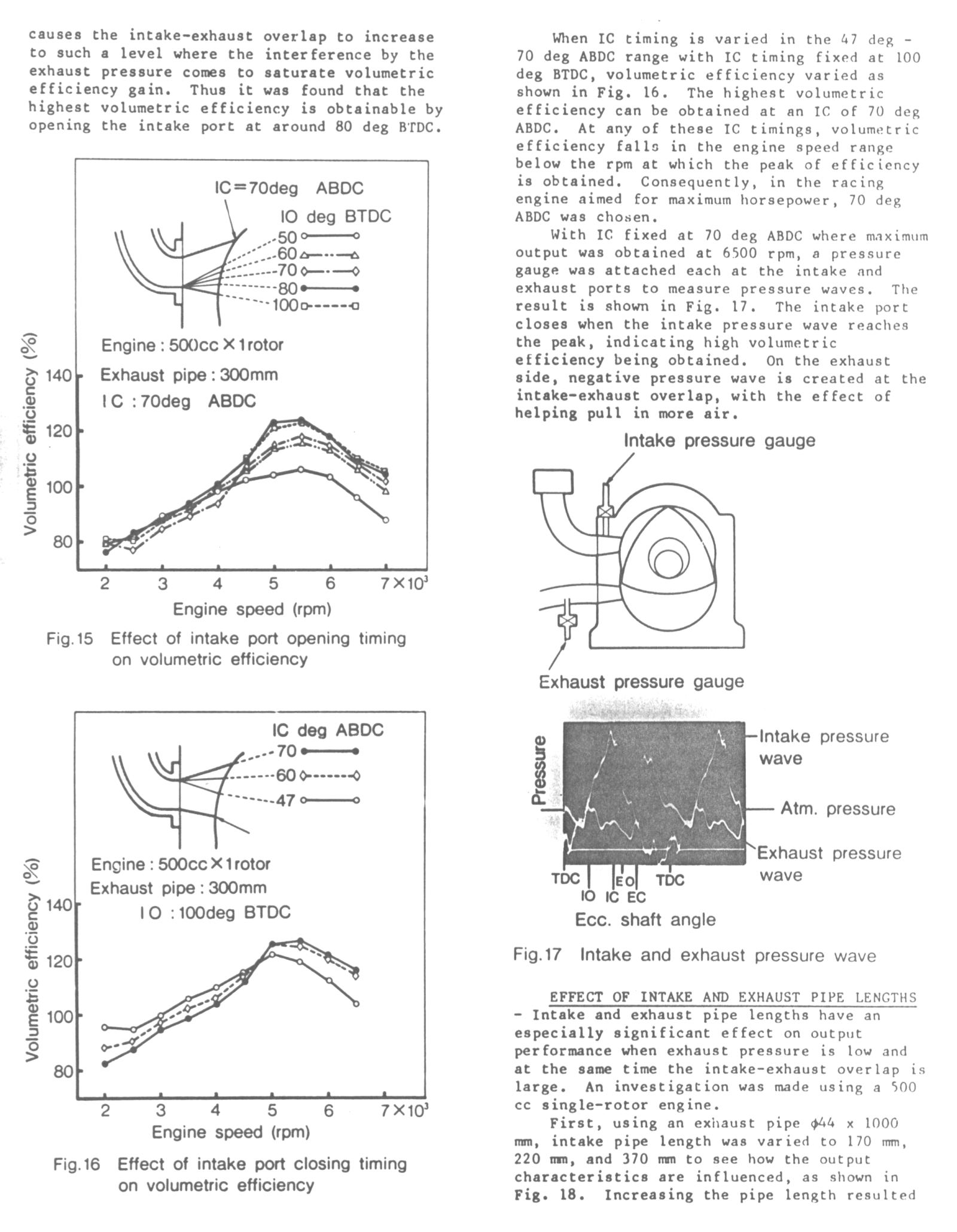
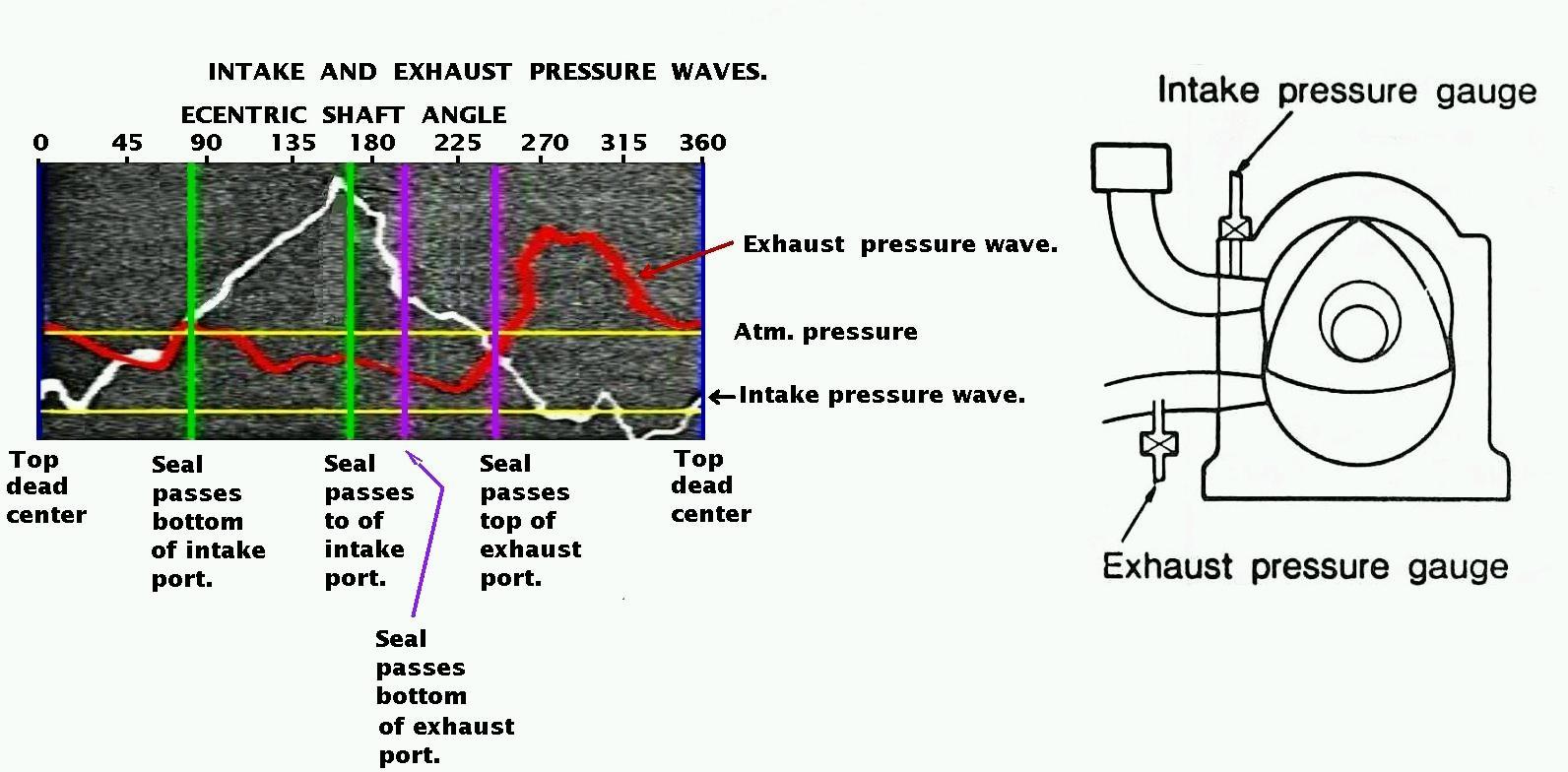
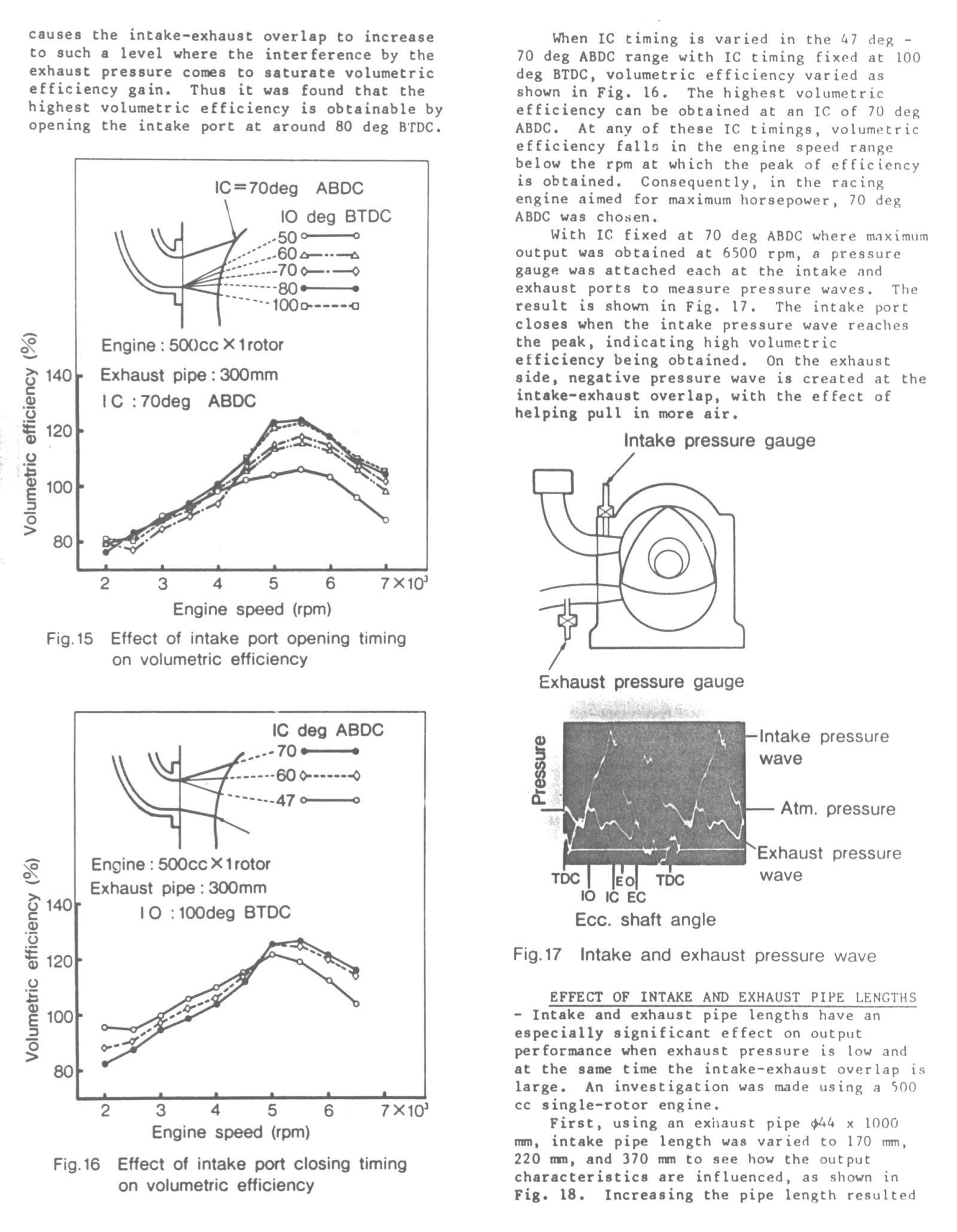
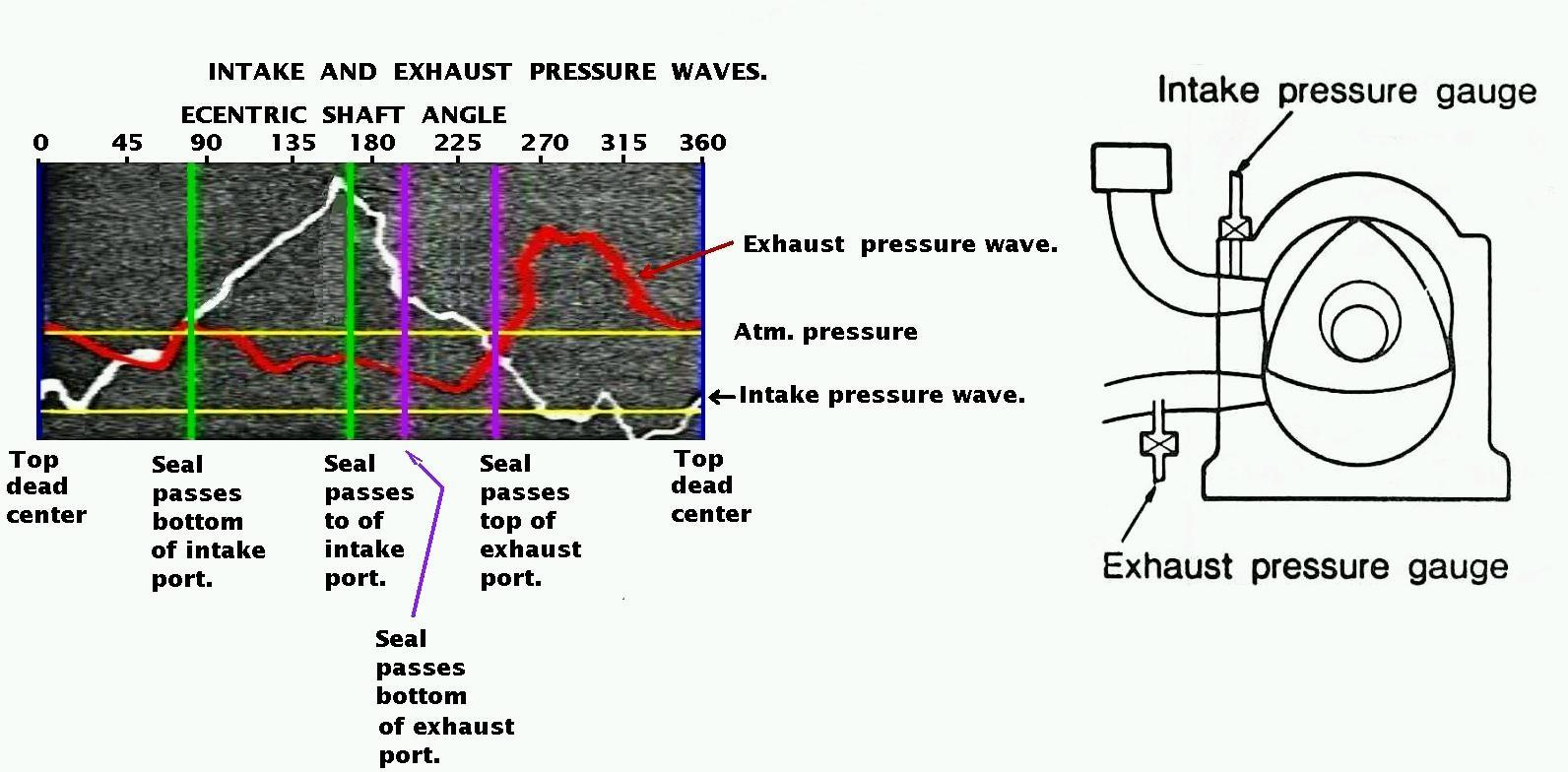
manifolds do. See the enclosed chart. A lot depends on WHEN you sample
the pressure. It changes with RPM in unpredictable and mysterious ways.
IMHO this is confusing the heck out of Tracy's computer. IMHO you need
to feed the manifold pressure from both intake tubes past the slide
throttle
using very small hoses into a beer can and then tap out of the beer can
with
one normal size hose going to the pressure sensor in the computer.
Hopefully
this will damp the pulsations and average the intake manifold pressure.
Al Gietzen tried this as I recall and it did not seem
to change anything. I don't know what size hose Al used
but I think very small hose is essential. On the order of .030
inside diameter or smaller.
Paul Lamar
Mark,
You don't need the beer can. If you use 1/8 od tubing, make a coil of
tubing
using at least 20 feet of tubing. 30 feet may be better. The length of
tubing works to damp the intake signal to something that the computer
makes
sense with. My experience is the tubing can work better than a reservoir
as
it is using the friction of air molecules on the surface of the tubing as
the damper, and will respond faster than a reservoir, but still be damped.
That doesn't mean the maps are correct, as it sounds like the manifold
pressure side of the map is way off.
To trouble shoot being rich or lean, have a squirt bottle of fuel handy
and
give the runners a quick squirt as the rpms are declining (while surging).
If this makes them instantly recover, the system is going lean. if it
forces
it to die, the system is going rich. that will tell you which way to go in
the tuning. My guess is it is very lean with the sensor connected. The
sensor disconnected simulates wide open throttle with no manifold vaccum
with high fuel demand, so the ecu increases the pulse width to the
injectors. When the sensor is connected, and the ecu sees manifold pressue
decreased, it reduces the pulse width.
make sure you are careful when performing this test...... and of course
you
have a fire bottle handy...
hope this helps,
Larry
Hi Larry,
20 feet of tubing is a fair size expense and bundle.
My lathe tail stock chuck will not hold a tiny .030 dia. drill or I would
make some orifice up and send them to Mark.
Perhaps you could make up some orifice that will plug into
red silicone vacuum plumbing tubing. OD of the orifice would be .125 to
fit
the tubing. 0.030, .025 and .020 ought to cover it.
The rest of the world uses mass air flow sensors for a good reason :)
Paul Lamar
Paul,
plastic tubing from McMaster Carr #5345k515 is 15 cents per foot. vac rated
polyethylene.
Larry
To each his own. I like the high temp red silicone stuff. In case
of a fire it withstands 500 F. Also stretches nicely to grab on to barbs.
Looks more professional :)
BTW a couple of things. If one is tunning the p-port using Tracy's system
don't assume the manifold pressure on average is below atmospheric. That
is not the case. The P-port engine is at least 120% volumetric efficiency
so the average manifold pressure is probably above atmospheric. This is why
the tuned p-port generates so much power. The poor man's
turbo charger. If you make this assumption the engine will run lean
on the top end. Also the pressure sensors need to be chosen to reflect
this fact. In other words if the pressure sensor is scaled so atmospheric
manifold pressure is five volts it will never work with a p-port engine.
It needs to be scaled plus or minus 15 psi around atmospheric.
The pressure sensor Tracy uses (I think) is a Free Scale MPX4250AP.
That puts out 5 volts at 36 psi. So it should be a minor software
problem to adapt that to a p-port or turbo engine. Here is a pdf.
Also lacking a data acquisition system a quick and easy check
on the manifold pressure wave form is use an oscilloscope and look
at the output wave form of the pressure sensors. This will also
reflect the response time of the pressure sensors.
Here are pictures of Tracy's computer that Mark owns. Here
is where to connect the O-scope.
Mark, if I were not so busy I would fly out bring my scope and help tune.
I can't get away until the end of April.
Paul Lamar
I'm not sure I buy this whole "high average manifold pressure" thing..
In order for the VE to be higher than one (100%), only the pressure
during the peak filling period needs to be higher than atmospheric.
The rest of the time it could be somewhat-quite negative.
I'm sure someone has the data, but I think it would be cool to
configure the inlet tubes with pitot and static ports at each end, and
then take data from each using sensors with enough frequency response
to be able to see how the pressure and flow behave at various
operating conditions.
Matt-
The HP out averages the airflow. Since the HP out is 20% above the HP
of a 100% engine the mass of air getting in the engine must also
be 20% above the 100% engine on average.
When does the p-port close? The answer is; it never closes.
Integrate the area under and over the atmos line and subtract.
See the attached data.
Paul Lamar
The Rotary Engine NewsLetter. Powered by Linux.
ACRE NL web site.
http://www.rotaryeng.net
Youtube key word UTUBPLEASE
Copyright 1998-2008 All world wide rights reserved.