Well as long as you start with 50 million dollars building
your own Wankel should be no problem. You know what they say
about aviation. "If you want to make a small fortune start with a
large one" :)
Paul Lamar
Oh yes, that is one very famous quote in auto racing. My personal
favorite is "I know there's money in racing, I put it there."Back to
the subject, $50 million we do not have, and if we did, that large sum
would be going into certification. Granted, we may be fools for
putting
so much time and money into a project with such a poor history,
however,
we are still willing to go forward with our plans of making an
aviation
rotary engine despite the great opposition involved with such an
undertaking.
I am not here to start an argument about what we can or cannot do,
merely collecting advice and opinions of other aviators to help
increase our chances of success.
Vladimir
You will forgive us because we have seen it all before.
Keep quiet and produce the goods.
Just hang in here awhile and you will learn all you need to know.
Paul Lamar
Vlaldimir,
My personal favorite would be a 150hp single rotor NA @ 150 lbs. - all
aluminium, water cooled.
Wear surfaces are important, det gun seems the best, or steel.
If designing fromscratch, a wider lighter rotor. The Mazda 16X has
gone back to the 12A width but bigger with a larger eccentric.
It can be done- best of luck, looking forward to reading about your
achievements.
George (down under)
Hi Vlaldimir,
Avoid the mistakes of your predecessors. Mistral Engines is a hugely
brilliant company with an outstanding product line. BUT, look at the
aircraft statistics available thru the FAA. The marketplace is shifting
toward Experimental light sport aircraft. Amateur built new
registrations are rising strongly. Certificated PISTON powered new
registrations are barely stable (even when adjusted for the current
economic downturn).
Certificated TURBOPROPS are on the rise but beyond our scope here. The
certificated PISTON powered aircraft industry is mired in it's own
business model and for insurance and liability reasons is unable to
change as Mistral is finding out. The Rotary IS different and anything
different in the certificated world is suspect...no matter how good!
My suggestion is to tailor your business plan toward the
EXPERIMENTAL marketplace ONLY. If you doubt the profit potential in this
market, google " R V " and check up on Dick VanGruevnson ( 6,000 planes
FLYING, only Dick knows how many kits sold still on the ground). Mistral
has a CERTIFICATED engine package that is a very hard sell into an
inflexible certificated industry and at the same time is way over priced
for the experimental marketplace. Their certification costs have to be
amortized into the engine pricing and that puts them in the same engine
selling price bracket as the venerable old Lycoming or Continental
competition.
With no rotary cost advantage, a slightly higher rotary BSFC, and a
customer mindset that history has proven the horizontally opposed piston
engine viable, airframe manufacturer's have no incentive to change.
BSFC....This is the place where if you seriously want to make a
difference, You CAN make a difference. There are suggestions on this
newsletter that are "application specific". It would be nice to
incorporate some of them but your goal should be to create as broad an
accomplishment as possible for the money invested. Investigate
"TURBOCOMPOUNDING". Paul and others on this list have done extensive
background on this subject and will be here to help you in any way.
Successfully done, this will give ALL rotary applications the advantage
rotaries need to give airframe manufacturers that reason they need to
justify designing around the rotary engine. The Mazda rotary engine work
and works well, you can CHANGE it easily enough, but IMPROVING it will
be very difficult. You can move the water pump, build in an alternator,
charge cool it (not historically successful),etc....so what?
BUT REDUCE THE FUEL COMSUMPTION 25 % and the world WILL notice.
Dave M
Brilliant essay Dave.
Thanks.
Paul Lamar
I have been watching Mistral quite closely, as my need is for a powerful
(400hp+) certificated engine, but I do not see where the Mistral engine
has achieved certification. At least, it doesn't show up in the FAA's
TCDS file - perhaps their legal name is something other than "Mistral"?
As a relative newcomer to this forum, I have been amazed at the amount
of information all y'all have. From your discussions I believe a 450 to
500 hp rotary is certainly achievable (2 or 3 rotor), with far better
sfc than the small turbines (Allison; Pratt; Walter).Flying
certificated aircraft, my needs are for a certificated engine, and I
fully expect to pay $60K+ per copy (perhaps $80 to $100K is more
realistic - but I'd hope for $60K!). If I have missed something, and a
+/-500 hp rotary exists, please clue me in.
If anyone is looking for a testbed aircraft, we operate several PA31P
aircraft - so we would have the capability to install a rotary on one
side for proving runs, while running a certificated (but no longer
factory supported) TIGO-541 on the other wing.
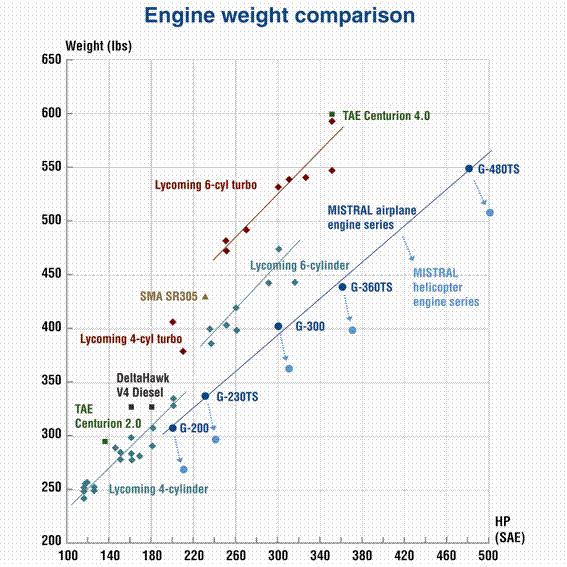
The Mistral G-360-TS installation will likely weigh in at 500 to 550 lbs
wet, with associated equipment (not including propeller), and is rated
at 360hp (320 max continuous).The TIGO-541 weighs in at roughly 750 to
800 lbs wet, with associated equipment (without propeller). While the
Mistral seems heavy compared to other rotary engines, it is
substantially lighter than the heavy (and touchy) TIGO-541.
Any thoughts / constructive comments / ideas from you would be
appreciated.
~ Nick Jilek
Mistral is working hard and highly focused on certification and
it could happen any day now. They have had a lot of FAA hoops to jump through
as the rotary is so different than a piston engine. One of the
problems is buying bearings with a paper trail as some rotary engine bearings
are quite different and bearing companies are reluctant to make aircraft
parts. They may wind up making their own. Also they are certifying a FADEC
at the same time. If you use existing aircraft carbs and magnetos
certification is much easier. I'll have more info when I get
back from Aero in Germany in a couple of weeks.
500 to 550 sounds heavy for a 3 rotor turbo as turbos can weigh as little as
16 pounds. The bare block is only 260 pounds. This Mistral chart
list about 440 pounds for a G-360-TS. Less for a helicopter engine
without gear box.
Paul Lamar
--
The Rotary Engine NewsLetter. Powered by Linux.
ACRE NL web site.
http://www.rotaryeng.net
Youtube key word UTUBPLEASE
Copyright 1998-2008 All world wide rights reserved.